(Image created by G. Volpe with the assistance of DALL·E 2)
What remains for humans to do in the age of AI? Date: 27 July 2026 Place: National Institute of Education (NIE), Nanyang Technological University (NTU), Singapore
Giovanni Volpe gave the invited talk “What remains for humans to do in the age of AI?” at the NIE NSSE AI Seminar, held at Nanyang Technological University (NTU) in Singapore.
The seminar was part of the “Professional Sharing by Experts in AI” series organized by the Natural Sciences and Science Education (NSSE) Department at the National Institute of Education (NIE).
The seminar took place within the week-long symposium “Human in the Lead: AI-informed Science Education Practices”, which brought together researchers from the natural sciences and science education to explore the rapidly evolving role of artificial intelligence in both scientific research and teaching.
In his talk, Giovanni discussed the question of what roles remain uniquely or essentially human as increasingly capable AI systems become integrated into research and education, and how scientists and educators can make productive use of these technologies while keeping humans in the lead.
Giovanni Volpe gives the plenary Talk “What remains for physicists to do in the age of AI?” at OPTIQUE BFC 2026 in Dijon, France.
What remains for physicists to do in the age of AI? Giovanni Volpe OPTIQUE BFC 2026 Date: 9 July 2026 Place: Palais des Congrès, Dijon, France
Giovanni Volpe gave the plenary presentation “What remains for physicists to do in the age of AI?” at OPTIQUE BFC 2026, the biennial congress of the Société Française d’Optique, held in Dijon, France, from 6 to 10 July 2026.
In recent years, the rapid growth of artificial intelligence, particularly deep learning, has transformed fields ranging from the natural sciences to technology. While deep learning can be regarded as a highly sophisticated form of curve fitting, the development of increasingly large and complex neural networks has led to remarkable advances, often surpassing expectations. As AI systems become ever more capable, this raises a fundamental question: what role remains for physicists and, more broadly, for humans?
A critical yet often overlooked aspect of current AI systems is their reliance on vast amounts of training data, much of which ultimately originates from humans. This raises important questions about what happens when human-generated data become scarce or when AI systems increasingly train on AI-generated content. Such feedback can lead models toward increasingly conventional or average outputs, potentially reducing originality and reliability.
In this context, physicists have a distinctive role to play. Their ability to develop fundamental understanding, identify symmetries and physical principles, design experiments, and formulate new questions can provide insights that cannot simply be extracted from existing datasets. Physics-informed approaches can also incorporate this knowledge directly into the architecture and training of AI systems.
The central message is that, in the age of AI, physicists should continue to be original, pursue fundamental questions, and search for the hidden principles governing the physical world.
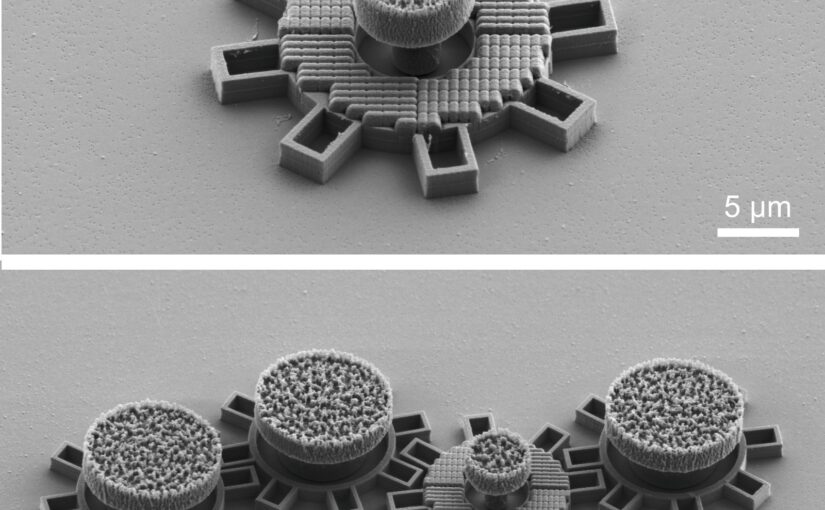
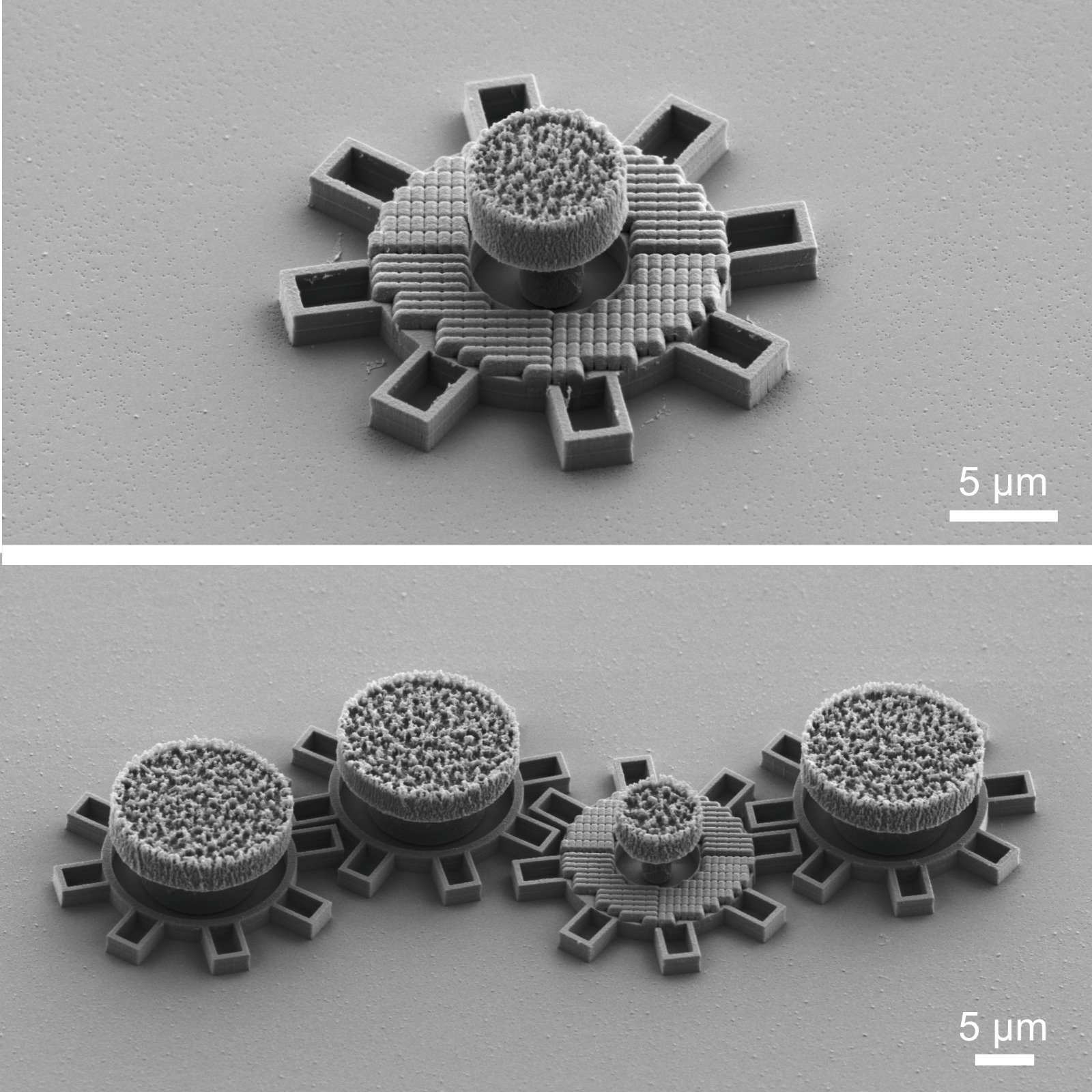
Top: single gear; Bottom: the second gear from the right has an optical metamaterial that react to laserlight and makes the gear move. All gears are made in silica directly on a chip. Each gear is about 0.016 mm in diameter. (Image by G. Wang).
Autonomous Robots for Intelligent Matter Giovanni Volpe Toward Intelligent Behavior in Macroscopic Active Matter Time: 09:00 Date: 6 July 2026 Place: CECAM-HQ-EPFL, Lausanne, Switzerland
Giovanni Volpe gave the invited talk “Autonomous Robots for Intelligent Matter” at the CECAM workshop “Toward Intelligent Behavior in Macroscopic Active Matter”, held at CECAM-HQ-EPFL in Lausanne, Switzerland, from 6 to 8 July 2026.
Active matter provides a framework for understanding systems composed of self-driven units, ranging from microscopic particles to animal groups and robotic swarms. While traditional active-matter models often describe agents through relatively simple interaction rules, autonomous robotic systems introduce additional capabilities such as sensing, information processing, decision-making, memory, and adaptation.
In his talk, Giovanni discussed how autonomous robots can provide experimental platforms for exploring these emerging forms of intelligent matter. By combining self-propulsion and physical interactions with sensing, feedback, and learning, robotic agents can adapt their behaviour to their surroundings and coordinate with one another, providing a bridge between active-matter physics and embodied intelligence.
These systems offer opportunities to investigate how complex collective behaviours emerge from interactions between individual agents and their environment, while also providing new approaches for designing adaptive and programmable matter. More broadly, they illustrate the growing convergence between statistical physics, robotics, nonlinear dynamics, and machine learning in the study of intelligent active systems.
Illustration of three different experiments autonomously performed by the SmartTrap system: DNA pulling experiments (top), red blood cell stretching (bottom left), and particle-particle interaction measurements (bottom right). (Image by M. Selin.)Smart Machines and Optical Manipulation at the Microscale
Giovanni Volpe 5th Münster Symposium on Intelligent Matter (MüSIM) (Flyer) Date: 24 June 2026 Time: 15:00 Place: Center for Soft Nanoscience (SoN), Münster, Germany
Microscale systems offer a unique opportunity to engineer machines whose function emerges from the interplay of geometry, interactions, and fluctuations. In this talk, I will present our work on smart machines at the microscale, combining nanofabrication, programmable interactions, and advanced optical methods to design and control colloidal micromechanisms and metamaterials.
I will first introduce how nanotechnology enables the realization of colloidal metamachines and microscopic mechanisms, where shape and mechanical constraints are engineered to produce targeted motion and response in fluid environments. I will then show how smart microscopy and optical manipulation—including high-resolution imaging, automated tracking, and light-based control—allow us to probe these machines in real time and quantify their dynamics. This approach enables precision measurements of effective interaction landscapes, including critical Casimir forces and their relation to fluctuation-induced forces known from QED Casimir physics.
Illustration of three different experiments autonomously performed by the SmartTrap system: DNA pulling experiments (top), red blood cell stretching (bottom left), and particle-particle interaction measurements (bottom right). (Image by M. Selin.)SmartTrap: automated precision experiments with optical tweezers
Martin Selin, Antonio Ciarlo, Giuseppe Pesce, Lars Bengtsson, Joan Camunas-Soler, Vinoth Sundar Rajan, Fredrik Westerlund, L. Marcus Wilhelmsson, Isabel Pastor, Felix Ritort, Steven B. Smith, Carlos Bustamante, Giovanni Volpe
Nature Methods (2026)
arXiv: 2505.05290
doi: 10.1038/s41592-026-03129-3
Optical tweezers are widely used in single-molecule biophysics, cell biomechanics and soft matter physics, but require a human operator, limiting throughput and repeatability. Here we present a smart optical tweezers platform, named SmartTrap, capable of performing complex experiments autonomously by integrating real-time three-dimensional particle tracking, custom electronics and a microfluidics system. Through a series of experiments, we demonstrate it can operate continuously, acquiring high-precision data over extended periods of time. By bridging the gap between manual experimentation and autonomous operation, SmartTrap establishes a robust and open-source framework for the next generation of optical tweezers research, capable of performing large-scale studies in single-molecule biophysics, cell mechanics and colloidal science with minimal experimental overhead and operator bias.
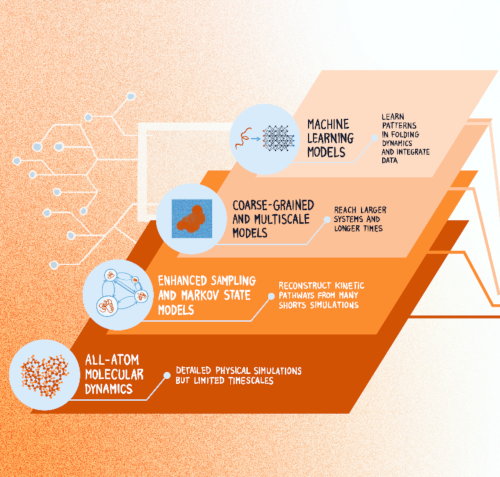
Computational advances in protein folding studies. Current approaches address multiple levels of resolution and methodological frameworks, however, none of the existing methods provides quantitative and dynamic information of the relationship between protein sequence and folding mechanism at all-atom resolution and at scale. (Graphics by J. Sacquegno.)Protein Dynamics Beyond Structure Prediction
Juliette Griffié, Sviatlana Shashkova, Antonio Ciarlo, Sreekanth K. Manikandan, Claes Andréasson, Malin Bäckström, Tristan Bereau, Hjalmar Brismar, Carlos Bustamante, Marta Carroni, Roberto Covino, Andreas Dahlin, Sebastian Deindl, Lucie Delemotte, Arne Elofsson, John Eriksson, Giovanna Fragneto, Anders Gunnarsson, Per Hammarström, Caroline Ingre, Christian Kaiser, Petronella Kettunen, Mark C. Leake, Benjamin Loos, Anna Månberg, Antonia S. J. S. Mey, Richard Neutze, Thomas Nyström, Karl Palmås, Charley Schaefer, Markus J. Tamás, Nicola Ticozzi, Tomás S. Pilvelic, Jacopo Sacquegno, B.M. (Betty)Tijms, Gunnar von Heijne, Björn Wallner, Vitali Zhaunerchyk, Simon Olsson, Joana B. Pereira, Julia Fernandez-Rodriguez, Fredrik Westerlund, Giovanni Volpe
arXiv: 2606.08647
How microorganisms respond to and interact with their environment can vary significantly from individual to individual, which can have important microbiological and ecological implications. However, most microscopy techniques can only observe motile microorganisms for short times because of their limited fields of view. Using Lagrangian tracking, a single microorganism can be followed in 3D, potentially indefinitely, allowing to decipher individual phenotypical traits. Current Lagrangian tracking methods use the fluorescence signal emitted by the microorganism as feedback to keep it in focus. However, over long times, epifluorescent imaging can induce photobleaching and photodamage, and importantly, not all microorganisms can easily be made fluorescent. Additionally, traditional algorithms used in feedback loops to determine microorganism position are prone to errors, especially in optically complex media. Here, we present a faster, more reliable, and versatile Lagrangian tracking method that uses deep learning to determine the 3D position of the microorganism. This new method demonstrates enhanced accuracy and speed in tracking fluorescent bacteria with fluorescence microscopy also in optically complex media. Furthermore, we track bacteria with other microscopy modalities, such as brightfield microscopy — for example, this enables us to track magnetotactic bacteria, which cannot be made fluorescent without degrading their magnetotactic properties. These novel capabilities allow to extract previously inaccessible quantitative information, significantly advancing the study of microorganism behavior — and thus opening new avenues for research in complex biological and ecological systems.
(Image created by G. Volpe with the assistance of DALL·E 2)What remain for physicists to do in the age of AI?
Giovanni Volpe
QT (Quantum Technology Division of MC2, Chalmers University of Technology) community building activity 2026 Date: 11 May 2026 Place: Stenungsbaden Yacht club
In recent years, the rapid growth of artificial intelligence, particularly deep learning, has transformed fields from natural sciences to technology. While deep learning is often viewed as a glorified form of curve fitting, its advancement to multi-layered, deep neural networks has resulted in unprecedented performance improvements, often surprising experts. As AI models grow larger and more complex, many wonder whether AI will eventually take over the world and what role remains for physicists and, more broadly, humans.
A critical, yet underappreciated fact is that these AI systems rely heavily on vast amounts of training data, most of which are generated and annotated by humans. This dependency raises an intriguing issue: what happens when human-generated data is no longer available, or when AI begins to train on AI-generated data? The phenomenon of AI poisoning, where the quality of AI outputs declines due to self-referencing, demonstrates the limitations of current AI models. For example, in image recognition tasks, such as those involving the MNIST dataset, AI tends to gravitate towards ‘safe’ or average outputs, diminishing originality and accuracy.
In this context, the unique role of humans becomes clear. Physicists, with their capacity for originality, deep understanding of physical phenomena, and the ability to exploit fundamental symmetries in nature, bring invaluable perspectives to the development of AI. By incorporating physics-informed training architectures and embracing the human drive for meaning and discovery, we can guide the future of AI in truly innovative directions. The message is clear: physicists must remain original, pursue their passions, and continue searching for the hidden laws that govern the world and society.
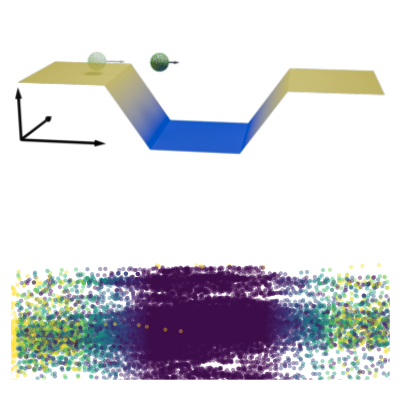
Experimental setup. (Top) Thermophoretic microswimmer undergoes active Brownian motion in a spatially-varying laser intensity profile that controls the self-thermophoretic propulsion of the swimmer using a feedback loop. (Bottom) Sample trajectory of the microswimmer over 15 minutes in a chamber. Colors indicate instantaneous velocity. (Image from the manuscript.)Delayed Active Swimmer in a Velocity Landscape
Viktor Holubec, Alexander Fischer, Giovanni Volpe, Frank Cichos
Physical Review Research 8, L022017 (2026)
arXiv: 2505.11042
doi: 10.1103/xn9x-ppjx
Active systems in nature and synthetic environments commonly exhibit spatially heterogeneous activity patterns and time-delayed responses from internal feedback mechanisms, exemplified by bacterial chemotaxis. We study an idealized active gas where particles modulate their self-propulsion based on local environmental conditions with such delays. Through integrated theoretical, computational, and experimental approaches, we demonstrate that steady-state density distributions and collective polarization exhibit characteristic peaks and valleys as functions of response delay time. We find that delays can amplify polarization by nearly an order of magnitude and trigger complete polarization reversal when particle displacement during the delay period surpasses the persistence length. Multiparticle simulations incorporating interparticle interactions validate that these phenomena remain robust in sufficiently dilute collective systems. Since density and polarization determine the current in active matter, our findings show that temporally programming the delay time allows control over both static and dynamic states in active systems, with implications for biological microswimmers and engineered microrobots.
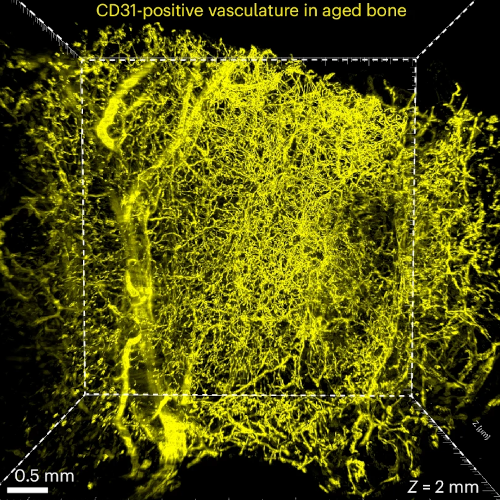
Visualization of the vasculature within human bone from a 75-year-old patient by immunostaining with antibodies against CD31. (Image from the manuscript.)Three-dimensional quantitative tissue clearing reveals differences in osteovascular niche of aged and young human mesenchymal stromal cells
Nelson Tsz Long Chu, Ostap Dregval, Yu-Wei Chang, Emil Kriukov, Xin Tian, Xin Liu, Dana Trompet, Misty Shuo Zhang, Lei Li, Zhong Li, Emiliano Gomez Ruiz, Joana B. Pereira, Mats Brittberg, Björn Barenius, Lars Sävendahl, Ralf H. Adams, Inger Gjertsson, Claes Ohlsson, Giovanni Volpe & Andrei S. Chagin
Nature Biomedical Engineering (2026)
bioRxiv: 10.1101/2025.10.07.680053
doi: 10.1038/s41551-026-01645-3
Human bone marrow mesenchymal stromal/stem cells (BM-MSCs) are widely used in clinical trials and tissue engineering, yet their native microenvironment remains poorly understood. Here we introduce a tissue-clearing protocol, DeepBone, for human bones and integrate it with simultaneous mRNA and protein detection. Using this protocol, we spatially map BM-MSCs relative to key bone microenvironment components, including human blood capillaries, adipocytes, sinusoids and bony trabeculae. Quantitative analysis reveals that the native microenvironment of human BM-MSCs in young bone is enriched in vasculature, sinusoids, bone matrix and adipocytes. In contrast, in aged bone, BM-MSCs show no preferential association with bone or adipocytes. Proliferative BM-MSCs are predominantly found along blood vessels. Moreover, we identify a specialized microenvironment for BM-MSCs in young bone, characterized by sinusoids coiled around trabeculae and enriched by R-type vessels. These findings provide insights into the native niches of BM-MSCs, offering a foundation for the development of tissue engineering strategies that mimic their physiological context.
DeepTrack 2 Logo. (Image from DeepTrack 2 Project)Artificial Intelligence for Microscopy: From Pixels to Physical Insight
Giovanni Volpe DINAMO 2026
Franschhoek, South Africa
7 April 2026