Protein Dynamics Beyond Structure Prediction on ArXiv

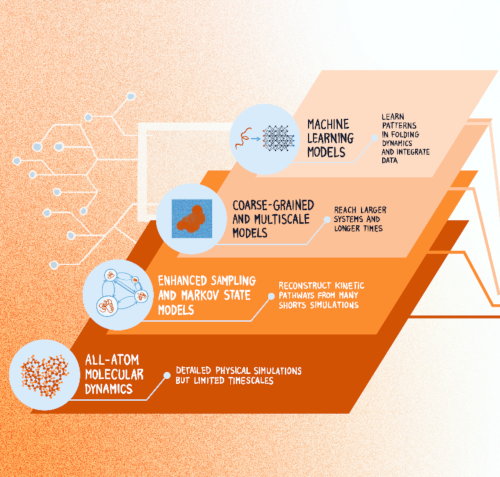
Computational advances in protein folding studies. Current approaches address multiple levels of resolution and methodological frameworks, however, none of the existing methods provides quantitative and dynamic information of the relationship between protein sequence and folding mechanism at all-atom resolution and at scale. (Graphics by J. Sacquegno.)
Protein Dynamics Beyond Structure Prediction
Juliette Griffié, Sviatlana Shashkova, Antonio Ciarlo, Sreekanth K. Manikandan, Claes Andréasson, Malin Bäckström, Tristan Bereau, Hjalmar Brismar, Carlos Bustamante, Marta Carroni, Roberto Covino, Andreas Dahlin, Sebastian Deindl, Lucie Delemotte, Arne Elofsson, John Eriksson, Giovanna Fragneto, Anders Gunnarsson, Per Hammarström, Caroline Ingre, Christian Kaiser, Petronella Kettunen, Mark C. Leake, Benjamin Loos, Anna Månberg, Antonia S. J. S. Mey, Richard Neutze, Thomas Nyström, Karl Palmås, Charley Schaefer, Markus J. Tamás, Nicola Ticozzi, Tomás S. Pilvelic, Jacopo Sacquegno, B.M. (Betty)Tijms, Gunnar von Heijne, Björn Wallner, Vitali Zhaunerchyk, Simon Olsson, Joana B. Pereira, Julia Fernandez-Rodriguez, Fredrik Westerlund, Giovanni Volpe
arXiv: 2606.08647

How microorganisms respond to and interact with their environment can vary significantly from individual to individual, which can have important microbiological and ecological implications. However, most microscopy techniques can only observe motile microorganisms for short times because of their limited fields of view. Using Lagrangian tracking, a single microorganism can be followed in 3D, potentially indefinitely, allowing to decipher individual phenotypical traits. Current Lagrangian tracking methods use the fluorescence signal emitted by the microorganism as feedback to keep it in focus. However, over long times, epifluorescent imaging can induce photobleaching and photodamage, and importantly, not all microorganisms can easily be made fluorescent. Additionally, traditional algorithms used in feedback loops to determine microorganism position are prone to errors, especially in optically complex media. Here, we present a faster, more reliable, and versatile Lagrangian tracking method that uses deep learning to determine the 3D position of the microorganism. This new method demonstrates enhanced accuracy and speed in tracking fluorescent bacteria with fluorescence microscopy also in optically complex media. Furthermore, we track bacteria with other microscopy modalities, such as brightfield microscopy — for example, this enables us to track magnetotactic bacteria, which cannot be made fluorescent without degrading their magnetotactic properties. These novel capabilities allow to extract previously inaccessible quantitative information, significantly advancing the study of microorganism behavior — and thus opening new avenues for research in complex biological and ecological systems.
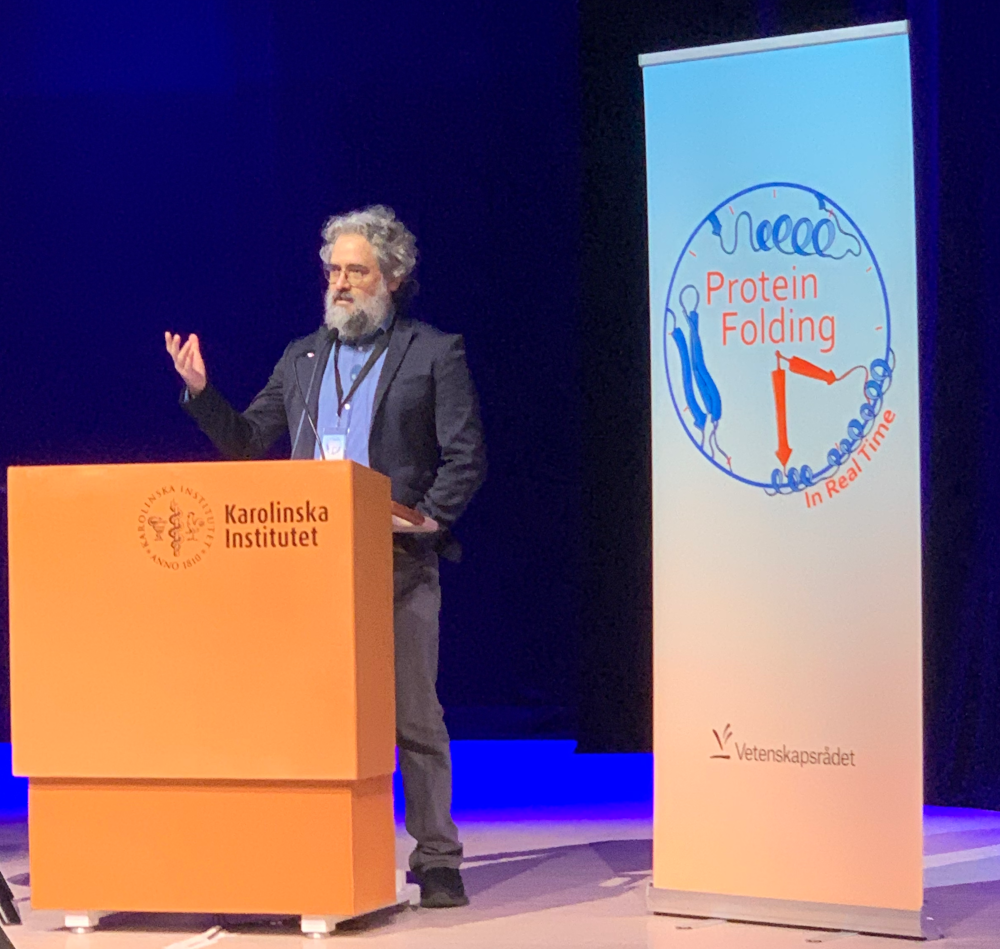
International conference “Protein Folding in Real Time: From Molecules to Disease”, Aula Medica, KI, Stockholm, 11-13 March 2026

Giovanni Volpe opens the Protein Folding in Real Time conference. (Photo by A. Ciarlo)
The international conference Protein Folding in Real Time: From Molecules to Disease opened today, 11 March 2026, at Aula Medica, KI, Stockholm.

The conference brings together researchers from multiple disciplines, including biophysics, molecular biology, computational science, and medicine, to discuss recent advances in the study of protein folding. Proteins must fold into precise three-dimensional structures to perform their biological functions, and failures in this process are associated with several diseases, including neurodegenerative disorders and cancer.

During the three-day meeting, participants attend a series of lectures and discussions covering topics such as single-molecule biophysics, high-resolution experimental techniques for observing folding dynamics, advanced molecular simulations, and artificial intelligence approaches for predicting folding pathways. Particular attention is given to the challenge of observing protein folding in real time, capturing transient intermediate states that determine whether proteins reach their functional structure or misfold.

The event also highlights the interdisciplinary and international nature of the initiative. Representatives from the Embassies of Italy, Japan, and Spain, together with UNESCO, take part in the meeting, emphasizing the global interest in advancing research on protein folding and its biomedical implications. The initiative aims to integrate experimental measurements, computational modeling, and data-driven approaches to build a predictive framework for protein folding dynamics. By combining advanced imaging, force spectroscopy, and machine learning methods, the initiative seeks to better understand how folding processes occur inside living systems and how their disruption can lead to disease.

Overall, the conference provides an opportunity for scientists from different institutions to exchange ideas, establish collaborations, and shape future research directions in the field of protein folding and misfolding. The launch of this initiative represents an important step toward bridging molecular-level observations with biomedical applications, ultimately contributing to improved strategies for diagnosing and treating diseases related to protein misfolding.

Technological Excellence Requires Human and Social Context on ArXiv

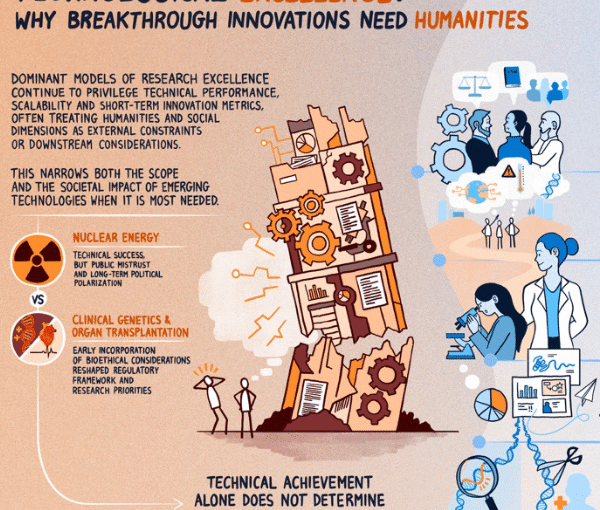
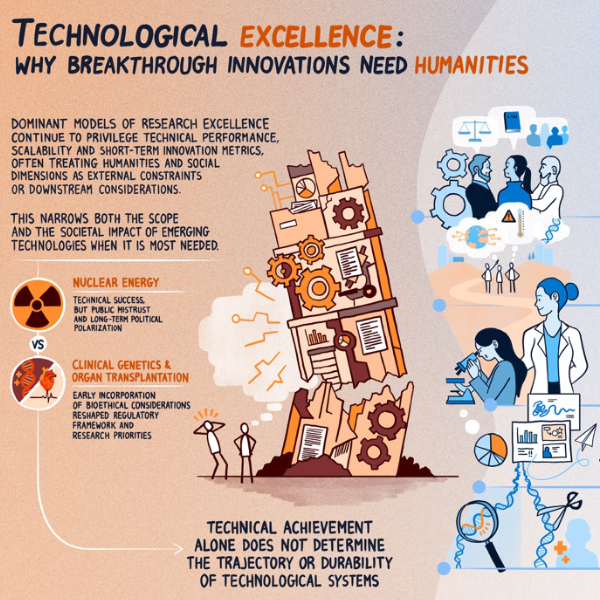
Why breakthrough research needs humanities and social sciences. (From an artwork by Jacopo Sacquegno.)
Technological Excellence Requires Human and Social Context
Karl Palmås, Mats Benner, Monica Billger, Ben Clarke, Raimund Feifel, Julia Fernandez-Rodriguez, Anna Foka, Juliette Griffié, Claes Gustafsson, Kerstin Hamilton, Johan Holmén, Kristina Lindström, Tobias Olofsson, Joana B. Pereira, Marisa Ponti, Julia Ravanis, Sviatlana Shashkova, Emma Sparr, Pontus Strimling, Fredrik Höök, Giovanni Volpe
arXiv: 2603.10653

Breakthrough technologies increasingly shape social institutions, economic systems, and political futures. Yet models of research excellence associated with such technologies often prioritize technical performance, scalability, and short-term innovation metrics while treating ethical, social, and cultural dimensions as secondary considerations. This perspective article argues that such separation is no longer tenable. We propose a broader understanding of excellence that combines technical rigor with ethical robustness, social intelligibility, and long-term relevance. The rapid emergence of generative and agentic artificial intelligence further underscores this argument. As technological systems increasingly operate through language, interpretation, and normative alignment, expertise traditionally cultivated in the humanities and social sciences becomes integral to the design, governance, and responsible deployment of such systems. Drawing on historical examples and contemporary research practices, this article examines five interconnected domains where the humanities and social sciences, treated as integrated dimensions of research practice, can strengthen technological development: (1) ethical, legal, and social integration in agenda-setting and research design; (2) plural and reflexive foresight practices that shape technological futures; (3) graduate education as a leverage point for cross-disciplinary literacy; (4) visualization and communication as epistemic and civic practices; and (5) institutional frameworks that move beyond rigid distinctions between basic and applied research. Across these dimensions, we propose practical strategies for embedding interdisciplinary collaboration structurally rather than symbolically.