Photograph of the soft robot, consisting of a multilayer rolled dielectric elastomer actuator integrated with a
flexible PET sheet. (Image by H. P. Thanabalan.)Hari’s work on soft robot for planetary exploration has been published on ESA’s website. His work is focused on developing soft, bio-inspired robots for planetary exploration, especially for environments like Mars. The core idea is to build robots that move more like living organisms, for example inchworms, that are designed to survive harsh extra terrestrial environments and use less power than conventional robotic systems. A major part of the research is the use of dielectric elastomer actuators (DEAs) which is essentially artificial muscles made from soft electroactive materials. When voltage is applied, these materials contract and expand, allowing the robot to crawl in a worm-like motion. The long-term vision is to create soft robotic explorers that can go places current rovers cannot such as subsurface openings that may contain water, ice, or signs of past microbial life.
Photograph of the soft robot, consisting of a multilayer rolled dielectric elastomer actuator integrated with a
flexible PET sheet. (Image by H. P. Thanabalan.)Hari Prakash Thanabalan defended his PhD thesis on March 23rd, 2026. Congrats!
The defense took place in PJ Salen lecture hall, Institutionen för fysik, Johanneberg Campus, Göteborg, at 13:00.
Title: Soft Robotic Platforms for Dynamic Conditions: From Adaptive Locomotion to Space Exploration
Abstract:
Inspired by living organisms, soft robots represent a significant advancement in robotics, offering exceptional flexibility and nearly infinite degrees of freedom. These properties make them ideal for unstructured and remote environments such as planetary surfaces. However, challenges remain in developing efficient and durable soft actuators capable of withstanding complex operational conditions. This work presents two interconnected parts.
In the first part, an inchworm-inspired soft robot was developed that is capable of controlled directionality through a passive alignment mechanism integrated with a 3D-printed grooved substrate. This design enables precise locomotion control using only a single rolled dielectric elastomer actuator (RDEA), eliminating the need for multiple actuators or complex control systems. Experimental validation confirms that manipulating groove angles on the substrate reliably guides locomotion, improving energy efficiency and mechanical simplicity.
In the second part, the fabrication and resilience of fault-tolerant RDEAs were tested. RDEAs utilising Single-Walled Carbon Nanotubes (SWCNTs) as compliant electrodes were developed to withstand multiple damages where they were tested for punctures and cuts. Additionally, the radiation tolerance of these actuators was evaluated under space-like conditions, including Galactic Cosmic Rays and Solar Particle Events, which expose materials to high-energy protons and alpha particles. A computational dual-simulation framework was applied, combining the Stopping and Range of Ions in Matter (SRIM) software for alpha particle interactions and ESA’s SPENVIS Multi-Layered Shielding Simulation Software (MULASSIS) for proton radiation effects.
This framework concerns material selection for robust RDEA fabrication aimed at extraterrestrial applications. Together, these projects advance the development of bioinspired soft robots with improved directional control and environmental resilience, supporting future applications in search and rescue, pipe inspection, and planetary exploration.
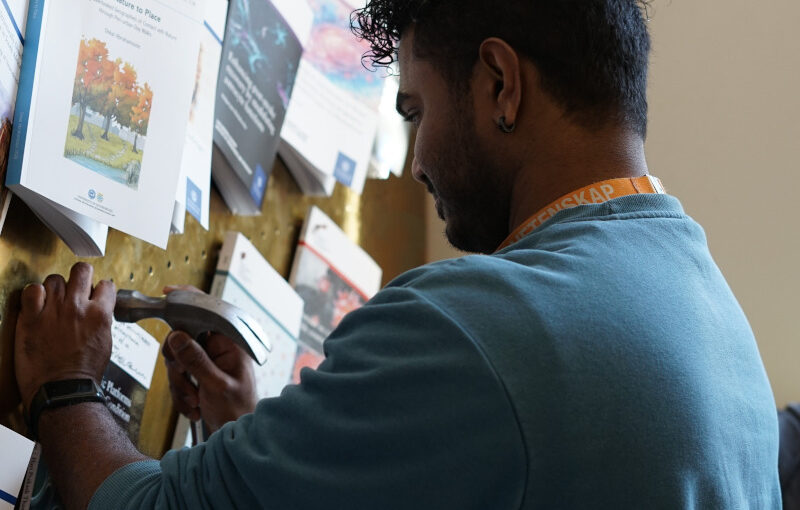
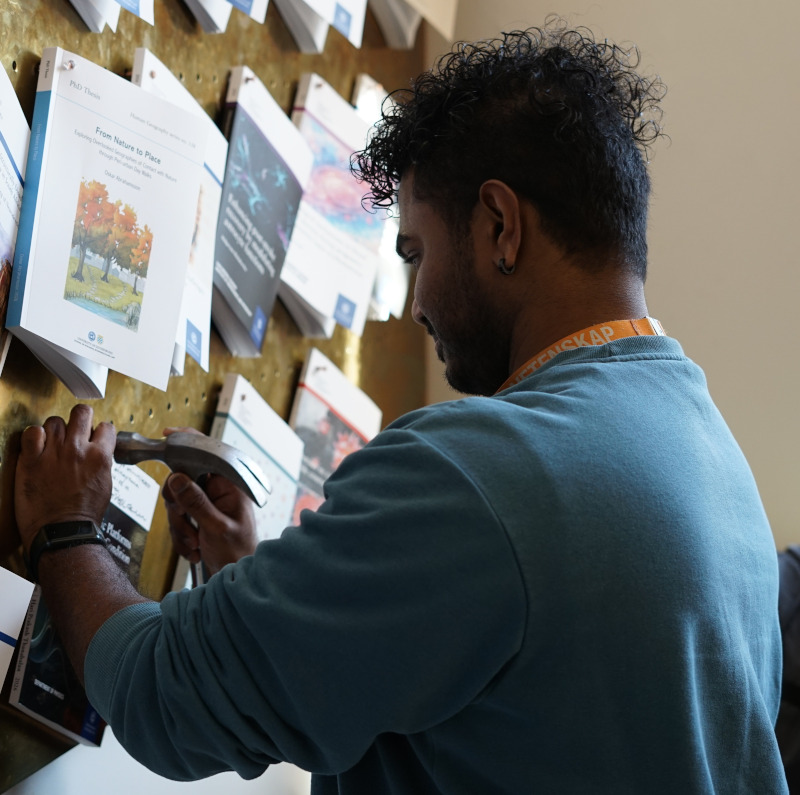
Hari nails his thesis. (Image by A. Ciarlo.)Hari Prakash Thanabalan nailed his PhD thesis, Soft Robotic Platforms for Dynamic Conditions: From Adaptive Locomotion to Space Exploration, on March 5th, 2026.
The nailing took place in Universitetsbyggnaden i Vasaparken, Universitetsplatsen 1, Göteborg, at 14:00.
In Swedish academia, “nailing” (spikning) is the formal public announcement and publication of a doctoral thesis. It happens weeks before the defence so that the public has time to read the thesis in advance and prepare questions for the defence. In addition to the physical nailing, the thesis is also published electronically (e-spikning) via GUPEA.
Hari Prakash will defend his thesis on the 23rd of March 2026 at 13:00 in PJ Salen lecture hall, Institutionen för fysik, Johanneberg Campus, Göteborg.
Photograph of the soft robot, consisting of a multilayer rolled dielectric elastomer actuator integrated with a
flexible PET sheet. (Image by H. P. Thanabalan.)Inchworm-Inspired Soft Robot with Groove-Guided Locomotion
Hari Prakash Thanabalan, Lars Bengtsson, Ugo Lafont, Giovanni Volpe
arXiv: 2512.07813
Soft robots require directional control to navigate complex terrains. However, achieving such control often requires multiple actuators, which increases mechanical complexity, complicates control systems, and raises energy consumption. Here, we introduce an inchworm-inspired soft robot whose locomotion direction is controlled passively by patterned substrates. The robot employs a single rolled dielectric elastomer actuator, while groove patterns on a 3D-printed substrate guide its alignment and trajectory. Through systematic experiments, we demonstrate that varying groove angles enables precise control of locomotion direction without the need for complex actuation strategies. This groove-guided approach reduces energy consumption, simplifies robot design, and expands the applicability of bio-inspired soft robots in fields such as search and rescue, pipe inspection, and planetary exploration.
The award, which includes a certificate, a cash prize of $300, and a T-shirt, is presented by the organisers of the conference in collaboration with SPIE Optics + Photonics.
Hari was awarded the prize for his presentation titled “Inchworm-Inspired Soft Robot with Groove-Guided Locomotion”. Below is the full abstract of her presentation:
Soft robots require directional control to navigate complex terrains. However, achieving such control often requires multiple actuators, which increases mechanical complexity, complicates control systems, and raises energy consumption. Here, we introduce an inchworm-inspired soft robot whose locomotion direction is controlled passively by patterned substrates. The robot employs a single rolled dielectric elastomer actuator, while groove patterns on a 3D-printed substrate guide its alignment and trajectory. Through systematic experiments, we demonstrate that varying groove angles enables precise control of locomotion direction without the need for complex actuation strategies. This groove-guided approach reduces energy consumption, simplifies robot design, and expands the applicability of bio-inspired soft robots in fields such as search and rescue, pipe inspection, and planetary exploration.
Inchworm-inspired soft robot. (Image by H. P. Thanabalan.)Bio-inspired soft robot for multi-directionality
Hari Prakash Thanabalan, Lars Bengtsson, Ugo Lafont, Giovanni Volpe
SPIE Optics+Photonics, San Diego, CA, USA, 3-7 August 2025 Date: 5th August 2025 Time: 8:30 AM – 8:45 AM Place: Conv. Ctr. Room 4
Soft robotics are the forefront of robotics evolution that leverages compliant materials such as silicone elastomer to mimic biological organisms. With infinite degrees of freedom, soft robots surpass rigid robots in adaptability making them ideal for exploration and manipulation tasks. Here we focus on inchworm inspired soft robot achieving multidirectional locomotion through groove-guided movement. By manipulating the groove angles on a substrate, we demonstrate multidirectional locomotion by utilising only a single actuator.
Half-time seminar in Nexus, with Prof. Bernhard Mehlig (examiner) and soft matter group. (Photo by A. Callegari.)Hari Prakash completed the first half of his doctoral studies and he defended his half-time on the 10th of June 2025.
The presentation titled “Soft Robotic Platforms for Variable Conditions : From Adaptive Locomotion to Space Exploration” was held in hybrid form, both with part of the audience in Nexus room and through Zoom. The half-time consisted of a presentation about his past and planned projects, followed by a discussion and questions proposed by his opponent, Professor Bernhard Mehlig.
The presentation started with a short background introduction to soft robotics and bio-inpired soft robotics, followed by soft actuators used in the field of soft robotics and focused on the soft actuator used throughout his projects. He further then proceeded to introduce his first project and paper (which is under preparation) , “Inchworm-Inspired Soft Robot with Groove-Guided Locomotion,” and finally proceeded to introduce his second project “Soft Inchworm-Inspired Robot Fault-Tolerant Artificial Muscles for Planetary Exploration – Simulation of fault-tolerant artificial muscles under proton, neutron, and alpha irradiation”, a project in collaboration with the European Space Agency (ESA).
In the last section, he outlined the proposed continuation of his PhD: Experimental and the development of inchworm inspired soft robot for space exploration, particularly the Martian environment, testing the robot under real proton, neutron and alpha irradiation, quantification and characterisation of the robot under space radiation.
Group picture of the participants to the Space Slam event. (Image provided by R. Cumming)On Tuesday 9th April 2024, the event called “Space Slam” took place at Chalmers University.
Here, young researchers get to present exciting space-related work they have been or are doing at Chalmers / Gothenburg University – in one or two minutes, with the help/support of a picture and/or a prop. This event was participated by Marcus Wandt, Sweden’s third astronaut.
In this event, Hari presented his topic titled “Annelid inspired soft robot for planetary exploration” where this project is in collaboration with the European Space Agency (ESTEC-ESA) and Gothenburg University.