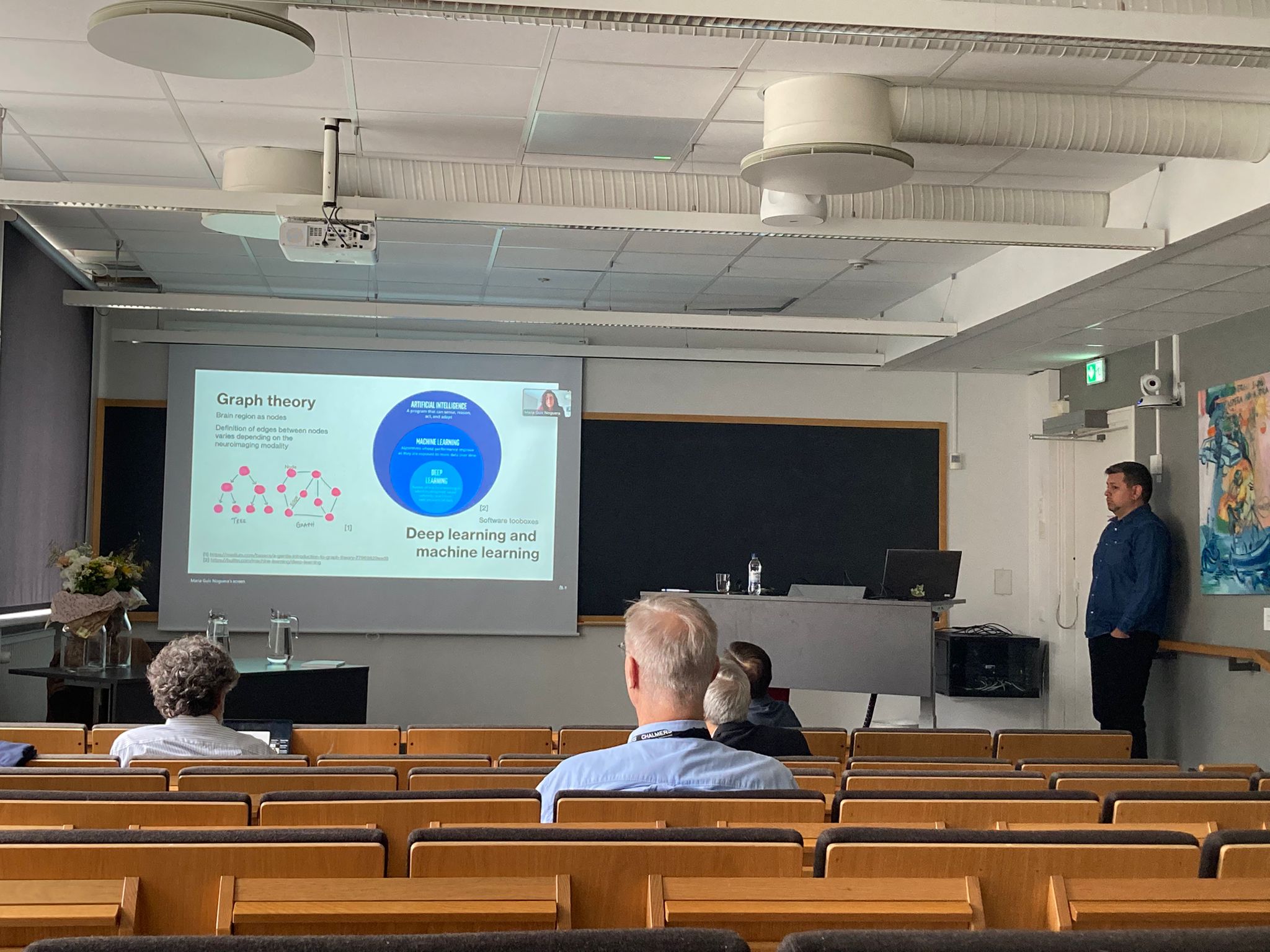
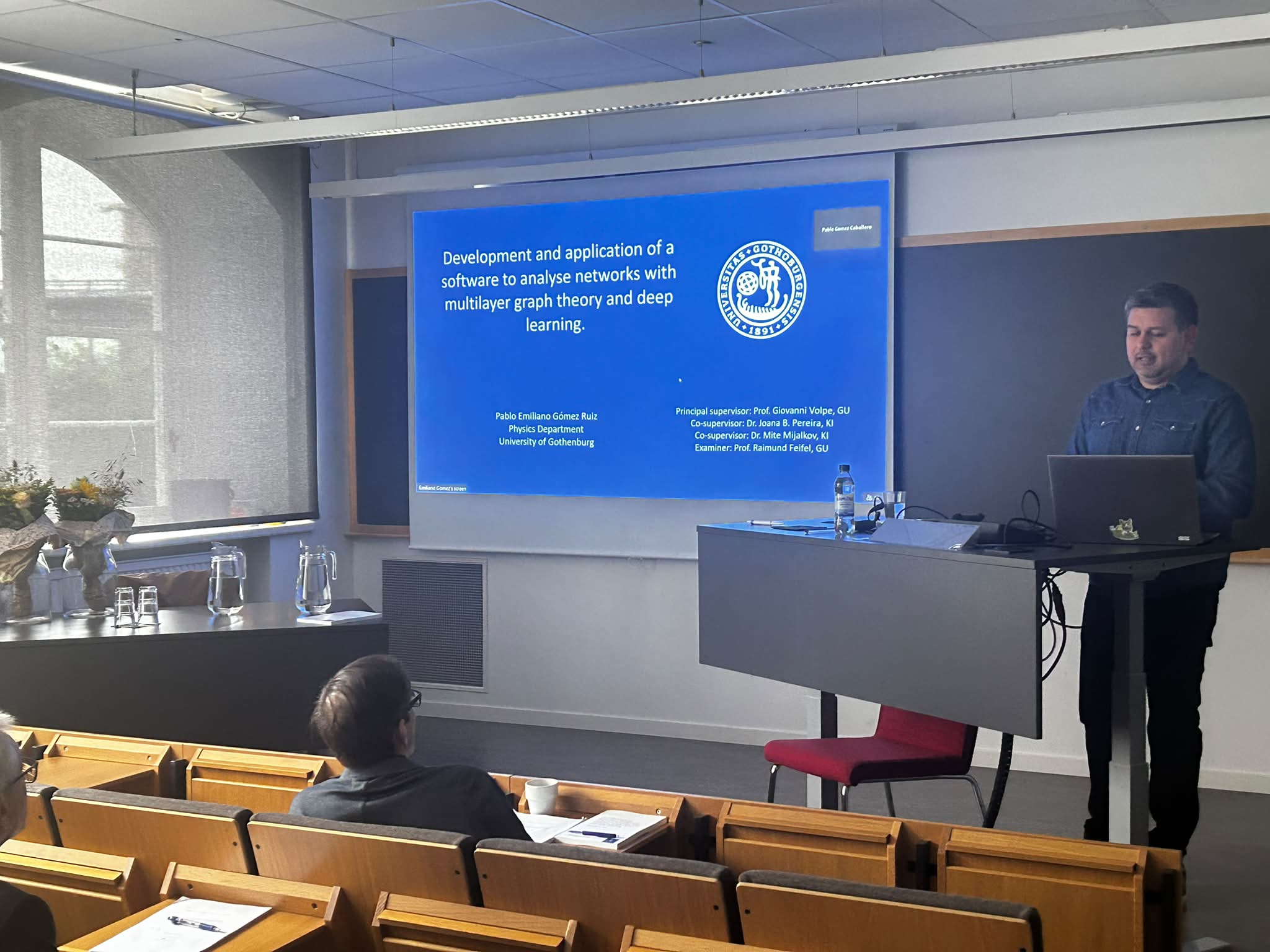
The defense took place in PJ Salen lecture hall, Institutionen för fysik, Johanneberg Campus, Göteborg, at 14:00.
Title: Development and application of software to analyze networks with multilayer graph theory and deep learning.
Abstract:
Understanding how the brain is wired is essential, it gives us a new level of insight of its functionality. By modeling the brain as a complex intercon- nected network, the connectome, researchers can abstract biological com- plexity into a mathematical framework suitable for analysis. The connec- tome can be understood by it’s structural links such as neuron’s synapses or by the functional links such as a statistical relationships between neu- ral activity between the brain’s regions. The mapping of these networks is achieved with neuroimaging, while their analysis is driven by the integration of graph theory and deep learning architectures.
In this work, we present a software “Brain Analysis using Graph Theory 2” (BRAPH 2.0), which is a direct solution of the need for a toolbox de- signed for both complex graph theory and deep learning analyses. Central to the software’s architecture is the “Genesis” pseudo-language, which allows researchers to bridge human-readable properties with computer code, facilitating the modular expansion of multilayer graph theory and deep learning pipelines of the software.
The capabilities of this framework are demonstrated through large-scale clinical applications. We analyze sex-related differences in the aging brain using a cohort of 37,543 participants from the UK Biobank. Our results reveal that multilayer metrics, which capture the dynamic interplay between positive and negative functional connections, are significantly more sensitive to sex-related topological changes than traditional unilayer measures.
Furthermore, we implement a Reservoir Computing (RC) pipeline to define computational “Memory Capacity” (MC) as a physical indicator of biological aging. Using the Cam-CAN and LEMON cohorts, we demonstrate that MC reliably predicts age-related decline, particularly within the frontal and parietal regions, and reflects the underlying integrity of white matter tracts and the locus coeruleus.
Thesis: https://hdl.handle.net/2077/91352
Supervisor: Giovanni Volpe
Examiner: Raimund Feifel
Opponent: Maria Guix Noguera
Committee: Remigio Cabrera-Trujillo, Paolo Vinai, Vitali Zhaunerchyk
Alternate board member: Witlef Wieczorek