The award-winning research was carried out during David’s research stay at the Soft Matter Lab, University of Gothenburg, highlighting the value of international collaboration in advancing frontier research.
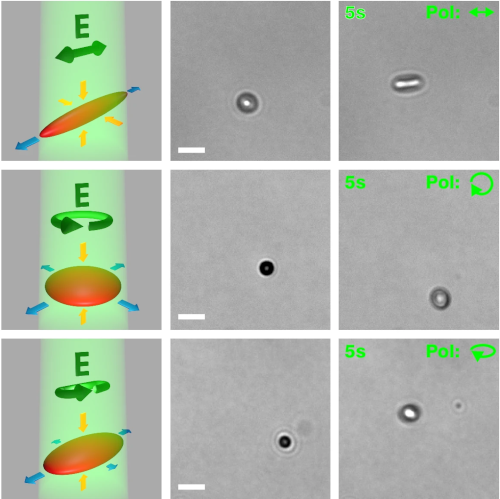
(Image from the manuscript.)Directional flows using capillary assembly of photo-deformable colloidal particles at water-air interfaces
David Urban, Marcel Rey, Antonio Ciarlo, Marie Friederike Schulte, Emiliano Descrovi & Giovanni Volpe
Nature Communications 17, 1004 (2026)
doi: 10.1038/s41467-025-67739-9
Colloidal particles at liquid interfaces experience long-ranged capillary interactions, whose magnitude and directionality depend on the particle shapes. When particle shapes are determined by fabrication or synthesis, the resulting shape-mediated interactions are predefined and often lead to the formation of persistent interfacial structures. Here, we introduce polymer particles at water-air interfaces whose shape and, therefore, interactions can be altered by illumination with polarized light. Specifically, we selectively trigger capillary self-assembly by anisotropically deforming the particles at the interface. Intriguingly, further deformation of already assembled particles induces sustained interfacial flows with velocities of up to 90 μm/s. Benefitting from polarization-defined deformation directions, we create flow-patterns that do not simply follow the illumination intensity pattern, such as shear flows along a single rectangular illumination stripe. We anticipate that this interplay between photo-deformation and capillary interactions of particles will enable various forms of mixing, manipulation, and assembly of soft matter at liquid interfaces.