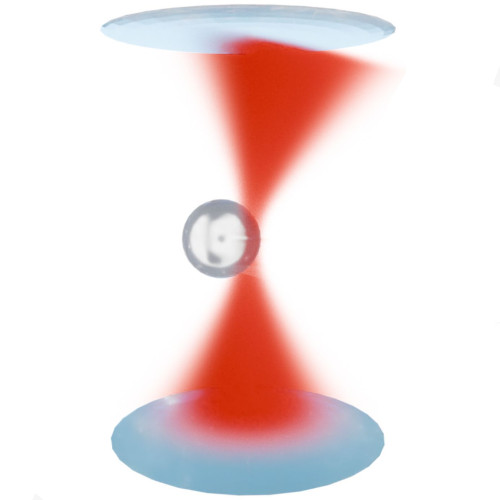
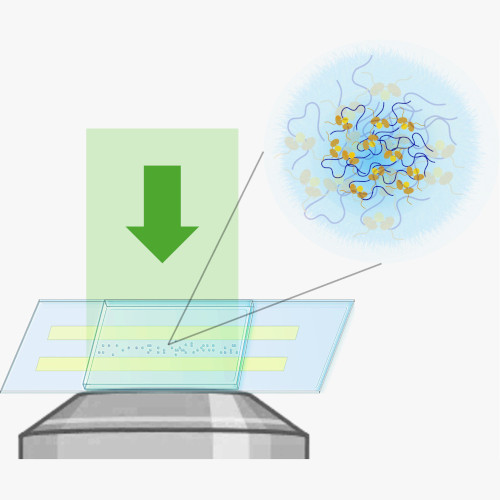
Schematic illustration of the light-momentum detection principle underlying SmartTrap. The momentum change of the trapping laser, induced by its interaction with the trapped particle, is measured to directly quantify optical forces with high precision, enabling real-time feedback and autonomous control in non-equilibrium experiments. (Figure by A. Ciarlo.)SmartTrap: Autonomous Optical Tweezers for Statistical Physics of Non-Equilibrium Systems
Antonio Ciarlo Date: 26th February 2026 Time: 13.30 Place: NORDITA, Stockholm, Sweden The 15th Nordic Workshop on Statistical Physics: Biological, Complex and Non-equilibrium Systems
Optical tweezers are a key tool in non-equilibrium statistical physics, allowing direct measurements of forces, work, and fluctuations in single-molecule and soft matter systems. However, manual operation limits throughput and the systematic study of rare events.
In this talk, Antonio Ciarlo will present SmartTrap, a fully autonomous optical tweezers platform integrating deep learning–based 3D tracking, adaptive feedback control, and automated microfluidics. The system operates without human intervention, executing complete force spectroscopy protocols.
Demonstrated with high-throughput DNA pulling experiments on λ-DNA, SmartTrap enables precise measurements of force–extension curves and folding kinetics. The platform also opens new possibilities for studies of colloids, single cells, and quantitative tests of non-equilibrium statistical physics.
Active Matter: Model Systems and Experimental Tests
Agnese Callegari, Antonio Ciarlo, Sreekanth Manikandan Dates and times:
23 Feb 14:00-15:00 (Agnese)
24 Feb 11:30-12:30 (Antonio)
24 Feb 14:00-15:00 (Sreekanth) Place: PJ Winter school on Geometry of nonequilibrium critical phenomena
Active matter is a broad class of systems that operate intrinsically out of equilibrium. It spans multiple length scales—from macroscopic to micro- and nanoscopic—and includes both biological and artificial realizations, often displaying rich and emerging collective behaviors. The study of active matter aims to explain and interpret these phenomena using concepts and tools from physics. As such, understanding active and non-equilibrium systems requires a combination of theoretical, computational, and experimental approaches.
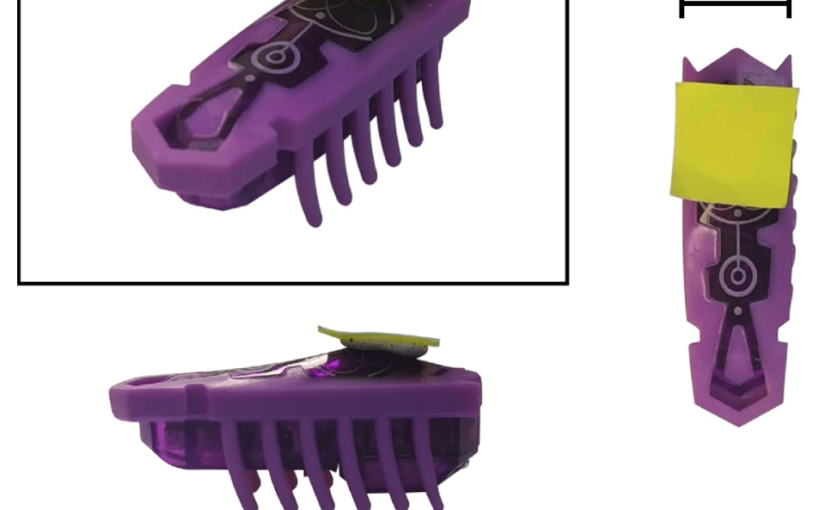
In the first part of the lecture, we introduce the concept of an active particle and demonstrate how it can be embodied in a macroscopic, self-propelled toy robot (a Hexbug). Despite their simplicity, such systems reproduce characteristic—and sometimes counterintuitive—features of microscopic active matter. These experiments have a strong pedagogical value and are designed to help bridge a gap in traditional physics curricula at the primary and secondary education levels.
The second part of the lecture focuses on active matter and non-equilibrium phenomena at the microscopic scale, where advanced experimental tools are essential. Optical tweezers provide precise control over microscopic systems and access to key physical observables. We introduce their operating principles and illustrate how they can be used to construct a minimal, well-controlled experimental model for studying non-equilibrium dynamics at the single-particle level.
In the final part of the lecture, we turn to the theoretical and computational tools required to analyze active matter systems. We discuss how non-equilibrium dynamics can be quantitatively characterized directly from experimental data in a model-independent framework. This naturally leads to an introduction to machine-learning–based inference techniques, which extract dynamical and thermodynamic information from data without relying on a priori assumptions about the underlying physical model.
References:
[1] A. Barona Balda, A. Argun, A. Callegari, G. Volpe. Playing with Active Matter, Am. J. Phys. 92, 847–858 (2024). https://doi.org/10.1119/5.0125111
[2] Martins, T.T., Malavazi, A.H.A., Kamizaki, L.P. et al. Fluctuation theorems with optical tweezers: theory and practice. Eur. Phys. J. Plus 141, 71 (2026). https://doi.org/10.1140/epjp/s13360-025-07181-4
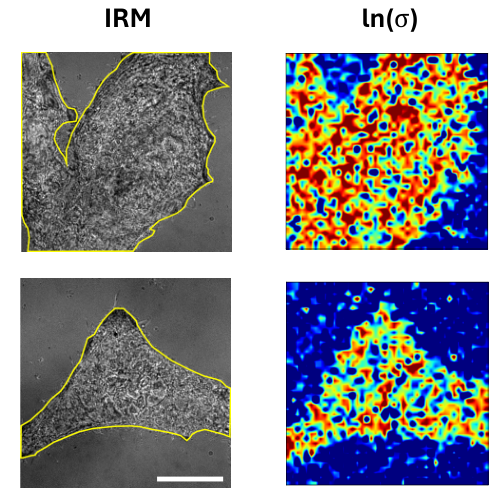
[3] Manikandan, Sreekanth K. and Ghosh, T. and Mandal, T. and Biswas, A. and Sinha, B. and Mitra, D. Estimate of entropy production rate can spatiotemporally resolve the active nature of cell flickering. Phys. Rev. Res. 6, 023310 (2024). https://doi.org/10.1103/PhysRevResearch.6.023310
Photos
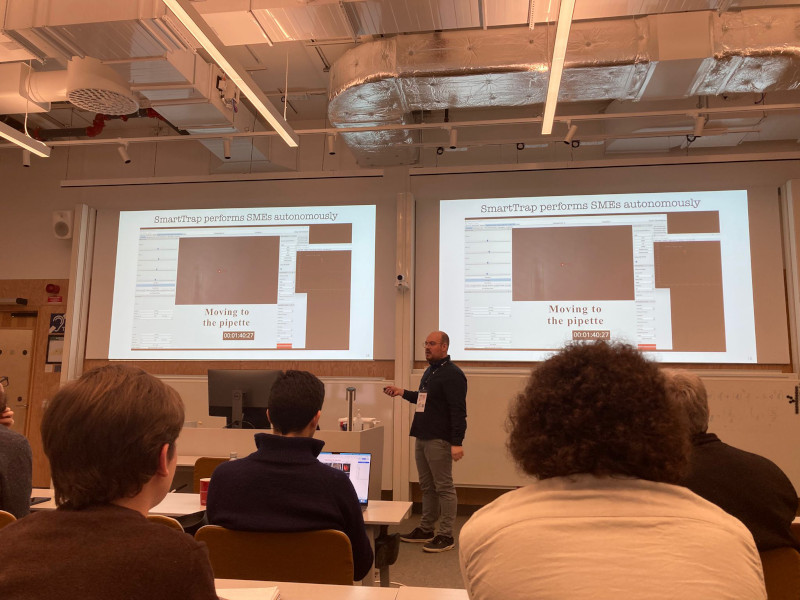
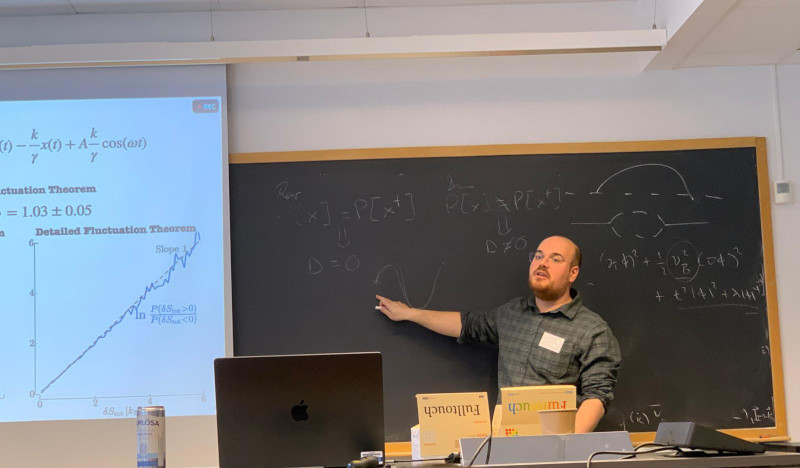
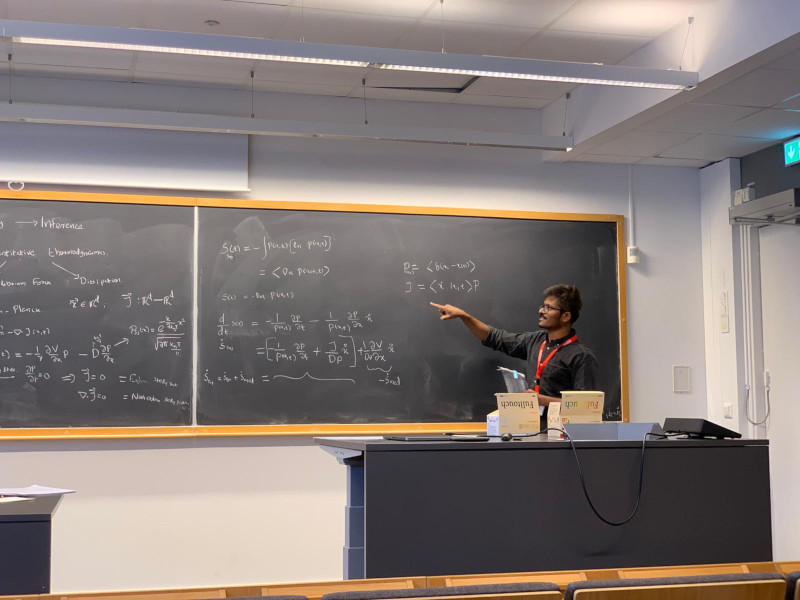
Antonio, presenting. (Photo by M. Orsino)Sreekanth, presenting. (Photo by A. Ciarlo)
Anton Widengård joined the Soft Matter Lab on 9 February 2026.
Anton is a master student in Biomedical Engineering at Chalmers University of Technology.
Alongside with his classmate Max Haraldsson, Anton will be working on his Master’s Thesis at Soft Matter Lab, in collaboration with IFLAI, supervised by Jesús Pineda.
Anton’s and Max’s research focuses on evaluating and efficiently adapting pre-trained deep-learning vision models for cell segmentation and tracking.
Max Haraldsson joined the Soft Matter Lab on 9 February 2026.
Max is a master student in Biomedical Engineering at Chalmers University of Technology.
Together with his classmate Anton Widengård, he will be conducting his Master’s thesis at the Soft Matter Lab in collaboration with IFLAI, with Jesús Pineda as supervisor.
Max’s and Anton’s project is about evaluating and efficiently adapting pre-trained deep learning models for cell segmentation and tracking.
Cover of the PhD thesis. (Image by F. Skärberg)Fredrik Skärberg defended his PhD thesis on January 29th, 2026. Congrats!
The defense took place in FB, Institutionen för fysik, Origovägen 6b, Göteborg, at 09:00.
Title: From Light to Data Using Deep Learning for Quantitative Microscopy
Abstract: Quantitative microscopy aims to measure physical properties of microscopic particles from optical images, but weak and complex signals often make this difficult. This thesis explores how computational methods, especially deep learning guided by physical understanding, can improve particle detection and characterization in microscopy.
The work introduces new approaches for locating and tracking particles, extends these ideas to three-dimensional and label-free imaging, and reviews practical analysis workflows. It further shows how combining complementary imaging techniques can enhance nanoparticle measurements and how deep learning can recover three-dimensional structural information from microscopy images.
Overall, this thesis strengthens the connection between optical measurements and quantitative particle information, expanding the potential of label-free microscopy for biological and nanoscale studies.
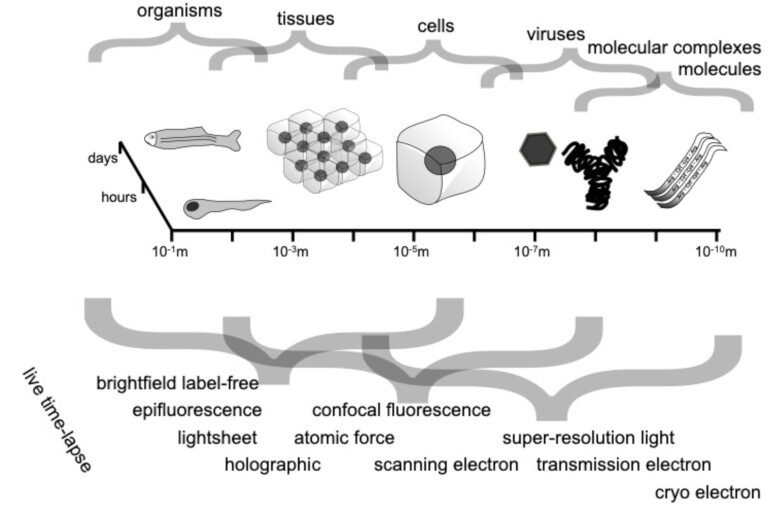
Spatio-temporal spectrum diagram of microscopy techniques and their applications. (Image by the Authors of the manuscript.)Roadmap on Deep Learning for Microscopy
Giovanni Volpe, Carolina Wählby, Lei Tian, Michael Hecht, Artur Yakimovich, Kristina Monakhova, Laura Waller, Ivo F. Sbalzarini, Christopher A. Metzler, Mingyang Xie, Kevin Zhang, Isaac C.D. Lenton, Halina Rubinsztein-Dunlop, Daniel Brunner, Bijie Bai, Aydogan Ozcan, Daniel Midtvedt, Hao Wang, Nataša Sladoje, Joakim Lindblad, Jason T. Smith, Marien Ochoa, Margarida Barroso, Xavier Intes, Tong Qiu, Li-Yu Yu, Sixian You, Yongtao Liu, Maxim A. Ziatdinov, Sergei V. Kalinin, Arlo Sheridan, Uri Manor, Elias Nehme, Ofri Goldenberg, Yoav Shechtman, Henrik K. Moberg, Christoph Langhammer, Barbora Špačková, Saga Helgadottir, Benjamin Midtvedt, Aykut Argun, Tobias Thalheim, Frank Cichos, Stefano Bo, Lars Hubatsch, Jesus Pineda, Carlo Manzo, Harshith Bachimanchi, Erik Selander, Antoni Homs-Corbera, Martin Fränzl, Kevin de Haan, Yair Rivenson, Zofia Korczak, Caroline Beck Adiels, Mite Mijalkov, Dániel Veréb, Yu-Wei Chang, Joana B. Pereira, Damian Matuszewski, Gustaf Kylberg, Ida-Maria Sintorn, Juan C. Caicedo, Beth A Cimini, Muyinatu A. Lediju Bell, Bruno M. Saraiva, Guillaume Jacquemet, Ricardo Henriques, Wei Ouyang, Trang Le, Estibaliz Gómez-de-Mariscal, Daniel Sage, Arrate Muñoz-Barrutia, Ebba Josefson Lindqvist, Johanna Bergman
Journal of Physics: Photonics 8, 012501 (2026)
arXiv: 2303.03793
doi: 10.1088/2515-7647/ae0fd1
Through digital imaging, microscopy has evolved from primarily being a means for visual observation of life at the micro- and nano-scale, to a quantitative tool with ever-increasing resolution and throughput. Artificial intelligence, deep neural networks, and machine learning (ML) are all niche terms describing computational methods that have gained a pivotal role in microscopy-based research over the past decade. This Roadmap encompasses key aspects of how ML is applied to microscopy image data, with the aim of gaining scientific knowledge by improved image quality, automated detection, segmentation, classification and tracking of objects, and efficient merging of information from multiple imaging modalities. We aim to give the reader an overview of the key developments and an understanding of possibilities and limitations of ML for microscopy. It will be of interest to a wide cross-disciplinary audience in the physical sciences and life sciences.
Cover of the PhD thesis. (Image by B. García)Berenice García defended her PhD thesis on January 28th, 2026. Congrats!
The defense took place in PJ, Institutionen för fysik, Origovägen 6b, Göteborg, at 09:00.
Title: Quantitative Optical Microscopy of Microscale Soft Matter Systems
Abstract: Many biological and soft-matter particles operate at sizes below the diffraction limit and scatter light only weakly, making them hard to study with conventional microscopy. This thesis introduces two complementary, label-free interferometric methods that enable single-particle characterization across the meso–microscale. By combining optical scattering, off-axis holography, and particle tracking, these approaches quantify size, refractive index, internal structure, and mobility of individual rigid nanoparticles and soft biomolecular condensates. Together, this work provides new tools for probing the physical principles of nanoscale soft matter and phase-separated biological assemblies.
Supervisor: Daniel Midtvedt Examiner: Bernhard Mehlig Opponent: Balpreet Singh Ahluwalia Committee: Per Augustsson, Arrate Muñoz Barrutia, Alexandra Stubelius Alternate board member: Kristian Gustafsson
Cover of the PhD thesis. (Image by Hula King, https://www.behance.net/hulaking)Yu-Wei Chang defended his PhD thesis on January 23rd, 2026. Congrats!
The defense will take place in SB-H7 lecture hall, SB-Building, Institutionen för fysik, Johanneberg Campus, Göteborg, at 13:00.
Title: A Unified Software-Generating Framework for Biological Data Analysis
Abstract: Biological data analysis relies heavily on software, but as projects grow it becomes hard to keep code, interfaces, and tests aligned, and to reuse methods without rewriting them. This thesis presents Genesis, which generates runnable modules, GUIs, and unit tests from a single human-readable .gen.m description of each analysis component. By maintaining a central library of these descriptions, analyses can be recombined for new questions while staying consistent. Four studies across neuroimaging, light-sheet microscopy, and plant Raman spectroscopy show the framework is reusable and extensible across domains.
Hang Zhao, supervised by Giovanni Volpe and Joana Pereira, will present his halftime seminar under the topic “Brain connectome revealed neuro-degenerative disease” on 9-10 am, 22nd Jan. 2026 in Nexus and through Zoom (https://gu-se.zoom.us/j/7726618257). The seminar starts from his presentation about the past and planned project, followed by a discussion and questions by his opponent, Professor Mattias Göksor.
Quantifying the spatiotemporal forces, affinities, and dissipative costs of cellular-scale non-equilibrium processes from experimental data and localizing it in space and time remain a significant open challenge. Here, I explore how principles from stochastic thermodynamics, combined with machine learning techniques, offer a promising approach to addressing this issue. I will present preliminary results from experiments on fluctuating cell membranes and simulations of non-equilibrium systems in stationary and time-dependently driven states. These studies reveal potential strategies for localizing entropy production in experimental biophysical contexts while also highlighting key challenges and limitations that must be addressed.