Sex differences in multilayer functional network topology over the course of aging in 37543 UK Biobank participants accepted on Network Neuroscience

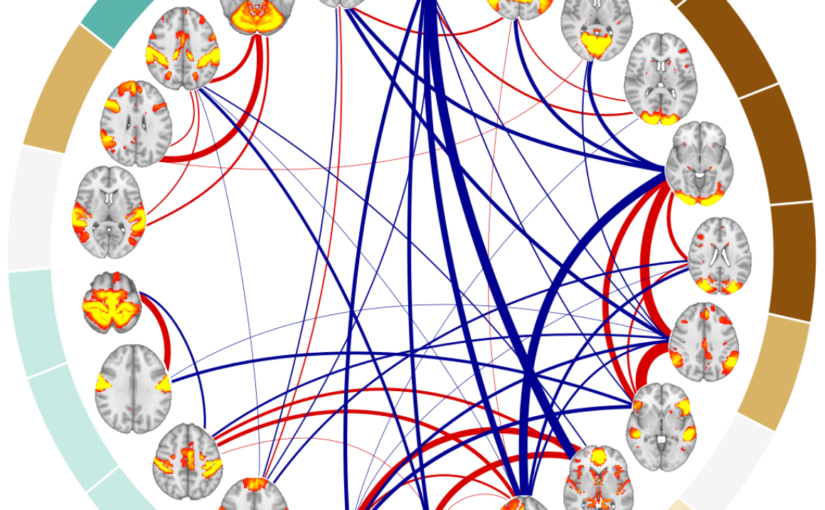
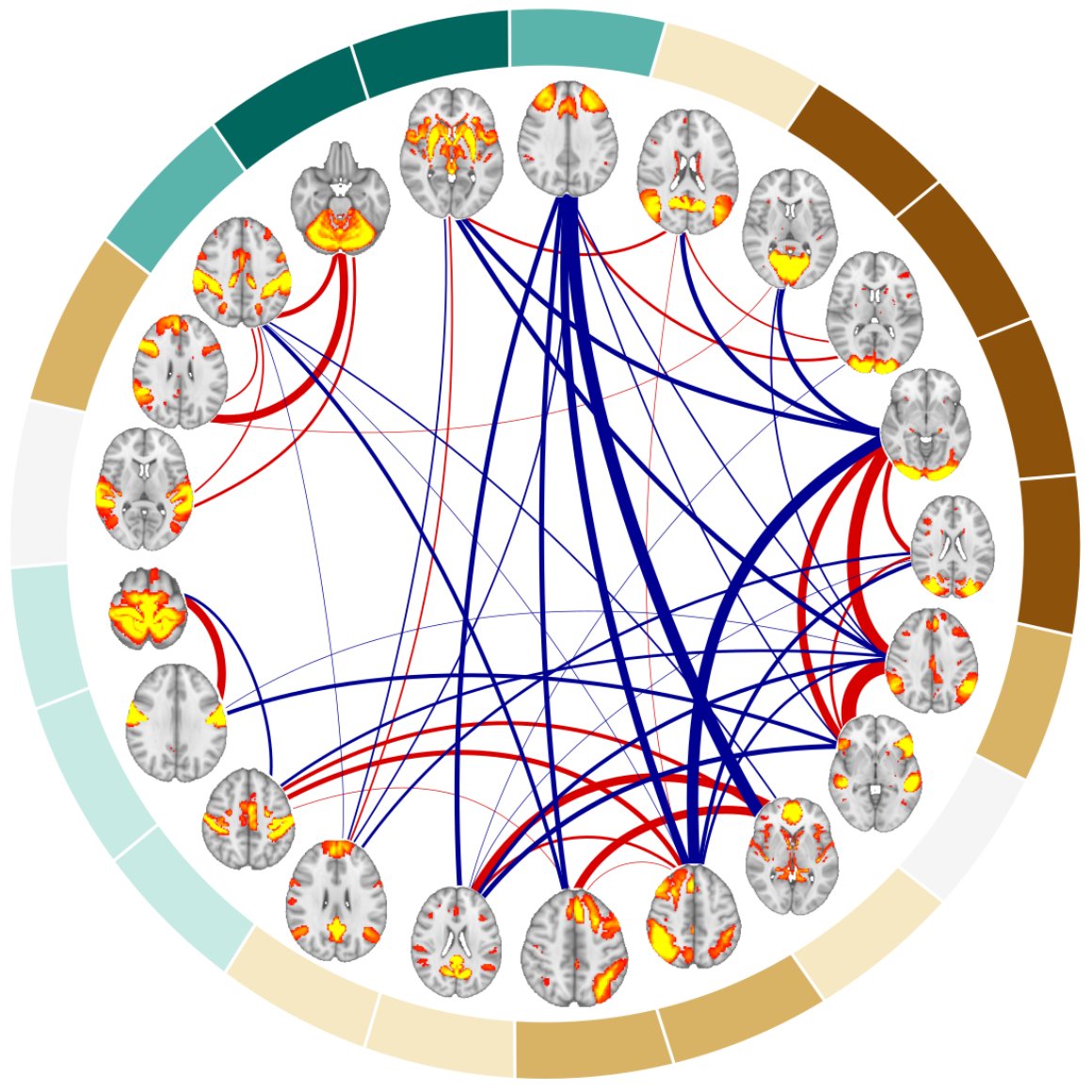
Example of the 21 resting-state networks used as nodes and their positive (red) and negative connections (blue) for one of 140 the subjects included in the analyses. (Image by the Authors of the manuscript.)
Sex differences in multilayer functional network topology over the course of aging in 37543 UK Biobank participants
Mite Mijalkov, Dániel Veréb, Oveis Jamialahmadi, Anna Canal-Garcia, Emiliano Gómez-Ruiz, Didac Vidal-Piñeiro, Stefano Romeo, Giovanni Volpe, Joana B. Pereira
Network Neuroscience 1-40 (2022)
doi: 10.1162/netn_a_00286
medRxiv: 10.1101/2022.03.08.22272089

Aging is a major risk factor for cardiovascular and neurodegenerative disorders, with considerable societal and economic implications. Healthy aging is accompanied by changes in functional connectivity between and within resting-state functional networks, which have been associated with cognitive decline. However, there is no consensus on the impact of sex on these age-related functional trajectories. Here, we show that multilayer measures provide crucial information on the interaction between sex and age on network topology, allowing for better assessment of cognitive, structural, and cardiovascular risk factors that have been shown to differ between men and women, as well as providing additional insights into the genetic influences on changes in functional connectivity that occur during aging. In a large cross-sectional sample of 37543 individuals from the UK Biobank cohort, we demonstrate that such multilayer measures that capture the relationship between positive and negative connections are more sensitive to sex-related changes in the whole-brain connectivity patterns and their topological architecture throughout aging, when compared to standard connectivity and topological measures. Our findings indicate that multilayer measures contain previously unknown information on the relationship between sex and age, which opens up new avenues for research into functional brain connectivity in aging.

Invited Talk by G. Volpe at Adaptivity in Nonlinear Dynamical Systems, Potsdam, 23 September 2022

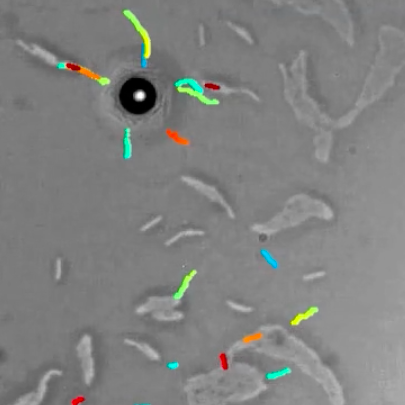
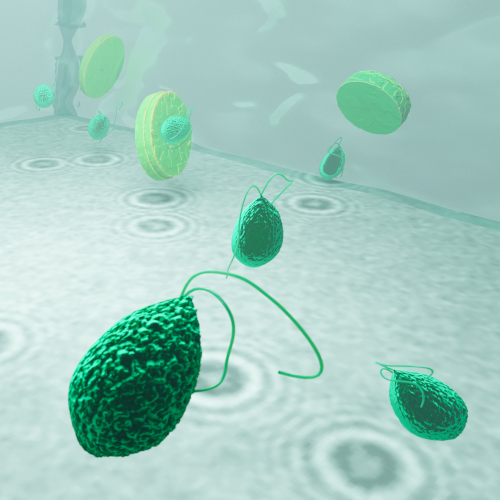
M. xanthus cell-cell and cell-particle local interactions during cellular aggregation.
Feedback between active matter and its environment
Giovanni Volpe
Invited Talk (Online) at the hybrid Workshop: Adaptivity in Nonlinear Dynamical Systems
Potsdam, Germany
23 September 2022, 9:30 CEST

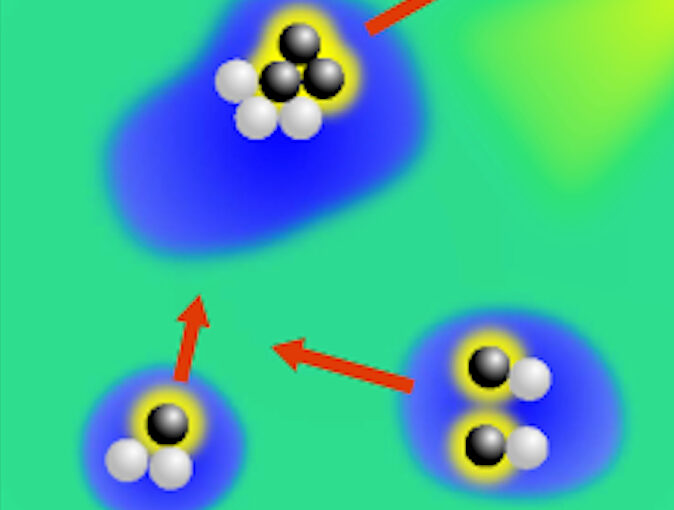
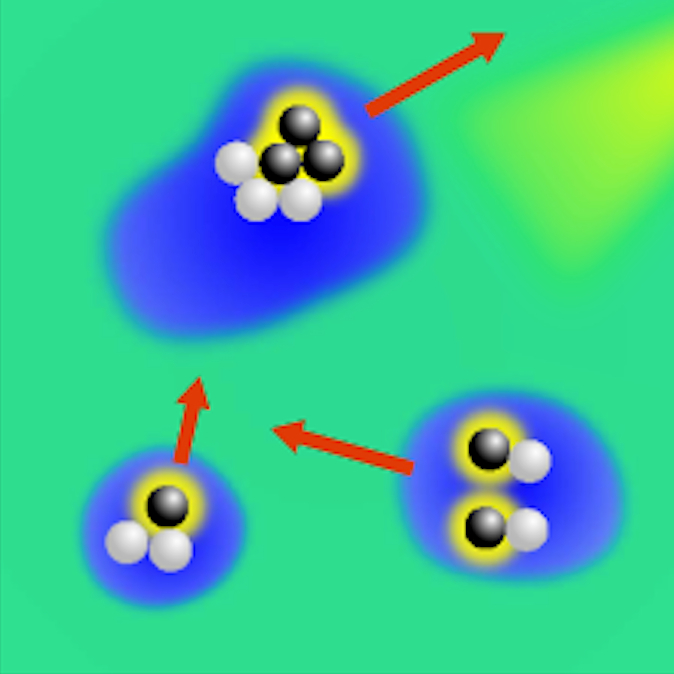
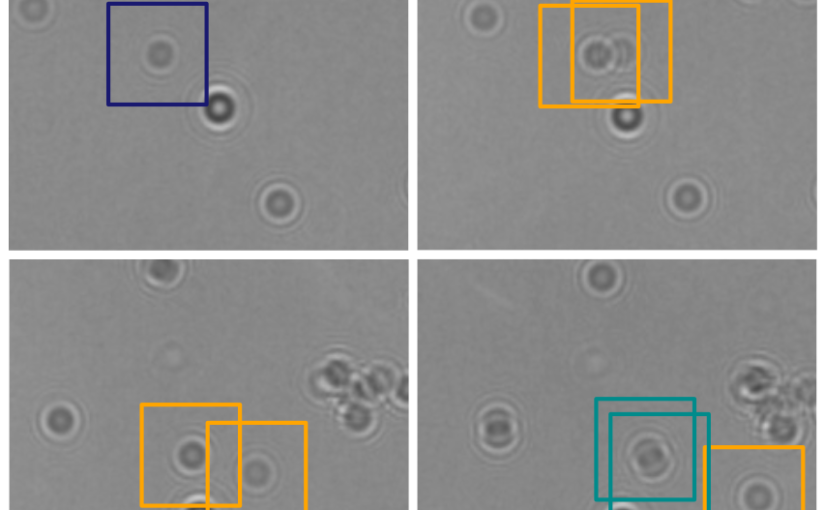
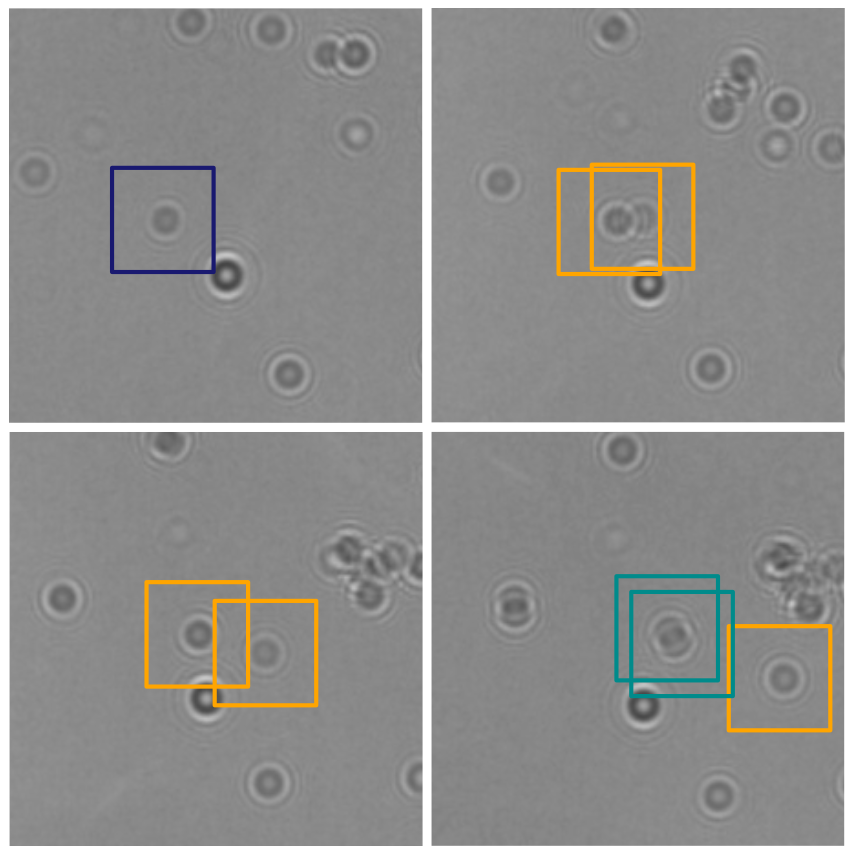
I will present some examples of how feedback cycles can occur between active matter and its environment. In particular, I’ll show the formation of active molecules and active droploids from passive colloidal building blocks; the emergence of non-Boltzmann statistics and active-depletion forces between plates in an active bath; and the environment topography alters the way to multicellularity in the bacterium Myxococcus xanthus.

Keynote Lecture by G. Volpe at ISMC 2022, Poznan, 20 September 2022

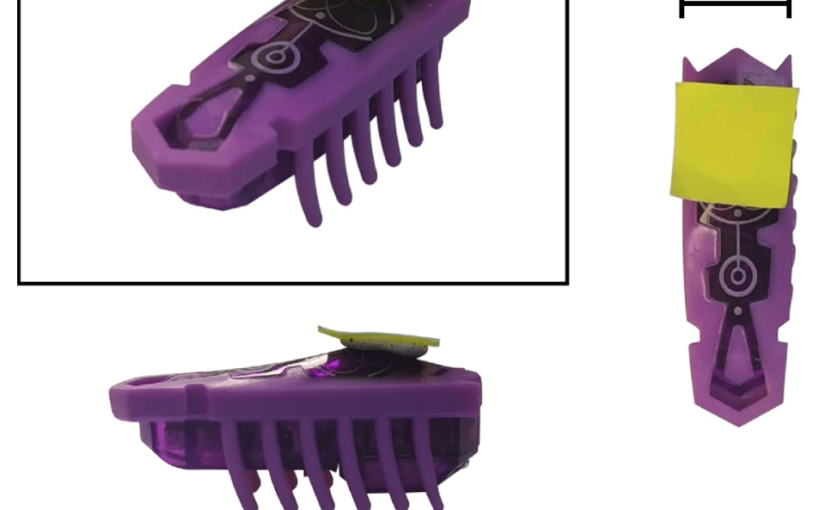
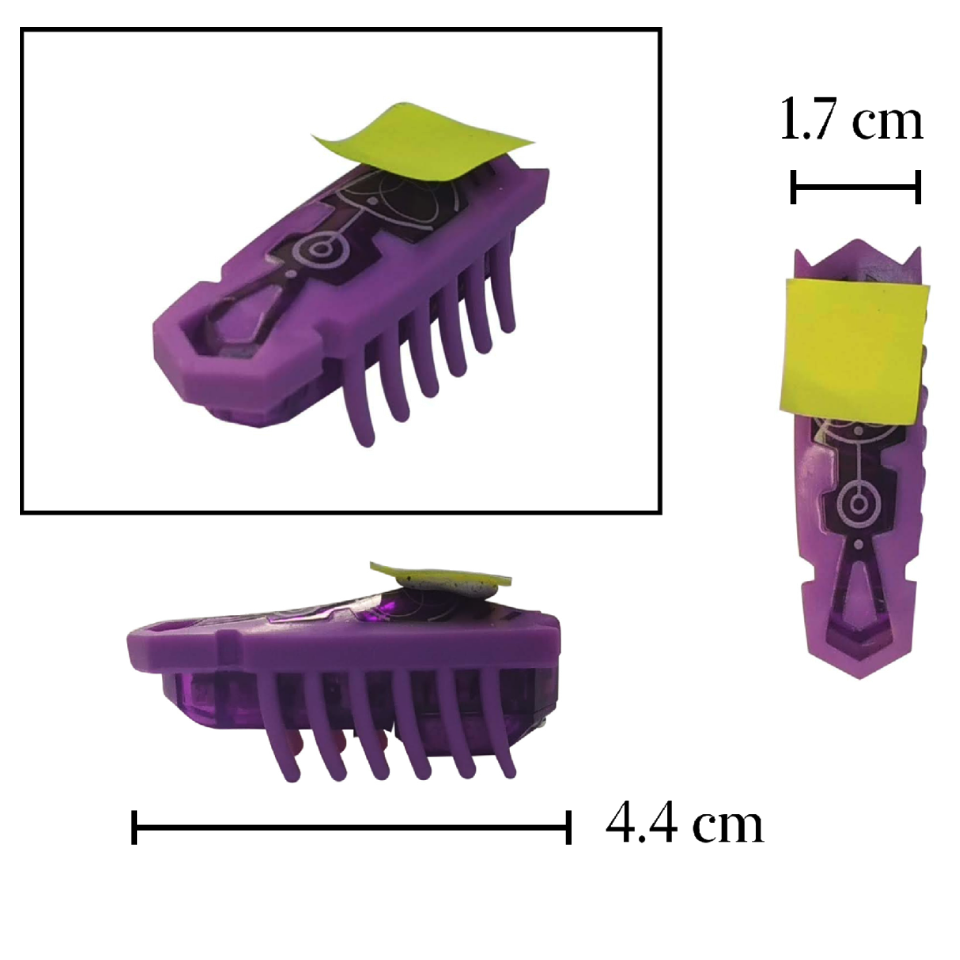
An exemplar of Hexbugs, commercially available toy robots that have been used in the experimental demonstration proposed. (Image from arXiv: 2209.04168)
Playing with Active Matter
Giovanni Volpe
Keynote Lecture at ISMC 2022
Poznan, Poland
20 September 2022, 13:30 CEST

In the last 20 years, active matter has been a very successful research field, bridging the fundamental physics of nonequilibrium thermodynamics with applications in robotics, biology, and medicine. This field deals with active particles, which, differently from passive Brownian particles, can harness energy to generate complex motions and emerging behaviors. Most active-matter experiments are performed with microscopic particles and require advanced microfabrication and microscopy techniques. Here, we propose some macroscopic experiments with active matter employing commercially available toy robots, i.e., the Hexbugs. We demonstrate how they can be easily modified to perform regular and chiral active Brownian motion. We also show that Hexbugs can interact with passive objects present in their environment and, depending on their shape, set them in motion and rotation. Furthermore, we show that, by introducing obstacles in the environment, we can sort the robots based on their motility and chirality. Finally, we demonstrate the emergence of Casimir-like activity-induced attraction between planar objects in the presence of active particles in the environment.

Soft Matter Lab members present at ISMC 2022, Poznan, 19-23 September 2022

The Soft Matter Lab participates to the ISMC 2022 in Poznan, Poland, 19-23 September 2022, with the presentations listed below.

Invited Talk by G. Volpe at Fluctuations in small complex systems VI, Venice, 9 September 2022

Label-free measurement of biomolecules and their diffusion
Giovanni Volpe
9 September 2022, 16:45 (CEST)
Venice meeting on Fluctuations in small complex systems VI
Istituto Veneto di Scienze, Lettere ed Arti
Palazzo Franchetti, Venezia, 5-9 September 2022

An anomalous competition: assessment of methods for anomalous diffusion through a community effort

An anomalous competition: assessment of methods for anomalous diffusion through a community effort
Carlo Manzo, Giovanni Volpe
Submitted to SPIE-ETAI
Date: 25 August 2022
Time: 9:00 (PDT)

Deviations from the law of Brownian motion, typically referred to as anomalous diffusion, are ubiquitous in science and associated with non-equilibrium phenomena, flows of energy and information, and transport in living systems. In the last years, the booming of machine learning has boosted the development of new methods to detect and characterize anomalous diffusion from individual trajectories, going beyond classical calculations based on the mean squared displacement. We thus designed the AnDi challenge, an open community effort to objectively assess the performance of conventional and novel methods. We developed a python library for generating simulated datasets according to the most popular theoretical models of diffusion. We evaluated 16 methods over 3 different tasks and 3 different dimensions, involving anomalous exponent inference, model classification, and trajectory segmentation. Our analysis provides the first assessment of methods for anomalous diffusion in a variety of realistic conditions of trajectory length and noise. Furthermore, we compared the prediction provided by these methods for several experimental datasets. The results of this study further highlight the role that anomalous diffusion has in defining the biological function while revealing insight into the current state of the field and providing a benchmark for future developers.

Presenter: Giovanni Volpe

Soft Matter Lab members present at SPIE Optics+Photonics conference in San Diego, 21-25 August 2022

The Soft Matter Lab participates to the SPIE Optics+Photonics conference in San Diego, CA, USA, 21-25 August 2022, with the presentations listed below.

Giovanni Volpe is also co-author of the presentations:

Invited Talk by G. Volpe at UCLA, 19 August 2022

Quantitative Digital Microscopy with Deep Learning
Giovanni Volpe
19 August 2022, 14:40 (PDT)
At the intersection of Photonics, Neuroscience, and AI
Ozcan Lab, UCLA, 19 August 2022

Video microscopy has a long history of providing insights and breakthroughs for a broad range of disciplines, from physics to biology. Image analysis to extract quantitative information from video microscopy data has traditionally relied on algorithmic approaches, which are often difficult to implement, time consuming, and computationally expensive. Recently, alternative data-driven approaches using deep learning have greatly improved quantitative digital microscopy, potentially offering automatized, accurate, and fast image analysis. However, the combination of deep learning and video microscopy remains underutilized primarily due to the steep learning curve involved in developing custom deep-learning solutions. To overcome this issue, we have introduced a software, currently at version DeepTrack 2.1, to design, train and validate deep-learning solutions for digital microscopy. We use it to exemplify how deep learning can be employed for a broad range of applications, from particle localization, tracking and characterization to cell counting and classification. Thanks to its user-friendly graphical interface, DeepTrack 2.1 can be easily customized for user-specific applications, and, thanks to its open-source object-oriented programming, it can be easily expanded to add features and functionalities, potentially introducing deep-learning-enhanced video microscopy to a far wider audience.

Multi-cohort and longitudinal Bayesian clustering study of stage and subtype in Alzheimer’s disease published in Nature Communications

Comparison of cluster-specific covariance matrixes with node strength. (Image by the Authors.)
Multi-cohort and longitudinal Bayesian clustering study of stage and subtype in Alzheimer’s disease
Konstantinos Poulakis, Joana B. Pereira, J.-Sebastian Muehlboeck, Lars-Olof Wahlund, Örjan Smedby, Giovanni Volpe, Colin L. Masters, David Ames, Yoshiki Niimi, Takeshi Iwatsubo, Daniel Ferreira, Eric Westman, Japanese Alzheimer’s Disease Neuroimaging Initiative & Australian Imaging, Biomarkers and Lifestyle study
Nature Communications 13, 4566 (2022)
doi: 10.1038/s41467-022-32202-6

Understanding Alzheimer’s disease (AD) heterogeneity is important for understanding the underlying pathophysiological mechanisms of AD. However, AD atrophy subtypes may reflect different disease stages or biologically distinct subtypes. Here we use longitudinal magnetic resonance imaging data (891 participants with AD dementia, 305 healthy control participants) from four international cohorts, and longitudinal clustering to estimate differential atrophy trajectories from the age of clinical disease onset. Our findings (in amyloid-β positive AD patients) show five distinct longitudinal patterns of atrophy with different demographical and cognitive characteristics. Some previously reported atrophy subtypes may reflect disease stages rather than distinct subtypes. The heterogeneity in atrophy rates and cognitive decline within the five longitudinal atrophy patterns, potentially expresses a complex combination of protective/risk factors and concomitant non-AD pathologies. By alternating between the cross-sectional and longitudinal understanding of AD subtypes these analyses may allow better understanding of disease heterogeneity.

Invited Talk by G. Volpe at Nordita, Stockholm, 2 August 2022

Interplay between active particles and their environment
Giovanni Volpe
2 August 2022, 10:30 (CEST)
Nordita workshop: Current and Future Themes in Soft and Biological Active Matter
Albano Building 3
Stockholm, 25 July-19 August 2022

In this seminar, I will present some examples of how the behaviour of active particles can be influenced by their environment. In particular, I’ll show the formation of active molecules and active droploids from passive colloidal building blocks; the emergence of non-Boltzmann statistics and active-depletion forces between plates in an active bath; and the environment topography alters the way to multicellularity in the bacterium Myxococcus xanthus.