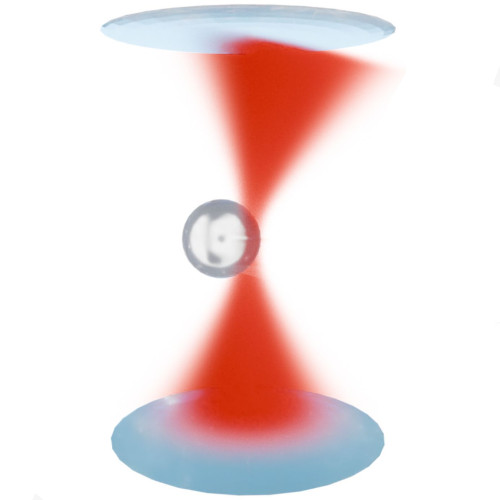
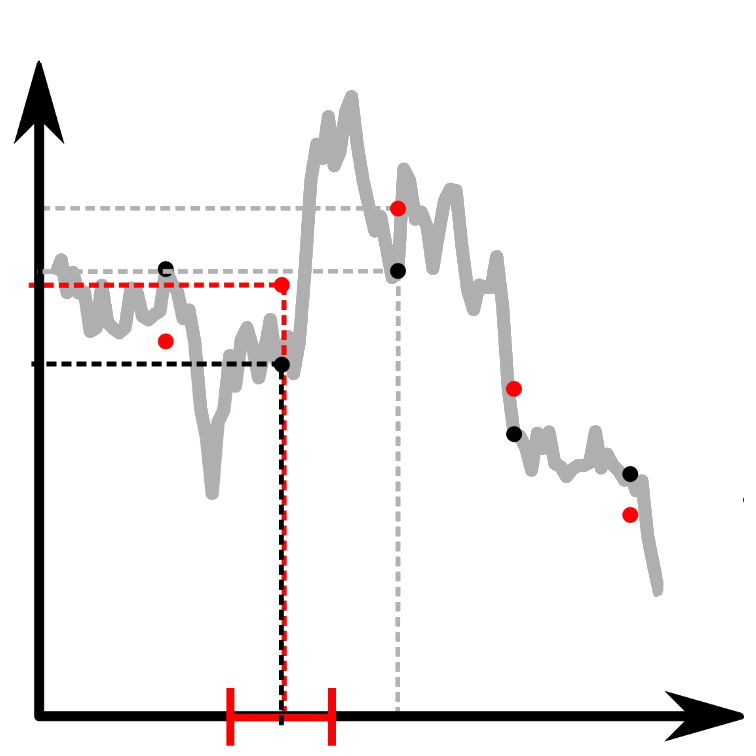
Schematic illustration of the light-momentum detection principle underlying SmartTrap. The momentum change of the trapping laser, induced by its interaction with the trapped particle, is measured to directly quantify optical forces with high precision, enabling real-time feedback and autonomous control in non-equilibrium experiments. (Figure by A. Ciarlo.)SmartTrap: Autonomous Optical Tweezers for Statistical Physics of Non-Equilibrium Systems
Antonio Ciarlo Date: 26th February 2026 Time: 13.30 Place: NORDITA, Stockholm, Sweden The 15th Nordic Workshop on Statistical Physics: Biological, Complex and Non-equilibrium Systems
Optical tweezers are a key tool in non-equilibrium statistical physics, allowing direct measurements of forces, work, and fluctuations in single-molecule and soft matter systems. However, manual operation limits throughput and the systematic study of rare events.
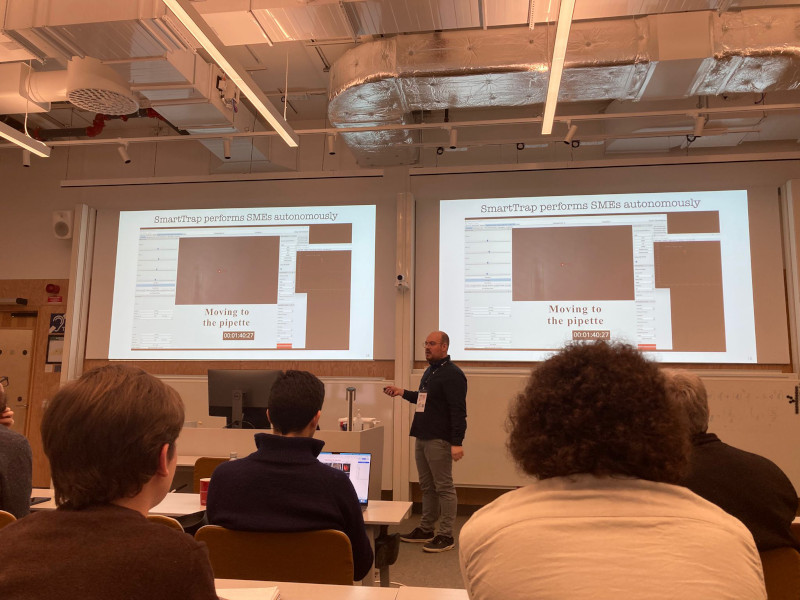
In this talk, Antonio Ciarlo will present SmartTrap, a fully autonomous optical tweezers platform integrating deep learning–based 3D tracking, adaptive feedback control, and automated microfluidics. The system operates without human intervention, executing complete force spectroscopy protocols.
Demonstrated with high-throughput DNA pulling experiments on λ-DNA, SmartTrap enables precise measurements of force–extension curves and folding kinetics. The platform also opens new possibilities for studies of colloids, single cells, and quantitative tests of non-equilibrium statistical physics.
Active Matter: Model Systems and Experimental Tests
Agnese Callegari, Antonio Ciarlo, Sreekanth Manikandan Dates and times:
23 Feb 14:00-15:00 (Agnese)
24 Feb 11:30-12:30 (Antonio)
24 Feb 14:00-15:00 (Sreekanth) Place: PJ Winter school on Geometry of nonequilibrium critical phenomena
Active matter is a broad class of systems that operate intrinsically out of equilibrium. It spans multiple length scales—from macroscopic to micro- and nanoscopic—and includes both biological and artificial realizations, often displaying rich and emerging collective behaviors. The study of active matter aims to explain and interpret these phenomena using concepts and tools from physics. As such, understanding active and non-equilibrium systems requires a combination of theoretical, computational, and experimental approaches.
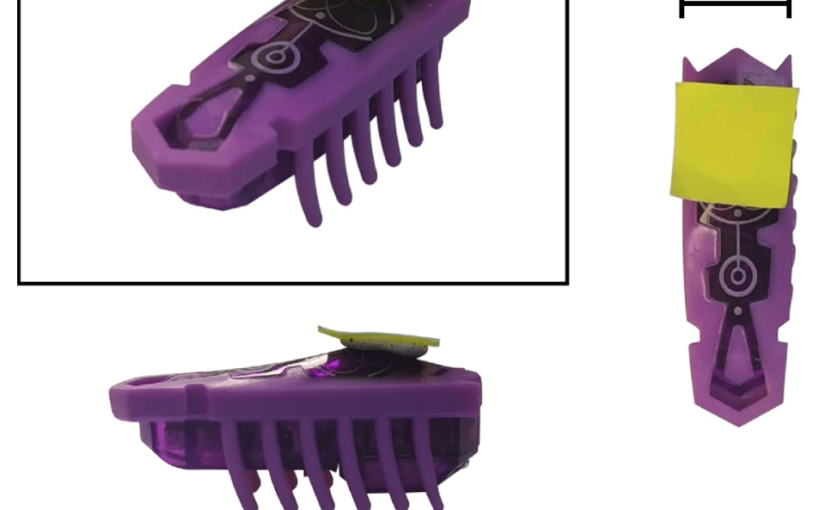
In the first part of the lecture, we introduce the concept of an active particle and demonstrate how it can be embodied in a macroscopic, self-propelled toy robot (a Hexbug). Despite their simplicity, such systems reproduce characteristic—and sometimes counterintuitive—features of microscopic active matter. These experiments have a strong pedagogical value and are designed to help bridge a gap in traditional physics curricula at the primary and secondary education levels.
The second part of the lecture focuses on active matter and non-equilibrium phenomena at the microscopic scale, where advanced experimental tools are essential. Optical tweezers provide precise control over microscopic systems and access to key physical observables. We introduce their operating principles and illustrate how they can be used to construct a minimal, well-controlled experimental model for studying non-equilibrium dynamics at the single-particle level.
In the final part of the lecture, we turn to the theoretical and computational tools required to analyze active matter systems. We discuss how non-equilibrium dynamics can be quantitatively characterized directly from experimental data in a model-independent framework. This naturally leads to an introduction to machine-learning–based inference techniques, which extract dynamical and thermodynamic information from data without relying on a priori assumptions about the underlying physical model.
References:
[1] A. Barona Balda, A. Argun, A. Callegari, G. Volpe. Playing with Active Matter, Am. J. Phys. 92, 847–858 (2024). https://doi.org/10.1119/5.0125111
[2] Martins, T.T., Malavazi, A.H.A., Kamizaki, L.P. et al. Fluctuation theorems with optical tweezers: theory and practice. Eur. Phys. J. Plus 141, 71 (2026). https://doi.org/10.1140/epjp/s13360-025-07181-4
[3] Manikandan, Sreekanth K. and Ghosh, T. and Mandal, T. and Biswas, A. and Sinha, B. and Mitra, D. Estimate of entropy production rate can spatiotemporally resolve the active nature of cell flickering. Phys. Rev. Res. 6, 023310 (2024). https://doi.org/10.1103/PhysRevResearch.6.023310
Photos
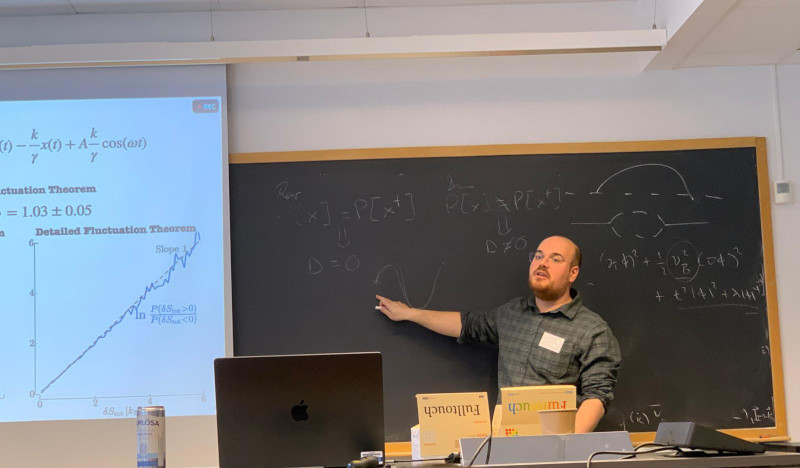
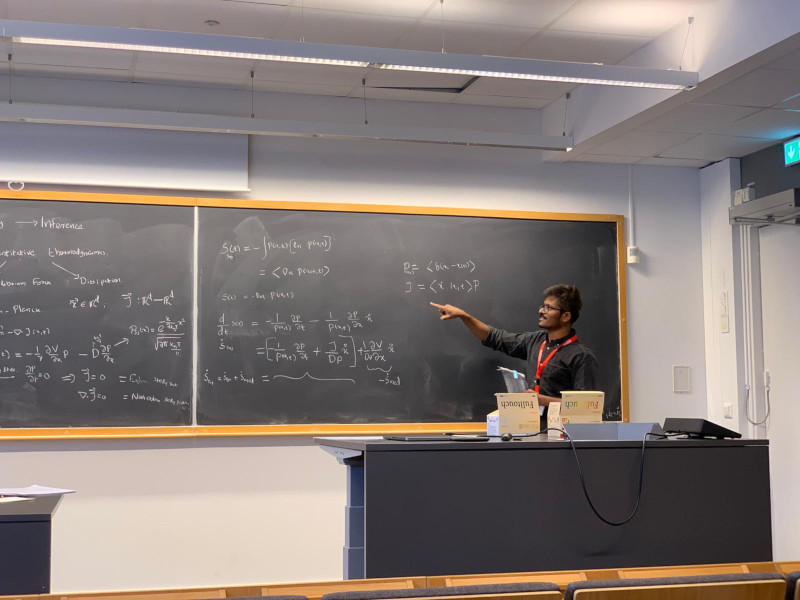
Antonio, presenting. (Photo by M. Orsino)Sreekanth, presenting. (Photo by A. Ciarlo)
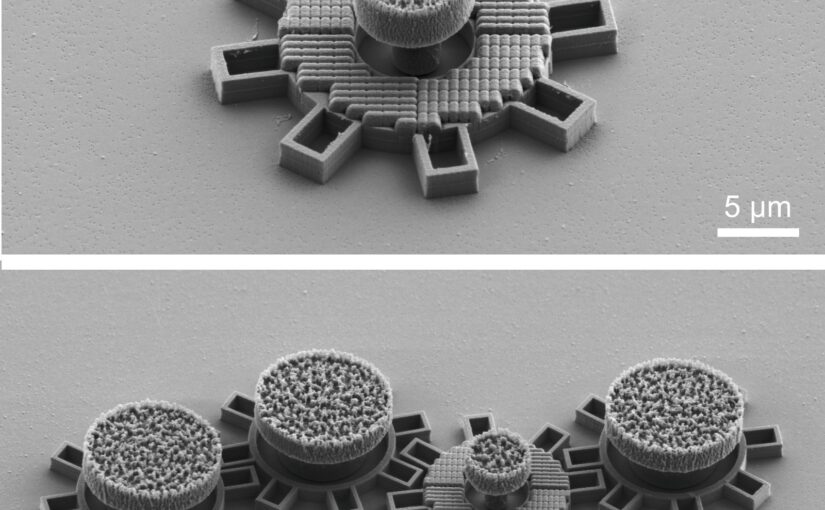
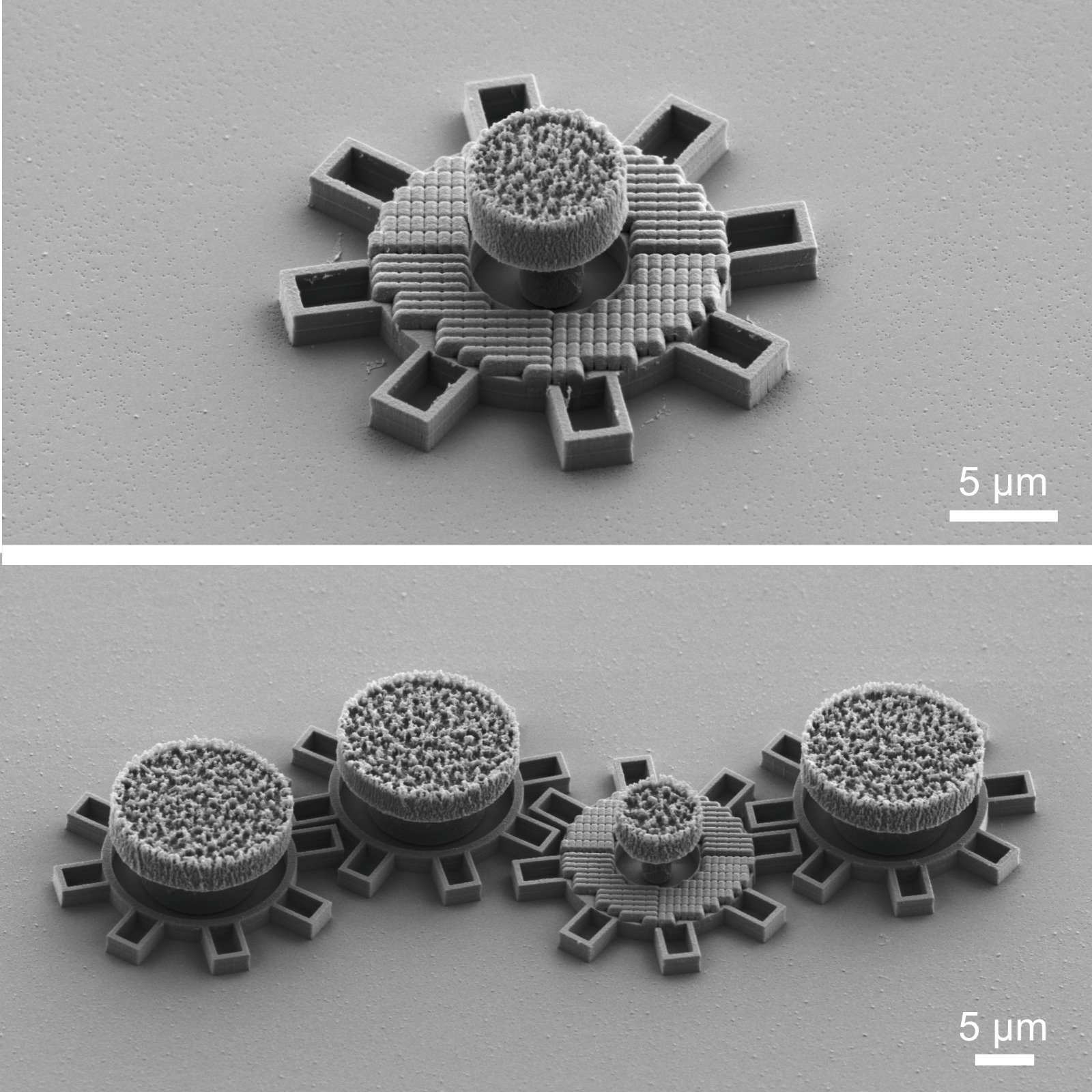
Top: single gear; Bottom: the second gear from the right has an optical metamaterial that react to laserlight and makes the gear move. All gears are made in silica directly on a chip. Each gear is about 0.016 mm in diameter. (Image by G. Wang)
Microscopic Geared Metamachines
Gan Wang, Marcel Rey, Antonio Ciarlo, Mohanmmad Mahdi Shanei, Kunli Xiong, Giuseppe Pesce, Mikael Käll and Giovanni Volpe
Nature Communications 16, 7767 (2025)
doi: 10.1038/s41467-025-62869-6
arXiv: 2409.17284
The miniaturization of mechanical machines is critical for advancing nanotechnology and reducing device footprints. Traditional efforts to downsize gears and micromotors have faced limitations at around 0.1 mm for over thirty years due to the complexities of constructing drives and coupling systems at such scales. Here, we present an alternative approach utilizing optical metasurfaces to locally drive microscopic machines, which can then be fabricated using standard lithography techniques and seamlessly integrated on the chip, achieving sizes down to tens of micrometers with movements precise to the sub-micrometer scale. As a proof of principle, we demonstrate the construction of microscopic gear trains powered by a single driving gear with a metasurface activated by a plane light wave. Additionally, we develop a versatile pinion and rack micromachine capable of transducing rotational motion, performing periodic motion, and controlling microscopic mirrors for light deflection. Our on-chip fabrication process allows for straightforward parallelization and integration. Using light as a widely available and easily controllable energy source, these miniaturized metamachines offer precise control and movement, unlocking new possibilities for micro- and nanoscale systems.
After the article was published, it was reported by many media outlets, University of Gothenburg, New Scientist, Optics.org, Phys.org, ScienceDaily, Discover Magazine, among others.
Graphical representation of colloidal interaction measurements using the automated miniTweezer. (Image by A. Ciarlo.)miniTweezer: an autonomous high-throughput optical tweezers platform for force spectroscopy Antonio Ciarlo, Martin Selin, Giuseppe Pesce, Carlos Bustamante, and Giovanni Volpe Date: 5 August 2025 Time: 9:45 AM – 10:15 AM Place: Conv. Ctr. Room 4
Optical tweezers are essential for single-molecule studies, providing direct access to the forces underlying biological processes such as protein folding, DNA transcription, and replication. However, manual experiments are labor-intensive, costly, and slow, especially when large data sets are required. Here we present the miniTweezer, a fully autonomous force spectroscopy platform that integrates optical tweezers with real-time image analysis and adaptive control. Once configured, it operates independently to perform high-throughput trapping, molecular attachment, and force measurements. Its robust design allows for extended unattended operation, significantly increasing the efficiency of data acquisition. We demonstrate its capabilities through DNA pulling experiments and highlight its broader applicability to microparticle interactions, colloidal assembly, and soft matter mechanics. By automating force spectroscopy, the miniTweezer enables large-scale, high-precision studies in biophysics, materials science, and nanotechnology.
Experimental trajectory (blue) of a particle trapped in air when the laser rotates at 1 Hz. The orange line represents the experimental laser trajectory. (Image by A. Ciarlo.)Probing fluid dynamics inertial effects of particles using optical tweezers Antonio Ciarlo, Giuseppe Pesce, Bernhard Mehlig, Antonio Sasso, and Giovanni Volpe Date: 4 August 2025 Time: 11:45 AM – 12:00 PM Place: Conv. Ctr. Room 3
Many natural phenomena involve dense particles suspended in a moving fluid, such as water droplets in clouds or dust grains in circumstellar disks. Studying these systems at the single particle level is challenging and requires precise control of flow and particle motion. Optical tweezers provide a powerful method for studying inertial effects in such environments. Here, we trap micrometer-sized particles in air and induce controlled dynamics by moving the trapping laser. We show that inertia becomes significant when the trap motion frequency is less than the harmonic trapping frequency, while at much higher motion frequencies, inertia has no effect. These results demonstrate the potential of trapping particles in air for studying inertial phenomena in fluids.
Illustration of three different experiments autonomously performed by the SmartTrap system: DNA pulling experiments (top), red blood cell stretching (bottom left), and particle-particle interaction measurements (bottom right). (Image by M. Selin.)SmartTrap: Automated Precision Experiments with Optical Tweezers
Martin Selin, Antonio Ciarlo, Giuseppe Pesce, Lars Bengtsson, Joan Camunas-Soler, Vinoth Sundar Rajan, Fredrik Westerlund, L. Marcus Wilhelmsson, Isabel Pastor, Felix Ritort, Steven B. Smith, Carlos Bustamante, Giovanni Volpe
arXiv: 2505.05290
There is a trend in research towards more automation using smart systems powered by artificial intelligence. While experiments are often challenging to automate, they can greatly benefit from automation by reducing labor and increasing reproducibility. For example, optical tweezers are widely employed in single-molecule biophysics, cell biomechanics, and soft matter physics, but they still require a human operator, resulting in low throughput and limited repeatability. Here, we present a smart optical tweezers platform, which we name SmartTrap, capable of performing complex experiments completely autonomously. SmartTrap integrates real-time 3D particle tracking using
deep learning, custom electronics for precise feedback control, and a microfluidic setup for particle handling. We demonstrate the ability of SmartTrap to operate continuously, acquiring high-precision data over extended periods of time, through a series of experiments. By bridging the gap between manual experimentation and autonomous operation, SmartTrap establishes a robust and open source framework for the next generation of optical tweezers research, capable of performing large-scale studies in single-molecule biophysics, cell mechanics, and colloidal science with reduced experimental
overhead and operator bias.
Representation of DNA stretching experiment with the miniTweezer. (Image by A. Ciarlo)miniTweezers2.0: smart optical tweezers for health and life sciences
Antonio Ciarlo Italy-Sweden bilateral workshop on smart sensor technologies and applications Date: 1 October 2024 Time: 14:40-15:05 Place: Meeting Room Kronan, Studenthuset, Linköping University, Campus Valla
Optical tweezers have become indispensable tools in various scientific fields such as biology, physics, chemistry, and materials science. Their wide range of applications has attracted the interest of scientists with limited expertise in optics and physics. Therefore, it is crucial to have a system that is accessible to non-experts. In this study, we present miniTweezers2.0, a highly versatile and user-friendly instrument enhanced by artificial intelligence. We demonstrate the capabilities of the system through three autonomous case study experiments. The first is DNA stretching, a fundamental experiment in single-molecule force spectroscopy. The second experiment focuses on stretching red blood cells, providing insight into their membrane stiffness. The final experiment examines the electrostatic interactions between microparticles in different environments. Our results highlight the potential of automated, versatile optical tweezers to advance our understanding of nanoscale and microscale systems by enabling high-throughput, unbiased measurements. The miniTweezers2.0 system successfully demonstrates the integration of artificial intelligence and automation to make optical tweezers more accessible and versatile, especially for health and life sciences. The adaptability of miniTweezers2.0 underscores its potential as a powerful tool for future scientific exploration across multiple disciplines.
Real-time control of optical tweezers with deep learning. (Image by the Authors of the manuscript.)Deep learning for optical tweezers
Antonio Ciarlo, David Bronte Ciriza, Martin Selin, Onofrio M. Maragò, Antonio Sasso, Giuseppe Pesce, Giovanni Volpe and Mattias Goksör
Nanophotonics, 13(17), 3017-3035 (2024)
doi: 10.1515/nanoph-2024-0013
arXiv: 2401.02321
Optical tweezers exploit light–matter interactions to trap particles ranging from single atoms to micrometer-sized eukaryotic cells. For this reason, optical tweezers are a ubiquitous tool in physics, biology, and nanotechnology. Recently, the use of deep learning has started to enhance optical tweezers by improving their design, calibration, and real-time control as well as the tracking and analysis of the trapped objects, often outperforming classical methods thanks to the higher computational speed and versatility of deep learning. In this perspective, we show how cutting-edge deep learning approaches can remarkably improve optical tweezers, and explore the exciting, new future possibilities enabled by this dynamic synergy. Furthermore, we offer guidelines on integrating deep learning with optical trapping and optical manipulation in a reliable and trustworthy way.
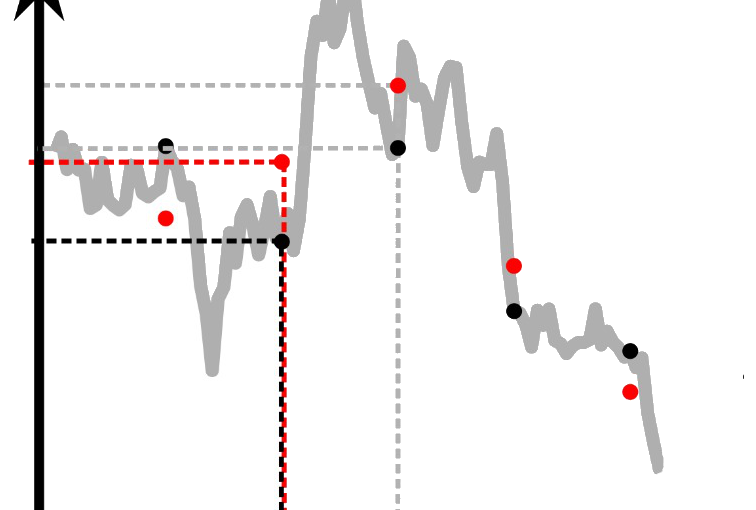
Different sampling methods for the trajectory of a particle. (Adapted from the manuscript.)Optimal calibration of optical tweezers with arbitrary integration time and sampling frequencies — A general framework
Laura Pérez-García, Martin Selin, Antonio Ciarlo, Alessandro Magazzù, Giuseppe Pesce, Antonio Sasso, Giovanni Volpe, Isaac Pérez Castillo, Alejandro V. Arzola
Biomedical Optics Express, 14, 6442-6469 (2023)
doi: 10.1364/BOE.495468
arXiv: 2305.07245
Optical tweezers (OT) have become an essential technique in several fields of physics, chemistry, and biology as precise micromanipulation tools and microscopic force transducers. Quantitative measurements require the accurate calibration of the trap stiffness of the optical trap and the diffusion constant of the optically trapped particle. This is typically done by statistical estimators constructed from the position signal of the particle, which is recorded by a digital camera or a quadrant photodiode. The finite integration time and sampling frequency of the detector need to be properly taken into account. Here, we present a general approach based on the joint probability density function of the sampled trajectory that corrects exactly the biases due to the detector’s finite integration time and limited sampling frequency, providing theoretical formulas for the most widely employed calibration methods: equipartition, mean squared displacement, autocorrelation, power spectral density, and force reconstruction via maximum-likelihood-estimator analysis (FORMA). Our results, tested with experiments and Monte Carlo simulations, will permit users of OT to confidently estimate the trap stiffness and diffusion constant, extending their use to a broader set of experimental conditions.