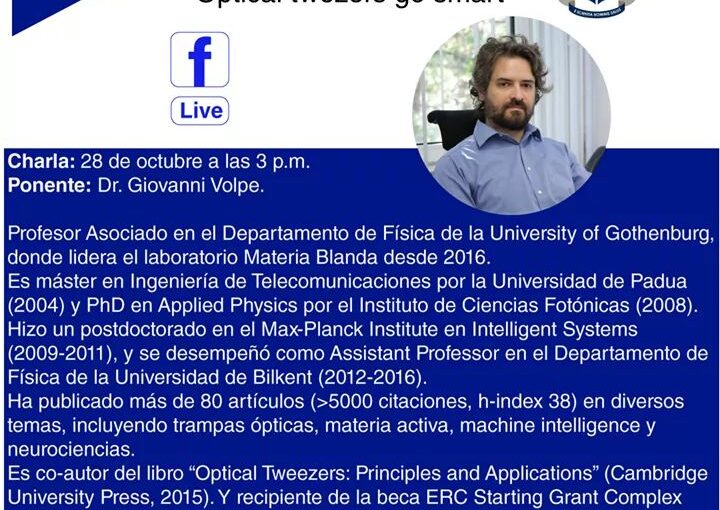
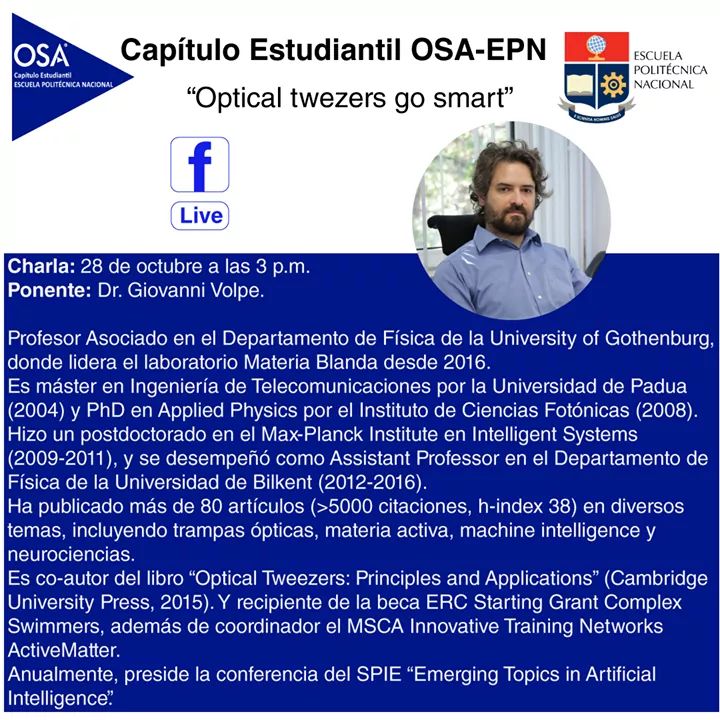
 Optical Tweezers Go Smart
Giovanni Volpe
28 October 2020, 15:00
Invited Talk (Online) at OSA-EPN Student Chapter, Escuela Politécnica Nacional, Ecuador
Category: Presentation
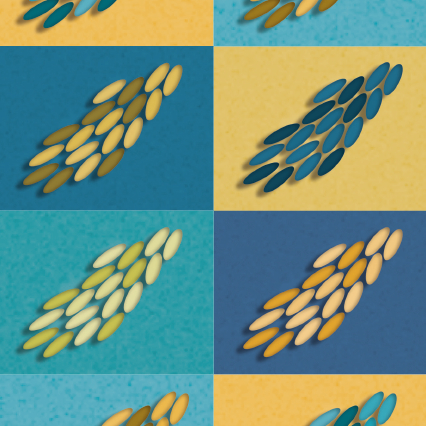
Keynote talk by G. Volpe at the Online Conference Motile Active Matter, 26 October 2020
Active Matter Meets Machine Learning: Opportunities and Challenges
Giovanni Volpe
26 October 2020, 13:45 CEST
Keynote talk (Online) at the Online Conference Motile Active Matter, Jülich Förschungszentrum, 26 October 2020
Abstract: Machine-learning methods are starting to shape active-matter research. Which new trends will this start? Which new groundbreaking insight and applications can we expect? More fundamentally, what can this contribute to our understanding of active matter? Can this help us to identify unifying principles and systematise active matter? This presentation addresses some of these questions with some concrete examples, exploring how machine learning is steering active matter towards new directions, offering unprecedented opportunities and posing practical and fundamental challenges. I will illustrate some most successful recent applications of machine learning to active matter with a slight bias towards work done in my research group: enhancing data acquisition and analysis [1, 2]; providing new data-driven models; improving navigation and search strategies [3, 4]; offering insight into the emergent dynamics of active matter in crowded and complex environments. I will discuss the opportunities and challenges that are emerging: implementing feedback control; uncovering underlying principles to systematise active matter; understanding the behaviour, organisation and evolution of biological active matter; realising active matter with embodied intelligence. Finally, I will highlight how active matter and machine learning can work together for mutual benefit.
References
[1] S. Helgadottir, A. Argun, G. Volpe, Digital video microscopy enhanced by deep learning. Optica 6, 506–513 (2019)
[2] S. Bo, F. Schmidt, R. Eichhorn, G. Volpe, Measurement of anomalous diffusion using recurrent neural networks. Phys. Rev. E 100, 010102(R) (2019)
[3] G. Volpe, G. Volpe, The topography of the environment alters the optimal search strategy for active particles. Proc. Natl. Acad. Sci. 114, 11350–11355 (2017)
[4] S. Colabrese, K. Gustavsson, A. Celani, L. Biferale, Flow navigation by smart microswimmers via reinforcement learning. Phys. Rev. Lett. 118, 158004 (2017).
Online seminar by G. Volpe at DiSTAP, Singapore-MIT Alliance for Research and Technology (SMART) Centre
Quantitative Digital Microscopy with Deep Learning
Giovanni Volpe
22 October 2020, 14:00 CEST
Invited Seminar (Online) at Disruptive & Sustainable Technologies for Agricultural Precision (DiSTAP), Singapore-MIT Alliance for Research and Technology (SMART) Centre, Singapore & Boston (MA)
Abstract: Video microscopy has a long history of providing insights and breakthroughs for a broad range of disciplines, from physics to biology. Image analysis to extract quantitative information from video microscopy data has traditionally relied on algorithmic approaches, which are often difficult to implement, time consuming, and computationally expensive. Recently, alternative data-driven approaches using deep learning have greatly improved quantitative digital microscopy, potentially offering automatized, accurate, and fast image analysis. However, the combination of deep learning and video microscopy remains underutilized primarily due to the steep learning curve involved in developing custom deep-learning solutions. To overcome this issue, we introduce a software, DeepTrack 2.0, to design, train and validate deep-learning solutions for digital microscopy. We use it to exemplify how deep learning can be employed for a broad range of applications, from particle localization, tracking and characterization to cell counting and classification. Thanks to its user-friendly graphical interface, DeepTrack 2.0 can be easily customized for user-specific applications, and, thanks to its open-source object-oriented programming, it can be easily expanded to add features and functionalities, potentially introducing deep-learning-enhanced video microscopy to a far wider audience.
References:
Benjamin Midtvedt, Saga Helgadottir, Aykut Argun, Jesús Pineda, Daniel Midtvedt, Giovanni Volpe, “Quantitative Digital Microscopy with Deep Learning”, arXiv:2010.08260 (2020)

Presentation by F. Schmidt on Career Transition from Research to Entrepreneurship, 14 October 2020

From basic research to founding a startup company: A personal journey to the unknown
Falko Schmidt
Career Seminar, Online, University of Gothenburg, Sweden
14 October 2020, 11:30-13:00
26 November 2020, 11:30-13:00
I am currently a PhD student at the Physics Department of the University of Gothenburg and will defend at the beginning of 2021. For a couple of years I have been playing with different ideas for a startup already, involving technical solutions developed during my time as PhD and was looking for their applications in the real world. After a couple of failures I have recently founded my own startup company Lucero AB. We will develop automated optical manipulation solutions for single cell analysis with applications in research on longevity, viral diseases and in the pharmaceutical industry. During this seminar I will share my insights on how to find ideas, how to validate them and the process towards creating a startup company.
This seminar is a recurring seminar and it is part of the Career Development and Entrepreneurship series initiated by the Faculty of Science. It will take place during the autumn 2020 and spring 2021.
Please check the links below for the planned dates:
14 October: Career seminars for PhD students at the Dept of Biological and Environmental Sciences and the Dept of Marine Sciences
26 November: Career seminars for PhD students at the Dept of Mathematical Sciences (GU and Chalmers)
Additional dates will be added later.
Invited talk by G. Volpe at GSJP, 1 October 2020
Giovanni Volpe will give an online invited presentation at the First Global Symposium on Janus Particles (GSJP) 2020.
GSJP will bring together a collection of experts who are in the vanguard of scientific and engineering investigations on Janus particles all around the globe.
The contribution of Giovanni Volpe will be presented according to the following schedule:
Giovanni Volpe
Light-controlled Assembly of Active Colloidal Molecules
Activity and life have emerged from a primordial broth of simple building blocks when the presence of energy flows made these blocks come together and interact in non-trivial ways. Here, we use experiments and simulations demonstrating that active molecules can be created and controlled by light. Shining light on a primordial broth containing passive particles of two different species, we create active colloidal molecules of increasing complexity, which behave as migrators, spinners and rotators. This demonstrates a powerful new route for nonequilibrium self-assembly, which may help explaining the emergence of complex systems in living matter and may also proof useful as a design principle for the construction of flexible micromotors and cargo transport in health care applications.
Date: 1 October 2020
Time: 10:10 (EST)
Place: Online
Presentation by S. Helgadottir at the Gothenburg Science Festival, 2 October 2020
Saga Helgadottir will give a presentation at the Gothenburg Science Festival 2020.
The International Science Festival Gothenburg is one of Europe’s leading popular science events. Its first edition dates back to 1997, and it is held every year in spring.
This year the festival will take place during autumn, 28 September-4 October. Due to the current situation the festival will be a digital event. The digital festival will be available during the week of the festival.
The contribution of Saga Helgadottir will be presented according to the following schedule:
Saga Helgadottir
Deep Learning for Object Recognition
Deep Learning is a machine learning technique that teaches computers to do what comes naturally to humans: learn by example. In this talk, I will show how Deep Learning can be used to identify objects in images, in particular microscopic particles.
Date: 2 October 2020
Time: 18:08
Duration: 17′
Link: Deep Learning for Object Recognition
Links:
Vetenskapsfestivalen Göteborg (in Swedish)
The International Science Festival Gothenburg (in English)
Full Program
Invited talk by G. Volpe at SCOP2020, 25 September 2020
Giovanni Volpe will give an online invited presentation at the Student Conference on Optics and Photonics (SCOP), organized by the OSA student chapter of Physical Research Laboratory, Ahmedabad, India.
The conference addresses various topics in optics with an emphasis on non linear optics and quantum optics, will be held during 23-25 September, 2020 at the Physical Research Laboratory (PRL), Ahmedabad, India.
The conference includes invited talks by eminent scientists from India and abroad, as well as posters and oral presentations by student participants and research fellows.
The contribution of Giovanni Volpe will be presented according to the following schedule:
Giovanni Volpe
Deep Learning for microscopy and optical trapping
Date: 25 September 2020
Time: 15:10 IST (GMT+5:30)
Place: Online
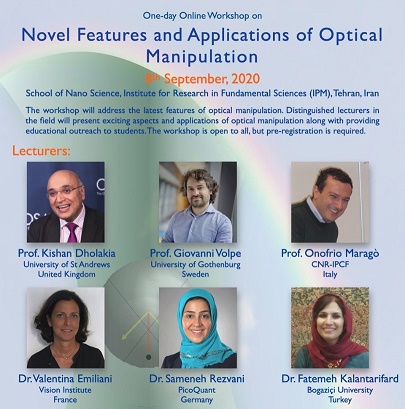
E-workshop: Novel Features and Applications of Optical Manipulation
The School of Nano Science, IPM, Tehran, Iran, with the support of IASBS, Zanjan, Iran, is organizing a one-day e-workshop on
Novel Features and Applications of Optical Manipulation
on September 8th, 2020.
The workshop will address the latest features of optical manipulation. Distinguished lecturers in the field will present exciting aspects and applications of optical manipulation along with providing educational outreach to students.
The workshop is open to all and it is free, but pre-registration is required. Registration dates: between 10 and 25 August.
Invited lecturers:
Prof. Kishan Dolakia
Prof. Giovanni Volpe
Prof. Onofrio Maragò
Dr. Valentina Emiliani
Dr. Samaneh Rezvani
Dr. Fatemeh Kalandarifard
Organizers:
Dr. Alireza Moradi
Prof. Reza Asgari
Date: 8 September 2020
Link: Workshop Homepage, Registration

Soft Matter Lab presentations at the SPIE Optics+Photonics Digital Forum
Seven members of the Soft Matter Lab (Saga Helgadottir, Benjamin Midtvedt, Aykut Argun, Laura Pérez-Garcia, Daniel Midtvedt, Harshith Bachimanchi, Emiliano Gómez) were selected for oral and poster presentations at the SPIE Optics+Photonics Digital Forum, August 24-28, 2020.
The SPIE digital forum is a free, online only event.
The registration for the Digital Forum includes access to all presentations and proceedings.
The Soft Matter Lab contributions are part of the SPIE Nanoscience + Engineering conferences, namely the conference on Emerging Topics in Artificial Intelligence 2020 and the conference on Optical Trapping and Optical Micromanipulation XVII.
The contributions being presented are listed below, including also the presentations co-authored by Giovanni Volpe.
Note: the presentation times are indicated according to PDT (Pacific Daylight Time) (GMT-7)
Emerging Topics in Artificial Intelligence 2020
Saga Helgadottir
Digital video microscopy with deep learning (Invited Paper)
26 August 2020, 10:30 AM
SPIE Link: here.
Aykut Argun
Calibration of force fields using recurrent neural networks
26 August 2020, 8:30 AM
SPIE Link: here.
Laura Pérez-García
Deep-learning enhanced light-sheet microscopy
25 August 2020, 9:10 AM
SPIE Link: here.
Daniel Midtvedt
Holographic characterization of subwavelength particles enhanced by deep learning
24 August 2020, 2:40 PM
SPIE Link: here.
Benjamin Midtvedt
DeepTrack: A comprehensive deep learning framework for digital microscopy
26 August 2020, 11:40 AM
SPIE Link: here.
Gorka Muñoz-Gil
The anomalous diffusion challenge: Single trajectory characterisation as a competition
26 August 2020, 12:00 PM
SPIE Link: here.
Meera Srikrishna
Brain tissue segmentation using U-Nets in cranial CT scans
25 August 2020, 2:00 PM
SPIE Link: here.
Juan S. Sierra
Automated corneal endothelium image segmentation in the presence of cornea guttata via convolutional neural networks
26 August 2020, 11:50 AM
SPIE Link: here.
Harshith Bachimanchi
Digital holographic microscopy driven by deep learning: A study on marine planktons (Poster)
24 August 2020, 5:30 PM
SPIE Link: here.
Emiliano Gómez
BRAPH 2.0: Software for the analysis of brain connectivity with graph theory (Poster)
24 August 2020, 5:30 PM
SPIE Link: here.
Optical Trapping and Optical Micromanipulation XVII
Laura Pérez-García
Reconstructing complex force fields with optical tweezers
24 August 2020, 5:00 PM
SPIE Link: here.
Alejandro V. Arzola
Direct visualization of the spin-orbit angular momentum conversion in optical trapping
25 August 2020, 10:40 AM
SPIE Link: here.
Isaac Lenton
Illuminating the complex behaviour of particles in optical traps with machine learning
26 August 2020, 9:10 AM
SPIE Link: here.
Fatemeh Kalantarifard
Optical trapping of microparticles and yeast cells at ultra-low intensity by intracavity nonlinear feedback forces
24 August 2020, 11:10 AM
SPIE Link: here.
Note: the presentation times are indicated according to PDT (Pacific Daylight Time) (GMT-7)
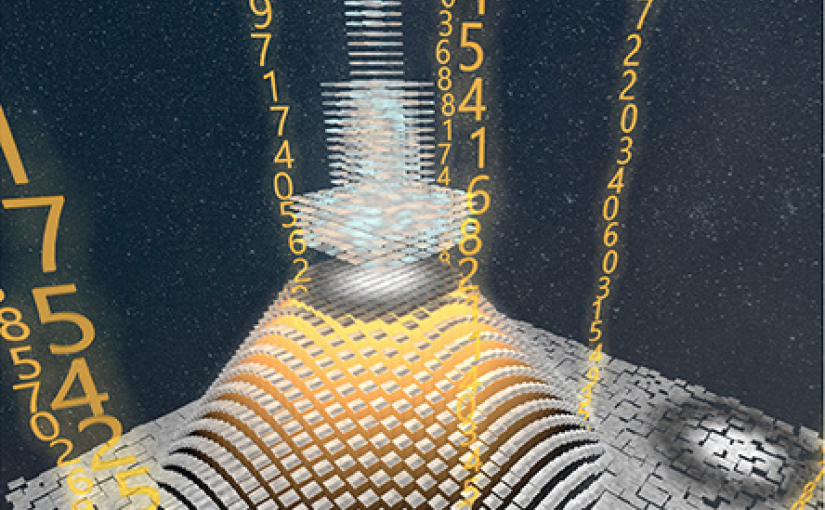
Digital video microscopy with deep learning
Digital video microscopy with deep learning
Saga Helgadottir
(Invited paper)
Microscopic particle tracking has had a long history of providing insight and breakthroughs within the physical and biological sciences, starting with Jean Perrin proved the existens of atoms in 1910 by projecting images of microscopic colloidal particles onto a sheet of paper and manually tracking their displacements. From the start of digital video microscopy over 20 years ago, automated single particle tracking algorithms have followed a similar pattern: pre-processing of the image to reduce noise, segmentation of the image to identify the features of interest, refining of these feature coordinates to sub-pixel accuracy and linking of the feature coordinates over several images to construct particle trajectories. By fine-tuning several user-defined parameters, these methods can be highly successful at tracking a well-defined kind of particle in good imaging conditions. However, their performance degrades severely at unsteady imaging conditions.
To overcome the limitations of traditional algorithmic approaches, data-driven methods using deep learning have been introduced. Deep-learning algorithms based on convolutional neural networks have been shown to accurately localize holographic colloidal particles and fluorescent biological objects. We have recently developed DeepTrack, a software package based on a convolutional neural network that outperforms algorithmic approaches in tracking colloidal particles as well as non spherical biological objects, especially in the presence of noise and under poor illumination conditions.
In this talk I will give an overview of the history of particle tracking before explaining the details of our solution DeepTrack and finally give an outlook on the field of deep learning in microscopy.
Time and place: Presentation published online on 24 August 2020
SPIE Link: here.