Metastable clusters and channels formed by active particles with aligning interactions
Metastable clusters and channels formed by active particles with aligning interactions
Simon Nilsson & Giovanni Volpe
New Journal of Physics 19, 115008 (2017)
DOI: 10.1088/1367-2630/aa9516
arXiv: 1706.01326
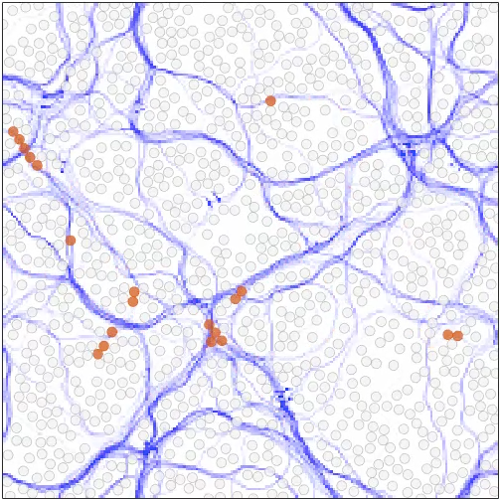
We introduce a novel model for active particles with short-range position-dependent aligning interactions and study their behaviour in crowded environments using numerical simulations. When only active particles are present, we observe a transition from a gaseous state to the emergence of metastable clusters as the level of orientational noise is reduced. When passive particles are also present, we observe the emergence of a network of metastable channels.
Experimental realization of a minimal microscopic heat engine
Experimental realization of a minimal microscopic heat engine
Aykut Argun, Jalpa Soni, Lennart Dabelow, Stefano Bo, Giuseppe Pesce, Ralf Eichhorn & Giovanni Volpe
Physical Review E 96(5), 052106 (2017)
DOI: 10.1103/PhysRevE.96.052106
arXiv: 1708.07197
Microscopic heat engines are microscale systems that convert energy flows between heat reservoirs into work or systematic motion. We have experimentally realized a minimal microscopic heat engine. It consists of a colloidal Brownian particle optically trapped in an elliptical potential well and simultaneously coupled to two heat baths at different temperatures acting along perpendicular directions. For a generic arrangement of the principal directions of the baths and the potential, the symmetry of the system is broken, such that the heat flow drives a systematic gyrating motion of the particle around the potential minimum. Using the experimentally measured trajectories, we quantify the gyrating motion of the particle, the resulting torque that it exerts on the potential, and the associated heat flow between the heat baths. We find excellent agreement between the experimental results and the theoretical predictions.
The topography of the environment alters the optimal search strategy for active particles
The topography of the environment alters the optimal search strategy for active particles
Giorgio Volpe & Giovanni Volpe
Proceedings of the National Academy of Science USA 114(43), 11350—11355 (2017)
DOI: 10.1073/pnas.1711371114
arXiv: 1706.07785
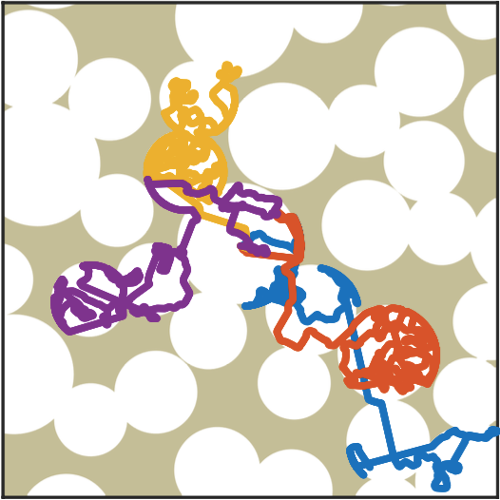
In environments with scarce resources, adopting the right search strategy can make the difference between succeeding and failing, even between life and death. At different scales, this applies to molecular encounters in the cell cytoplasm, to animals looking for food or mates in natural landscapes, to rescuers during search-and- rescue operations in disaster zones, and to genetic computer algo- rithms exploring parameter spaces. When looking for sparse targets in a homogeneous environment, a combination of ballistic and diffusive steps is considered optimal; in particular, more ballistic Lévy flights with exponent α ≤ 1 are generally believed to optimize the search process. However, most search spaces present complex to- pographies. What is the best search strategy in these more realistic scenarios? Here we show that the topography of the environment significantly alters the optimal search strategy towards less ballistic and more Brownian strategies. We consider an active particle performing a blind cruise search for non-regenerating sparse targets in a two-dimensional space with steps drawn from a Lévy distribution with exponent varying from α = 1 to α = 2 (Brownian). We demon- strate that, when boundaries, barriers and obstacles are present, the optimal search strategy depends on the topography of the environ- ment with α assuming intermediate values in the whole range under consideration. We interpret these findings using simple scaling arguments and discuss their robustness to varying searcher’s size. Our results are relevant for search problems at different length scales, from animal and human foraging, to microswimmers’ taxis, to bio- chemical rates of reaction.
Oleksii Bielikh defended his Master thesis in Complex Adaptive Systems at Chalmers University of Technology on 5 October 2017.
Thesis title: Generation of Random Graphs for Graph Theory Analysis Applied to the Study of Brain Connectivity
Thesis advisor: Giovanni Volpe
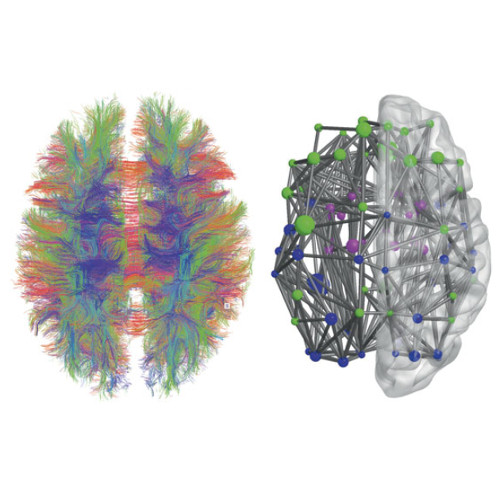
One of the current frontiers in neurosciences is to understand brain connectivity both in healthy subjects and patients. Recent studies suggest that brain connectivity measured with graph theory is a reliable candidate biomarker of neuronal dysfunction and disease spread in neurodegenerative disorders. Widespread abnormalities in the topology of the cerebral networks in patients correlate with a higher risk of developing dementia and worse prognosis.
In order to recognize such abnormalities, brain network graph measures should be compared with the corresponding measures calculated on random graphs with the same degree distribution. However, creating a random graph with prescribed degree sequence that has number of nodes of magnitude of 105 is a recognized problem. Existing algorithms have a variety of shortcomings, among which are slow run-time, non-uniformity of results and divergence of degree distribution with the target one.
The goal of this thesis is to explore the possibility of finding an algorithm that can be used with very large networks. Multiple common algorithms were tested to check their scaling with increasing number of nodes. The results are compared in order to find weaknesses and strengths of particular algorithms, and certain changes are offered that speed up their runtimes and/or correct for the downsides. The degree distributions of the resulting random graphs are compared to those of the target graphs, which are constructed in a way that mimics some of the most common characteristics of brain networks, namely small-worldness and scale-free topology, and it is discussed why some of the models are more appropriate than others in this case. Simulations prove that the majority of algorithms are vastly inefficient in creating random large graphs with necessary limitations on their topology, while some can be adapted to showcase to a certain extent promising results.
Abnormal structural brain connectome in individuals with preclinical Alzheimer’s disease
Abnormal structural brain connectome in individuals with preclinical Alzheimer’s disease
Joana B. Pereira, Danielle van Westen, Erik Stomrud, Tor Olof Strandberg, Giovanni Volpe, Eric Westman & Oskar Hansson
Cerebral Cortex 28(10), 3638—3649 (2018)
DOI: 10.1093/cercor/bhx236
Alzheimer’s disease has a long preclinical phase during which amyloid pathology and neurodegeneration accumulate in the brain without producing overt cognitive deficits. It is currently unclear whether these early disease stages are associated with a progressive disruption in the communication between brain regions that subsequently leads to cognitive decline and dementia. In this study we assessed the organization of structural networks in cognitively normal (CN) individuals harboring amyloid pathology (A+N−), neurodegeneration (A−N+), or both (A+N+) from the prospective and longitudinal Swedish BioFINDER study. We combined graph theory with diffusion tensor imaging to investigate integration, segregation, and centrality measures in the brain connectome in the previous groups. At baseline, our findings revealed a disrupted network topology characterized by longer paths, lower efficiency, increased clustering and modularity in CN A−N+ and CN A+N+, but not in CN A+N−. After 2 years, CN A+N+ showed significant abnormalities in all global network measures, whereas CN A−N+ only showed abnormalities in the global efficiency. Network connectivity and organization were associated with memory in CN A+N+ individuals. Altogether, our findings suggest that amyloid pathology is not sufficient to disrupt structural network topology, whereas neurodegeneration is.
BRAPH: A graph theory software for the analysis of brain connectivity
BRAPH: A graph theory software for the analysis of brain connectivity
Mite Mijalkov, Ehsan Kakaei, Joana B. Pereira, Eric Westman & Giovanni Volpe
PLoS ONE 12(8), e0178798 (2017)
DOI: 10.1371/journal.pone.0178798
bioRxiv: 106625
The brain is a large-scale complex network whose workings rely on the interaction between its various regions. In the past few years, the organization of the human brain network has been studied extensively using concepts from graph theory, where the brain is represented as a set of nodes connected by edges. This representation of the brain as a connectome can be used to assess important measures that reflect its topological architecture. We have developed a freeware MatLab-based software (BRAPH–BRain Analysis using graPH theory) for connectivity analysis of brain networks derived from structural magnetic resonance imaging (MRI), functional MRI (fMRI), positron emission tomography (PET) and electroencephalogram (EEG) data. BRAPH allows building connectivity matrices, calculating global and local network measures, performing non-parametric permutations for group comparisons, assessing the modules in the network, and comparing the results to random networks. By contrast to other toolboxes, it allows performing longitudinal comparisons of the same patients across different points in time. Furthermore, even though a user-friendly interface is provided, the architecture of the program is modular (object-oriented) so that it can be easily expanded and customized. To demonstrate the abilities of BRAPH, we performed structural and functional graph theory analyses in two separate studies. In the first study, using MRI data, we assessed the differences in global and nodal network topology in healthy controls, patients with amnestic mild cognitive impairment, and patients with Alzheimer’s disease. In the second study, using resting-state fMRI data, we compared healthy controls and Parkin- son’s patients with mild cognitive impairment.
Two-dimensional nature of the active Brownian motion of catalytic microswimmers at solid and liquid interfaces
Two-dimensional nature of the active Brownian motion of catalytic microswimmers at solid and liquid interfaces
Kilian Dietrich, Damian Renggli, Michele Zanini, Giovanni Volpe, Ivo Buttinoni & Lucio Isa
New Journal of Physics 19, 065008 (2017)
DOI: 10.1088/1367-2630/aa7126
Colloidal particles equipped with platinum patches can establish chemical gradients in H2O2-enriched solutions and undergo self-propulsion due to local diffusiophoretic migration. In bulk (3D), this class of active particles swim in the direction of the surface heterogeneities introduced by the patches and consequently reorient with the characteristic rotational diffusion time of the colloids. In this article, we present experimental and numerical evidence that planar 2D confinements defy this simple picture. Instead, the motion of active particles both on solid substrates and at flat liquid–liquid interfaces is captured by a 2D active Brownian motion model, in which rotational and translational motion are constrained in the xy-plane. This leads to an active motion that does not follow the direction of the surface heterogeneities and to timescales of reorientation that do not match the free rotational diffusion times. Furthermore, 2D-confinement at fluid–fluid interfaces gives rise to a unique distribution of swimming velocities: the patchy colloids uptake two main orientations leading to two particle populations with velocities that differ up to one order of magnitude. Our results shed new light on the behavior of active colloids in 2D, which is of interest for modeling and applications where confinements are present.
Simon Nilsson defended his Master thesis in Complex Adaptive Systems at Chalmers University of Technology on 14 June 2017.
Thesis title: Collective Dynamics in a Complex Environment
Thesis advisor: Giovanni Volpe
Collective behaviour is a phenomenon that often occurs in systems of many interacting individuals. Common macroscopic examples of collective behaviour are flocks of birds, swarms of insects and crowds of people. On the microscopic scale, it is often observed in so-called active systems, constituted by self-propelled particles, also known as active particles. Motile bacteria or synthetic microswim- mers are among the most commonly studied active particles.
The potential applications of collective behaviour and understanding thereof encompass multiple disciplines, ranging from robotics and medicine to algorithms, like ant colony optimization. However, the apparent complexity makes under- standing an intimidating task. Despite this, simple models have proven successful in capturing the defining characteristics of such systems.
This thesis examines a well-known model of active matter and expands it to incorporate necessary components to explore the effects a complex environment has on this pre-existing model. Additionally, a new model is proposed and explored in purely active systems as well as in complex environments. Simulations show that a phase transition between a gaseous state and the formation of metastable clusters occurs as the level of orientational noise decreases. Furthermore, they show that this model describes the formation of metastable channels in a crowded environment of passive particles.
Lovisa Hagstöm, Erik Holmberg, Eliza Nordén, Teodor Norrestad, Martin Selin & Lisa Sjöblom defended their Bachelor Thesis at Chambers University of Technology on 23 May 2017.
Title: Autonoma agenter i komplexa miljöer — En studie av tidsfördröjningens inverkan på kollektiva beteenden
Abstract: Interagerande autonoma agenter är ett högintressant och relativt outforskat område. Syftet med detta arbete är att utforska grundläggande metoder för att simulera aktiva agenter som påverkas av ett intensitetsfält med en fördröjning. Fördröjningen mellan agentens indata och dess reaktion på denna visar sig vara väsentlig vad gäller styrandet av dess beteende. Efter att de grundläggande metoderna är etablerade ämnar återstoden av arbetet att fördjupa sig i tre olika aspekter av autonoma agenter. Den rotationella diffusionskoefficienten, DR, visar sig vara en parameter som likt farten kan användas för att styra agenternas beteende. Dock syns inga kvalitativa skillnader i beteendet om inte en fördröjning införs. Med en positiv fördröjning söker sig agenterna till områden med stort DR och med en negativ söker de sig till områden med litet DR. Intressanta beteenden framkallas också genom att låta en aktiv agent röra sig i en propagerande vågpotential, både i en och två dimensioner. För det endimensionella vågfallet kan man med hjälp av fördröjningen styra om agenten färdas mot eller från vågkällan. Agenter som interagerar via tvådimensionella vågpulser kan manipuleras till att samlas eller sprida sig, beroende på fördröjningens karaktär. Slutligen utreds möjligheterna att använda autonoma aktiva agenter för att simulera rovdjur och bytesdjur. För att realisera detta används fördröjningen som styrande parameter. Utöver detta utvecklas en enkel evolutionsalgoritm där byten och rovdjur visar sig kunna anpassa sig efter varandra. Fördröjningar visar sig överlag vara ett kraftfullt verktyg för att påverka beteendet hos aktiva agenter med stor potential i framtida applikationer.
Supervisor: Giovanni Volpe, Department of Physics, University of Gothenburg Examiner: Lena Falk, Department of Physics, University of Gothenburg
Small Mass Limit of a Langevin Equation on a Manifold
Small Mass Limit of a Langevin Equation on a Manifold
Jeremiah Birrell, Scott Hottovy, Giovanni Volpe & Jan Wehr
Annales Henri Poincaré 18(2), 707—755 (2017)
DOI: 10.1007/s00023-016-0508-3
arXiv: 1604.04819
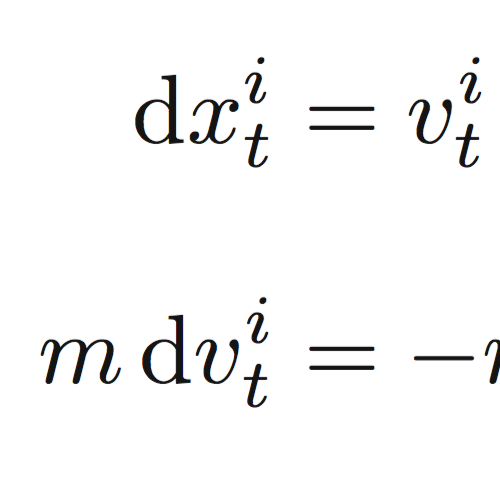
We study damped geodesic motion of a particle of mass m on a Riemannian manifold, in the presence of an external force and noise. Lifting the resulting stochastic differential equation to the orthogonal frame bundle, we prove that, as m → 0, its solutions converge to solutions of a limiting equation which includes a noise-induced drift term. A very special case of the main result presents Brownian motion on the manifold as a limit of inertial systems.