Casimir forces investigated by blinking optical tweezers
Agnese Callegari
Flowing Matter 2018, Lisbon, Portugal
5-9 February 2018
News
Microscopic Critical Engine published in Phys. Rev. Lett.
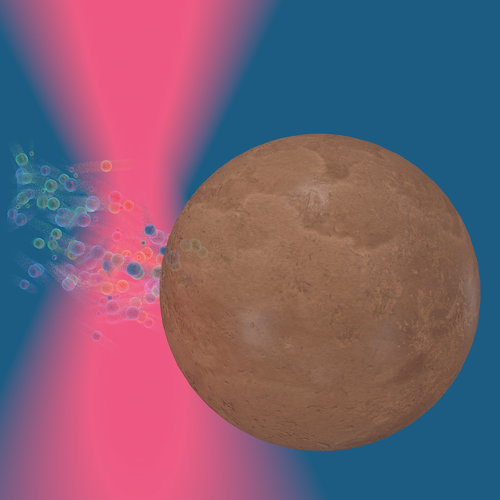
Microscopic engine powered by critical demixing
Falko Schmidt, Alessandro Magazzù, Agnese Callegari, Luca Biancofiore, Frank Cichos & Giovanni Volpe
Physical Review Letters 120(6), 068004 (2018)
DOI: 10.1103/PhysRevLett.120.068004
arXiv: 1705.03317
We experimentally demonstrate a microscopic engine powered by the local reversible demixing of a critical mixture. We show that, when an absorbing microsphere is optically trapped by a focused laser beam in a sub-critical mixture, it is set into rotation around the optical axis of the beam because of the emergence of diffusiophoretic propulsion. This behavior can be controlled by adjusting the optical power, the temperature, and the criticality of the mixture.
Featured in :
“Focus: A Tiny Engine Powered by Light and Liquid Physics”, Physics 11, 16 (February 9, 2018)
“Laser + Critical Liquid = Micro-Engine”, Optics & Photonics News (February 12, 2018)
“Tiny engine powered by demixing fluid” Phys.Org (February 12, 2018)
“Расслаивание растворителя закрутило микрочастицы вокруг лазерного пучка”, N+1: научные статьи, новости, открытия (February 12, 2018)
“Tiny engine powered by remixing fluid”, Brinkwire (February 16, 2018)
Seminar by G. Volpe at Institute of Protein Biochemistry (CNR), Naples, 25 Jan 2018
Active Matter in Complex and Crowded Environments
Giovanni Volpe
Institute of Protein Biochemistry, National Research Council (CNR), Naples, Italy
25 January 2018
Dynamic Deposition of Particles in Evaporating Droplets published in J. Phys. Chem. Lett.
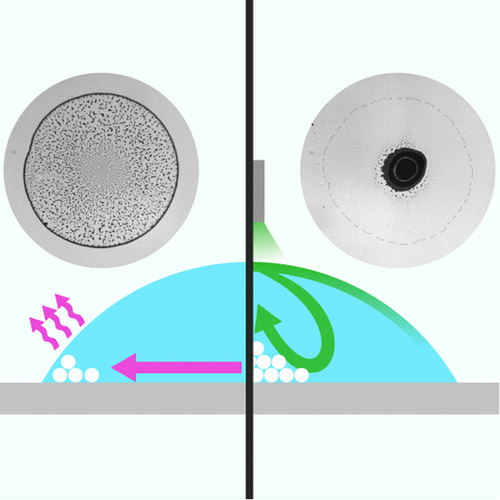
Dynamic control of particle deposition in evaporating droplets by an external point source vapor
Robert Malinowski, Giovanni Volpe, Ivan Parkin & Giorgio Volpe
The Journal of Physical Chemistry Letters 9(3), 659—664 (2018)
DOI: 10.1021/acs.jpclett.7b02831
arXiv: 1801.08218
The deposition of particles on a surface by an evaporating sessile droplet is important for phenomena as diverse as printing, thin-film deposition, and self-assembly. The shape of the final deposit depends on the flows within the droplet during evaporation. These flows are typically determined at the onset of the process by the intrinsic physical, chemical, and geometrical properties of the droplet and its environment. Here, we demonstrate deterministic emergence and real-time control of Marangoni flows within the evaporating droplet by an external point source of vapor. By varying the source location, we can modulate these flows in space and time to pattern colloids on surfaces in a controllable manner.
Maximilian Leyman joins the Soft Matter Lab
Maximilian Leyman joined the Soft Matter Lab on 15 January 2018.
He is a Master student in the Complex Adaptive Systems Master at Chalmers University of Technology.
He will work on his Master thesis on the numerical study of the motion of robots with sensorial feedback.
Freddie Ogemark joins the Soft Matter Lab
Freddie Ogemark joined the Soft Matter Lab on 12 January 2018.
He is a Master student in the Complex Adaptive Systems Master at Chalmers University of Technology.
He will work on his Master thesis on the experimental study of the motion of robots with sensorial feedback.
Altered Brain Network in Amyloid Pathology published in Neurobiol. Aging
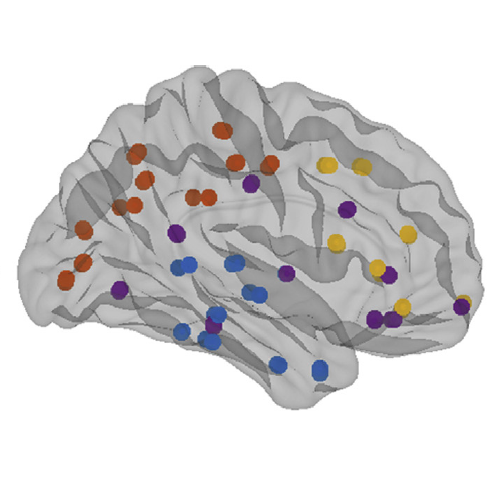
Altered structural network organization in cognitively normal individuals with amyloid pathology
Olga Voevodskaya, Joana B. Pereira, Giovanni Volpe, Olof Lindberg, Erik Stomrud, Danielle van Westen, Eric Westman & Oskar Hansson
Neurobiology of Aging 64, 15—24 (2018)
DOI: 10.1016/j.neurobiolaging.2017.11.014
Recent findings show that structural network topology is disrupted in Alzheimer’s disease (AD), with changes occurring already at the prodromal disease stages. Amyloid accumulation, a hallmark of AD, begins several decades before symptom onset, and its effects on brain connectivity at the earliest disease stages are not fully known. We studied global and local network changes in a large cohort of cognitively healthy individuals (N = 299, Swedish BioFINDER study) with and without amyloid-β (Aβ) pathology (based on cerebrospinal fluid Aβ42/Aβ40 levels). Structural correlation matrices were constructed based on magnetic resonance imaging cortical thickness data. Despite the fact that no significant regional cortical atrophy was found in the Aβ-positive group, this group exhibited an altered global network organization, including decreased global efficiency and modularity. At the local level, Aβ-positive individuals displayed fewer and more disorganized modules as well as a loss of hubs. Our findings suggest that changes in network topology occur already at the presymptomatic (preclinical) stage of AD and may precede detectable cortical thinning.
Amyloid Network Topology in Alzheimer published in Cerebral Cortex
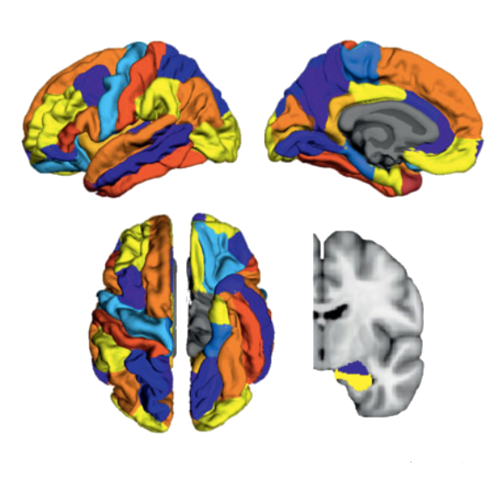
Amyloid network topology characterizes the progression of Alzheimer’s disease during the predementia stages
Joana B. Pereira, Tor Olof Strandberg, Sebastian Palmqvist, Giovanni Volpe, Danielle van Westen, Eric Westman & Oskar Hansson, for the Alzheimer’s Disease Neuroimaging Initiative
Cerebral Cortex 28(1), 340—349 (2018)
DOI: 10.1093/cercor/bhx294
There is increasing evidence showing that the accumulation of the amyloid-β (Aβ) peptide into extracellular plaques is a central event in Alzheimer’s disease (AD). These abnormalities can be detected as lowered levels of Aβ42 in the cerebrospinal fluid (CSF) and are followed by increased amyloid burden on positron emission tomography (PET) several years before the onset of dementia. The aim of this study was to assess amyloid network topology in nondemented individuals with early stage Aβ accumulation, defined as abnormal CSF Aβ42 levels and normal Florbetapir PET (CSF+/PET−), and more advanced Aβ accumulation, defined as both abnormal CSF Aβ42 and Florbetapir PET (CSF+/PET+). The amyloid networks were built using correlations in the mean 18F-florbetapir PET values between 72 brain regions and analyzed using graph theory analyses. Our findings showed an association between early amyloid stages and increased covariance as well as shorter paths between several brain areas that overlapped with the default-mode network (DMN). Moreover, we found that individuals with more advanced amyloid accumulation showed more widespread changes in brain regions both within and outside the DMN. These findings suggest that amyloid network topology could potentially be used to assess disease progression in the predementia stages of AD.
Metastable Clusters and Channels published in New J. Phys.
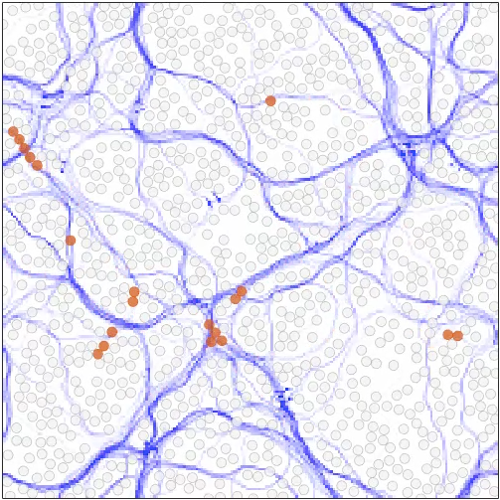
Metastable clusters and channels formed by active particles with aligning interactions
Simon Nilsson & Giovanni Volpe
New Journal of Physics 19, 115008 (2017)
DOI: 10.1088/1367-2630/aa9516
arXiv: 1706.01326
We introduce a novel model for active particles with short-range position-dependent aligning interactions and study their behaviour in crowded environments using numerical simulations. When only active particles are present, we observe a transition from a gaseous state to the emergence of metastable clusters as the level of orientational noise is reduced. When passive particles are also present, we observe the emergence of a network of metastable channels.
Minimal Microscopic Heat Engine published in Phys. Rev. E

Experimental realization of a minimal microscopic heat engine
Aykut Argun, Jalpa Soni, Lennart Dabelow, Stefano Bo, Giuseppe Pesce, Ralf Eichhorn & Giovanni Volpe
Physical Review E 96(5), 052106 (2017)
DOI: 10.1103/PhysRevE.96.052106
arXiv: 1708.07197
Microscopic heat engines are microscale systems that convert energy flows between heat reservoirs into work or systematic motion. We have experimentally realized a minimal microscopic heat engine. It consists of a colloidal Brownian particle optically trapped in an elliptical potential well and simultaneously coupled to two heat baths at different temperatures acting along perpendicular directions. For a generic arrangement of the principal directions of the baths and the potential, the symmetry of the system is broken, such that the heat flow drives a systematic gyrating motion of the particle around the potential minimum. Using the experimentally measured trajectories, we quantify the gyrating motion of the particle, the resulting torque that it exerts on the potential, and the associated heat flow between the heat baths. We find excellent agreement between the experimental results and the theoretical predictions.