News

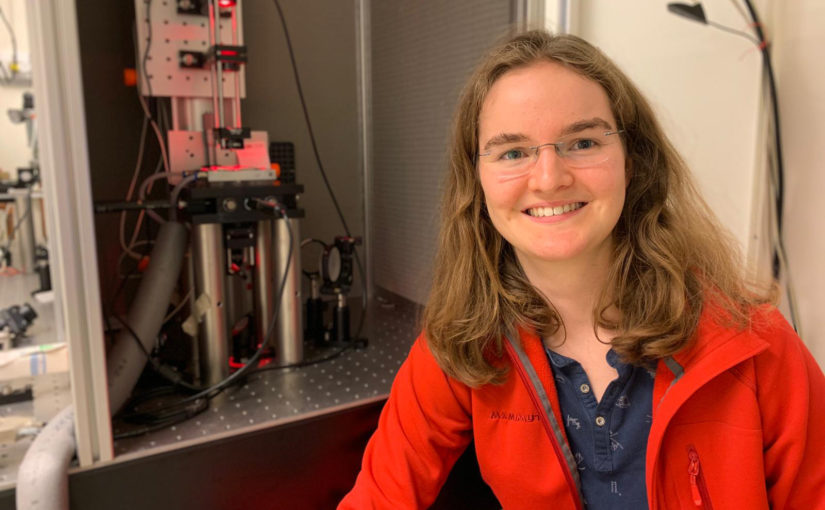
Presentation by Saga Helgadottir at the CECAM Workshop “Active Matter and Artificial Intelligence”, Lausanne, Switzerland, 30 September 2019

Digital video microscopy enhanced by deep learning

Saga Helgadottir, Aykut Argun & Giovanni Volpe
CECAM Workshop “Active Matter and Artificial Intelligence”, Lausanne, Switzerland
30 September 2019

Single particle tracking is essential in many branches of science and technology, from the measurement of biomolecular forces to the study of colloidal crystals. Standard methods rely on algorithmic approaches; by fine-tuning several user-defined parameters, these methods can be highly successful at tracking a well-defined kind of particle under low-noise conditions with constant and homogenous illumination. Here, we introduce an alternative data-driven approach based on a convolutional neural network, which we name DeepTrack. We show that DeepTrack outperforms algorithmic approaches, especially in the presence of noise and under poor illumination conditions. We use DeepTrack to track an optically trapped particle under very noisy and unsteady illumination conditions, where standard algorithmic approaches fail. We then demonstrate how DeepTrack can also be used to track multiple particles and non-spherical objects such as bacteria, also at very low signal-to-noise ratios. In order to make DeepTrack readily available for other users, we provide a Python software package, which can be easily personalized and optimized for specific applications.

Saga Helgadottir, Aykut Argun & Giovanni Volpe, Optica 6(4), 506—513 (2019)
doi: 10.1364/OPTICA.6.000506
arXiv: 1812.02653
GitHub: DeepTrack

03:40 PM–04:00 PM, Monday, September 30, 2019
Presentation by Saga Helgadottir at the AI for Health and Healthy AI conference, Gothenburg, Sweden, 30 August 2019

Digital video microscopy enhanced by deep learning

Saga Helgadottir, Aykut Argun & Giovanni Volpe
AI for Health and Healthy AI conference, Gothenburg, Sweden
30 August 2019

Single particle tracking is essential in many branches of science and technology, from the measurement of biomolecular forces to the study of colloidal crystals. Standard methods rely on algorithmic approaches; by fine-tuning several user-defined parameters, these methods can be highly successful at tracking a well-defined kind of particle under low-noise conditions with constant and homogenous illumination. Here, we introduce an alternative data-driven approach based on a convolutional neural network, which we name DeepTrack. We show that DeepTrack outperforms algorithmic approaches, especially in the presence of noise and under poor illumination conditions. We use DeepTrack to track an optically trapped particle under very noisy and unsteady illumination conditions, where standard algorithmic approaches fail. We then demonstrate how DeepTrack can also be used to track multiple particles and non-spherical objects such as bacteria, also at very low signal-to-noise ratios. In order to make DeepTrack readily available for other users, we provide a Python software package, which can be easily personalized and optimized for specific applications.

Friday, August 30, 2019

Saga Helgadottir, Aykut Argun & Giovanni Volpe, Optica 6(4), 506—513 (2019)
doi: 10.1364/OPTICA.6.000506
arXiv: 1812.02653
GitHub: DeepTrack

Seminar by G. Volpe at MTL BrainHack School 2019, Montreal, Canada, 22 August 2019

Be friendly to your users:
Add comments and tutorials to your code
Giovanni Volpe
MTL BrainHack School 2019, Montreal, 22 August 2019
https://brainhackmtl.github.io/school2019/

When releasing a software package, it is critical to provide potential users with all the information they need to help them using it.
Using the example of Braph — a software we recently developed to study brain connectivity http://braph.org/ —, I’ll illustrate how we have commented the code, created a website and off-line documentation, and recoded video tutorials.
I’ll conclude with some practical advice and some best practices.

Talk by G. Volpe at SPIE OTOM XVI, San Diego, 14 Aug 2019

FORMA: a high-performance algorithm for the calibration of optical tweezers
Laura Pérez-García, Alejandro V. Arzola, Jaime Donlucas Pérez, Giorgio Volpe  & Giovanni Volpe
SPIE Nanoscience + Engineering, Optical trapping and Optical Manipulation XV, San Diego (CA), USA
11-15 August 2019

We introduce a powerful algorithm (FORMA) for the calibration of optical tweezers. FORMA estimates accurately the conservative and non-conservative components of the force field with important advantages over established techniques, being parameter-free, requiring ten-fold less data and executing orders-of-magnitude faster. We demonstrate FORMA performance using optical tweezers, showing how, outperforming other available techniques, it can identify and characterise stable and unstable equilibrium points in generic force fields.

Reference: Pérez-García et al., Nature Communications 9, 5166 (2018)
doi: 10.1038/s41467-018-07437-x

Plenary Presentation by G. Volpe at SPIE Nanoscience + Engineering, San Diego, 12 Aug 2019

Optical forces go smart
Giovanni Volpe
Plenary Presentation
SPIE Nanoscience + Engineering, San Diego (CA), USA
11-15 August 2019

Optical forces have revolutionized nanotechnology. In particular, optical forces have been used to measure and exert femtonewton forces on nanoscopic objects. This has provided the essential tools to develop nanothermodynamics, to explore nanoscopic interactions such as critical Casimir forces, and to realize microscopic devices capable of autonomous operation. The future of optical forces now lies in the development of smarter experimental setups and data-analysis algorithms, partially empowered by the machine-learning revolution. This will open unprecedented possibilities, such as the study of the energy and information flows in nanothermodynamics systems, the design of novel forms of interactions between nanoparticles, and the realization of smart microscopic devices.

Clustering of Janus Particles published in Soft Matter

Clustering of Janus particles in optical potential driven by hydrodynamic fluxes

Clustering of Janus Particles in Optical Potential Driven by Hydrodynamic Fluxes
S. Masoumeh Mousavi, Iryna Kasianiuk, Denis Kasyanyuk, Sabareesh K. P. Velu, Agnese Callegari, Luca Biancofiore & Giovanni Volpe
Soft Matter 15(28), 5748—5759 (2019)
doi: 10.1039/C8SM02282H
arXiv: 1811.01989

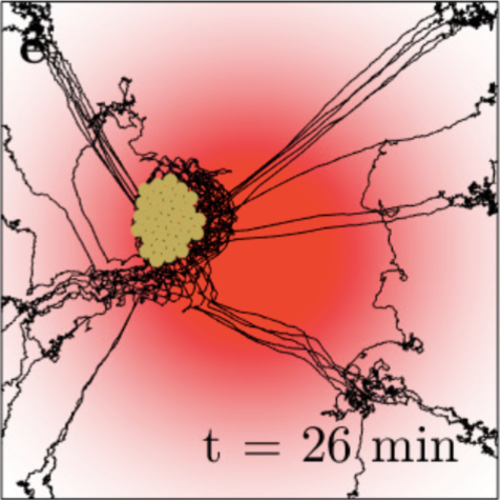
Self-organisation is driven by the interactions between the individual components of a system mediated by the environment, and is one of the most important strategies used by many biological systems to develop complex and functional structures. Furthermore, biologically-inspired self-organisation offers opportunities to develop the next generation of materials and devices for electronics, photonics and nanotechnology. In this work, we demonstrate experimentally that a system of Janus particles (silica microspheres half-coated with gold) aggregates into clusters in the presence of a Gaussian optical potential and disaggregates when the optical potential is switched off. We show that the underlying mechanism is the existence of a hydrodynamic flow induced by a temperature gradient generated by the light absorption at the metallic patches on the Janus particles. We also perform simulations, which agree well with the experiments and whose results permit us to clarify the underlying mechanism. The possibility of hydrodynamic-flux-induced reversible clustering may have applications in the fields of drug delivery, cargo transport, bioremediation and biopatterning.

Invited talk by G. Volpe at MPI-PKS Workshop, Dresden, Germany, 23 July 2019

Deep Learning Applications in Photonics and Active Matter
Giovanni Volpe
Invited talk at the “
Microscale Motion and Light” MPI-PKS Workshop, Dresden, Germany, 22-26 July 2019
https://www.pks.mpg.de/mml19/

After a brief overview of artificial intelligence, machine learning and deep learning, I will present a series of recent works in which we have employed deep learning for applications in photonics and active matter. In particular, I will explain how we employed deep learning to enhance digital video microscopy [1], to estimate the properties of anomalous diffusion [2], and to improve the calculation of optical forces. Finally, I will provide an outlook for the application of deep learning in photonics and active matter.

References

[1] S. Helgadottir, A. Argun and G. Volpe, Digital video microscopy enhanced by deep learning. Optica 6(4), 506—513 (2019)
doi: 10.1364/OPTICA.6.000506

[2] S. Bo, F Schmidt, R. Eichborn and G. Volpe, Measurement of Anomalous Diffusion Using Recurrent Neural Networks. arXiv: 1905.02038

Sophia Simon visits the Soft Matter Lab. Welcome!

Sophia Simon is a bachelor student at the Freie Universität of Berlin. She will do her summer internship at the Soft Matter Lab from July 21 to September 27, 2019, with a grant from DAAD (Deutscher Akademischer Austauschdienst). She will work on the tunability of critical Casimir forces in critical mixtures.

Anomalous Diffusion Measurement with Neural Networks published in Phys Rev E

Measurement of Anomalous Diffusion Using Recurrent Neural Networks

Measurement of Anomalous Diffusion Using Recurrent Neural Networks
Stefano Bo, Falko Schmidt, Ralf Eichborn & Giovanni Volpe
Physical Review E 100(1), 010102(R) (2019)
doi: 10.1103/PhysRevE.100.010102
arXiv: 1905.02038

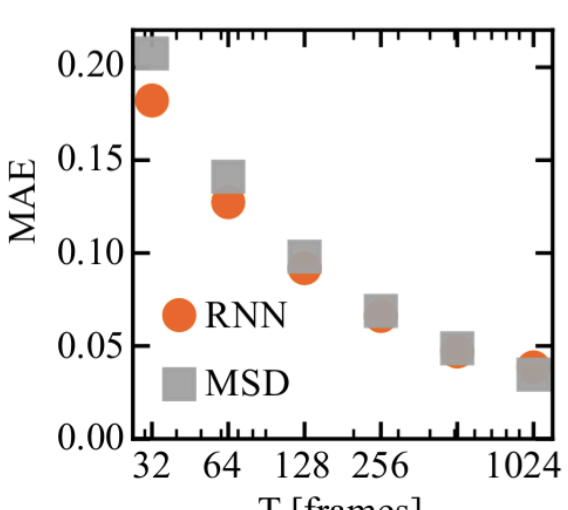
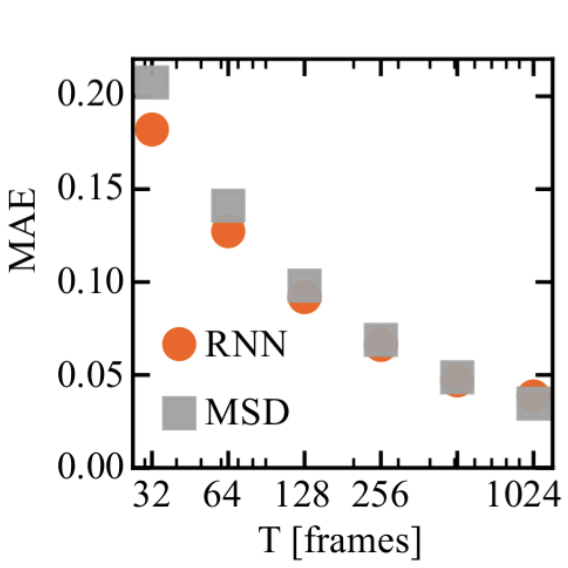
Anomalous diffusion occurs in many physical and biological phenomena, when the growth of the mean squared displacement (MSD) with time has an exponent different from one. We show that recurrent neural networks (RNN) can efficiently characterize anomalous diffusion by determining the exponent from a single short trajectory, outperforming the standard estimation based on the MSD when the available data points are limited, as is often the case in experiments. Furthermore, the RNN can handle more complex tasks where there are no standard approaches, such as determining the anomalous diffusion exponent from a trajectory sampled at irregular times, and estimating the switching time and anomalous diffusion exponents of an intermittent system that switches between different kinds of anomalous diffusion. We validate our method on experimental data obtained from sub-diffusive colloids trapped in speckle light fields and super-diffusive microswimmers.

Influence of Sensorial Delay on Clustering and Swarming published in Phys. Rev. E

Influence of Sensorial Delay on Clustering and Swarming

Influence of Sensorial Delay on Clustering and Swarming
Rafal Piwowarczyk, Martin Selin, Thomas Ihle & Giovanni Volpe
Physical Review E 100(1), 012607 (2019)
doi: 10.1103/PhysRevE.100.012607
arXiv:  1803.06026

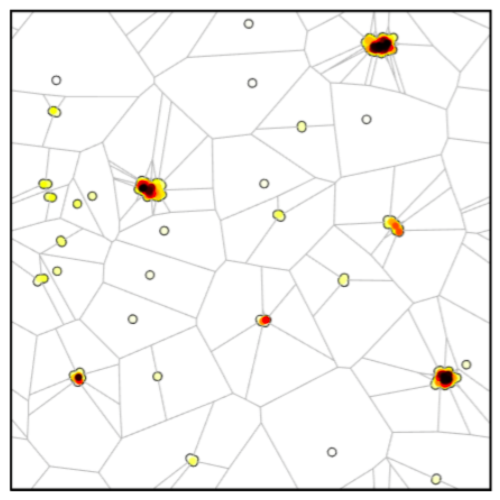
We show that sensorial delay alters the collective motion of self-propelling agents with aligning interactions: In a two-dimensional Vicsek model, short delays enhance the emergence of clusters and swarms, while long or negative delays prevent their formation. In order to quantify this phenomenon, we introduce a global clustering parameter based on the Voronoi tessellation, which permits us to efficiently measure the formation of clusters. Thanks to its simplicity, sensorial delay might already play a role in the organization of living organisms and can provide a powerful tool to engineer and dynamically tune the behavior of large ensembles of autonomous robots.