How morphology affects optical trapping of red blood cells in health and disease published in Biomedical Optics Express

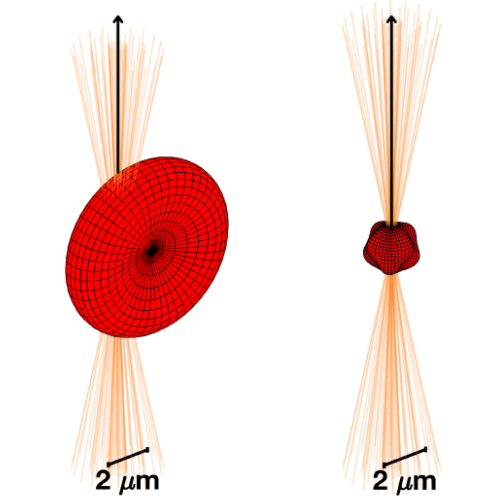
 Left: trapping of a healthy (biconcave) red blood cell. Right: trapping of an echinocyte-like cell with membrane protrusions. In the representation of the trapping (focused) beam, only rays originating from points close enough to the propagation axis are drawn. More peripheral rays are omitted. (Image from the manuscript.)
How morphology affects optical trapping of red blood cells in health and disease
Emir Erdem, Gökberk Kabacaoğlu, Giovanni Volpe, Agnese Callegari, and Luca Biancofiore
Biomedical Optics Express 17, 5355-5372 (2026)
doi: 10.1364/BOE.609102

Optical tweezers are widely used to manipulate microscopic particles and biological cells through optical forces and torques, yet how cell shape controls trapping response has not been fully elucidated. Here, we develop a computational framework to investigate single-beam optical trapping of red blood cells with physiologically and pathologically relevant deformed morphologies. Representative cell shapes are generated parametrically and analyzed using static displacement and rotation tests, together with Brownian dynamics simulations. We show that all considered morphologies remain laterally and orientationally confined in a single-beam trap, while axial localization is weaker by pure optical means and is experimentally realized by the balance between the optical force and the buoyancy-corrected cell weight. Cell geometry strongly affects translational and rotational stiffness, preferred orientation, and Brownian confinement. In particular, shape-induced anisotropy produces distinct dynamical signatures, indicating that optical trapping measurements may be sensitive to morphological alterations beyond simple changes in cell size or volume. These results establish a quantitative connection between red-blood-cell morphology, trap stiffness, and dynamics, providing a computational framework for interpreting morphology-dependent optical trapping experiments.

Clustering of Janus Particles published in Soft Matter

Clustering of Janus particles in optical potential driven by hydrodynamic fluxes

Clustering of Janus Particles in Optical Potential Driven by Hydrodynamic Fluxes
S. Masoumeh Mousavi, Iryna Kasianiuk, Denis Kasyanyuk, Sabareesh K. P. Velu, Agnese Callegari, Luca Biancofiore & Giovanni Volpe
Soft Matter 15(28), 5748—5759 (2019)
doi: 10.1039/C8SM02282H
arXiv: 1811.01989

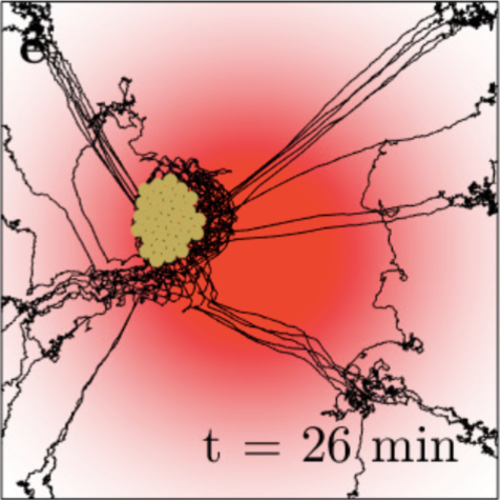
Self-organisation is driven by the interactions between the individual components of a system mediated by the environment, and is one of the most important strategies used by many biological systems to develop complex and functional structures. Furthermore, biologically-inspired self-organisation offers opportunities to develop the next generation of materials and devices for electronics, photonics and nanotechnology. In this work, we demonstrate experimentally that a system of Janus particles (silica microspheres half-coated with gold) aggregates into clusters in the presence of a Gaussian optical potential and disaggregates when the optical potential is switched off. We show that the underlying mechanism is the existence of a hydrodynamic flow induced by a temperature gradient generated by the light absorption at the metallic patches on the Janus particles. We also perform simulations, which agree well with the experiments and whose results permit us to clarify the underlying mechanism. The possibility of hydrodynamic-flux-induced reversible clustering may have applications in the fields of drug delivery, cargo transport, bioremediation and biopatterning.

Microscopic Critical Engine featured in Phys.Org

Microscopic engine powered by critical demixing

Our recent article Microscopic engine powered by critical remixing
by Falko Schmidt, Alessandro Magazzù, Agnese Callegari, Luca Biancofiore, Frank Cichos & Giovanni Volpe, published in Physical Review Letters 120(6), 068004 (2018) has been featured in “Tiny engine powered by demixing fluid” Phys.Org (February 12, 2018)

Microscopic Critical Engine featured in Optics & Photonics News

Microscopic engine powered by critical demixing

Our recent article Microscopic engine powered by critical remixing
by Falko Schmidt, Alessandro Magazzù, Agnese Callegari, Luca Biancofiore, Frank Cichos & Giovanni Volpe, published in Physical Review Letters 120(6), 068004 (2018) has been featured in “Laser + Critical Liquid = Micro-Engine”, Optics & Photonics News (February 12, 2018)

Optics & Photonics News (OPN) is The Optical Society’s monthly news magazine. It provides in-depth coverage of recent developments in the field of optics and offers busy professionals the tools they need to succeed in the optics industry, as well as informative pieces on a variety of topics such as science and society, education, technology and business. OPN strives to make the various facets of this diverse field accessible to researchers, engineers, businesspeople and students. Contributors include scientists and journalists who specialize in the field of optics.

Microscopic Critical Engine featured in APS Physics

Microscopic engine powered by critical demixing

Our recent article Microscopic engine powered by critical remixing
by Falko Schmidt, Alessandro Magazzù, Agnese Callegari, Luca Biancofiore, Frank Cichos & Giovanni Volpe, published in Physical Review Letters 120(6), 068004 (2018) has been featured in “Focus: A Tiny Engine Powered by Light and Liquid Physics”, Physics 11, 16 (February 9, 2018)

Physics provides daily online-only news and commentary about a selection of papers from the APS journals collection. It is aimed at the reader who wants to keep up with highlights of physics research with explanations that don’t rely on complex technical detail.

The category Physics: focus stories features only a few number of articles each week selected among the set of articles published on all the APS journals.
Research articles that have an interdisciplinary character are usually selected, and their explanations are geared toward students and non-experts. Features are written by a journalist for an audience with a general interest in physics.

Microscopic Critical Engine published in Phys. Rev. Lett.

Microscopic engine powered by critical demixing

Microscopic engine powered by critical demixing
Falko Schmidt, Alessandro Magazzù, Agnese Callegari, Luca Biancofiore, Frank Cichos & Giovanni Volpe
Physical Review Letters 120(6), 068004 (2018)
DOI: 10.1103/PhysRevLett.120.068004
arXiv: 1705.03317

We experimentally demonstrate a microscopic engine powered by the local reversible demixing of a critical mixture. We show that, when an absorbing microsphere is optically trapped by a focused laser beam in a sub-critical mixture, it is set into rotation around the optical axis of the beam because of the emergence of diffusiophoretic propulsion. This behavior can be controlled by adjusting the optical power, the temperature, and the criticality of the mixture.

Featured in :
“Focus: A Tiny Engine Powered by Light and Liquid Physics”, Physics 11, 16 (February 9, 2018)
“Laser + Critical Liquid = Micro-Engine”, Optics & Photonics News (February 12, 2018)
“Tiny engine powered by demixing fluid” Phys.Org (February 12, 2018)
“Расслаивание растворителя закрутило микрочастицы вокруг лазерного пучка”, N+1: научные статьи, новости, открытия (February 12, 2018)
“Tiny engine powered by remixing fluid”, Brinkwire (February 16, 2018)