The study, now published in eLife, and co-written by researchers at the Soft Matter Lab of the Department of Physics at the University of Gothenburg, demonstrates how the combination of holographic microscopy and deep learning provides a strong complimentary tool in marine microbial ecology. The research allows quantitative assessments of microplankton feeding behaviours, and biomass increase throughout the cell cycle from generation to generation.
Active droploids. (Image taken from Nat. Commun. 12, 6005 (2021).)Experimental study of critical fluctuations and critical Casimir forces
Giovanni Volpe
Invited seminar at QSIT/Quantum Center, ETH Zurich
Thursday, November 3, 2022 – 16:00 – 17:00
Critical Casimir forces (CCF) are a powerful tool to control the self-assembly and complex behavior of microscopic and nanoscopic colloids. While CCF were theoretically predicted in 1978, their first direct experimental evidence was provided only in 2008, using total internal reflection microscopy (TIRM). Since then, these forces have been investigated under various conditions, for example, by varying the properties of the involved surfaces or with moving boundaries. In addition, a number of studies of the phase behavior of colloidal dispersions in a critical mixture indicate critical Casimir forces as candidates for tuning the self-assembly of nanostructures and quantum dots, while analogous fluctuation-induced effects have been investigated, for example, at the percolation transition of a chemical sol, in the presence of temperature gradients, and even in granular fluids and active matter. In this presentation, I’ll give an overview of this field with a focus on recent results on the measurement of many-body forces in critical Casimir forces, the realization of micro- and nanoscopic engines powered by critical fluctuations, and the creation of light-controllable colloidal molecules and active droploids.
Date: Thursday, November 3, 2022 Time: 16:00 Place: ETH Zurich, Campus Hönggerberg, HPF G 6 Host: Lukas Novotny
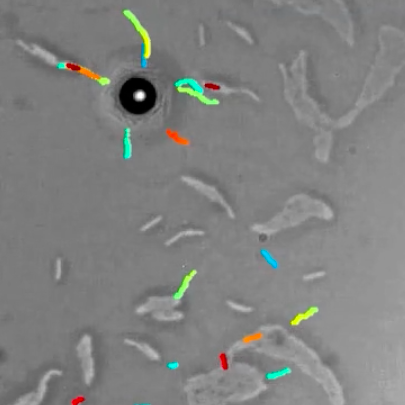
Tracking of microplankton by holographic optical microscopy and deep learning. (Image by H. Bachimanchi.)Microplankton life histories revealed by holographic microscopy and deep learning
Harshith Bachimanchi, Benjamin Midtvedt, Daniel Midtvedt, Erik Selander, and Giovanni Volpe
eLife 11, e79760 (2022)
arXiv: 2202.09046
doi: 10.7554/eLife.79760
The marine microbial food web plays a central role in the global carbon cycle. Our mechanistic understanding of the ocean, however, is biased towards its larger constituents, while rates and biomass fluxes in the microbial food web are mainly inferred from indirect measurements and ensemble averages. Yet, resolution at the level of the individual microplankton is required to advance our understanding of the oceanic food web. Here, we demonstrate that, by combining holographic microscopy with deep learning, we can follow microplanktons throughout their lifespan, continuously measuring their three dimensional position and dry mass. The deep learning algorithms circumvent the computationally intensive processing of holographic data and allow rapid measurements over extended time periods. This permits us to reliably estimate growth rates, both in terms of dry mass increase and cell divisions, as well as to measure trophic interactions between species such as predation events. The individual resolution provides information about selectivity, individual feeding rates and handling times for individual microplanktons. This method is particularly useful to explore the flux of carbon through micro-zooplankton, the most important and least known group of primary consumers in the global oceans. We exemplify this by detailed descriptions of micro-zooplankton feeding events, cell divisions, and long term monitoring of single cells from division to division.
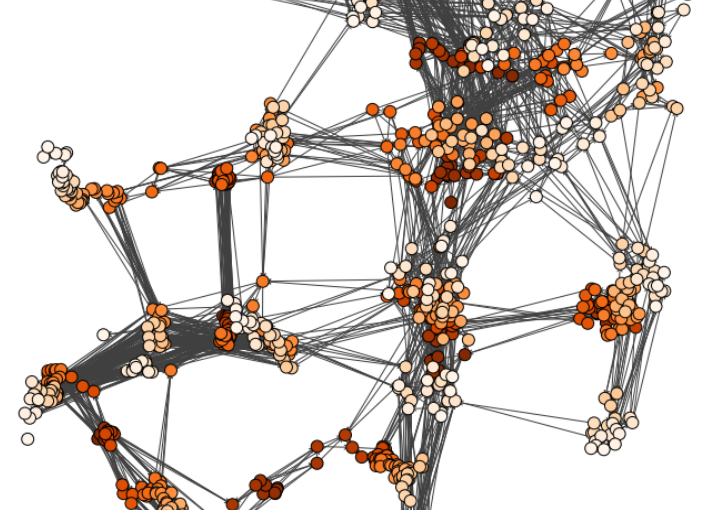
Example of the 21 resting-state networks used as nodes and their positive (red) and negative connections (blue) for one of 140 the subjects included in the analyses. (Image by the Authors of the manuscript.)Sex differences in multilayer functional network topology over the course of aging in 37543 UK Biobank participants
Mite Mijalkov, Dániel Veréb, Oveis Jamialahmadi, Anna Canal-Garcia, Emiliano Gómez-Ruiz, Didac Vidal-Piñeiro, Stefano Romeo, Giovanni Volpe, Joana B. Pereira
Network Neuroscience 1-40 (2022)
doi: 10.1162/netn_a_00286
medRxiv: 10.1101/2022.03.08.22272089
Aging is a major risk factor for cardiovascular and neurodegenerative disorders, with considerable societal and economic implications. Healthy aging is accompanied by changes in functional connectivity between and within resting-state functional networks, which have been associated with cognitive decline. However, there is no consensus on the impact of sex on these age-related functional trajectories. Here, we show that multilayer measures provide crucial information on the interaction between sex and age on network topology, allowing for better assessment of cognitive, structural, and cardiovascular risk factors that have been shown to differ between men and women, as well as providing additional insights into the genetic influences on changes in functional connectivity that occur during aging. In a large cross-sectional sample of 37543 individuals from the UK Biobank cohort, we demonstrate that such multilayer measures that capture the relationship between positive and negative connections are more sensitive to sex-related changes in the whole-brain connectivity patterns and their topological architecture throughout aging, when compared to standard connectivity and topological measures. Our findings indicate that multilayer measures contain previously unknown information on the relationship between sex and age, which opens up new avenues for research into functional brain connectivity in aging.
Drawing of a coffee mug using only coffee. (Image by M. Rey.)Versatile strategy for homogeneous drying of dispersed particles Marcel Rey, Submitted to ISMC 2022 Date: 7 October 2022 Time: 11:20 (CET)
After spilling coffee, a tell-tale stain is left by the drying droplet. This universal phenomenon, known as the “coffee ring effect”, is observed independent of the dispersed material. However, for many technological processes such as coating techniques and ink-jet printing a uniform particle deposition is required and the coffee ring effect is a major drawback.
Here, we present a simple and versatile strategy to achieve homogeneous drying patterns by modifying the surface of the dispersed particles with surface-active polymers. A particle dispersion is mixed with excess surface-active polymers (e.g. polyvinyl alcohol). The polymer partially adsorbs onto the particles and excess polymer is removed by centrifugation and redispersion. While pure particle dispersions form a typical coffee ring, the polymer-modified dispersions dry into a uniform particle deposit. In this talk, I will discuss how the polymer coating prevents accumulation and pinning at the droplet edge and leads to a uniform particle deposition after drying.
It should be highlighted that the presented method is independent of particle shape (e.g. spherical, ellipsoidal or ill-defined particle shapes) and is applicable to a variety of commercial pigment particles (e.g. hematite, goethite or titanium dioxide). Further, the method works for different dispersion media (e.g. aqueous, polar and apolar solvents), demonstrating the practicality of this work for everyday processes.
(Photo by A. Argun.)Vide Ramsten started his PhD at the Physics Department of the University of Gothenburg on the 3rd of October 2022.
Vide has a double master degree in System, control and mechatronics from Chalmers University of Technology and Engineering Cybernetics from the University of Stuttgart.
In his PhD, Vide will focus his research on the development of and experimental testing with swarm robotics.
Drawing of a coffee mug using only coffee. (Image by M. Rey.)Versatile strategy for homogeneous drying of dispersed particles Marcel Rey, Submitted to ISMC 2022 Date: 28 September 2022 Time: 11:20 (CET)
After spilling coffee, a tell-tale stain is left by the drying droplet. This universal phenomenon, known as the “coffee ring effect”, is observed independent of the dispersed material. However, for many technological processes such as coating techniques and ink-jet printing a uniform particle deposition is required and the coffee ring effect is a major drawback.
Here, we present a simple and versatile strategy to achieve homogeneous drying patterns by modifying the surface of the dispersed particles with surface-active polymers. A particle dispersion is mixed with excess surface-active polymers (e.g. polyvinyl alcohol). The polymer partially adsorbs onto the particles and excess polymer is removed by centrifugation and redispersion. While pure particle dispersions form a typical coffee ring, the polymer-modified dispersions dry into a uniform particle deposit. In this talk, I will discuss how the polymer coating prevents accumulation and pinning at the droplet edge and leads to a uniform particle deposition after drying.
It should be highlighted that the presented method is independent of particle shape (e.g. spherical, ellipsoidal or ill-defined particle shapes) and is applicable to a variety of commercial pigment particles (e.g. hematite, goethite or titanium dioxide). Further, the method works for different dispersion media (e.g. aqueous, polar and apolar solvents), demonstrating the practicality of this work for everyday processes.
M. xanthus cell-cell and cell-particle local interactions during cellular aggregation.Feedback between active matter and its environment
Giovanni Volpe
Invited Talk (Online) at the hybrid Workshop: Adaptivity in Nonlinear Dynamical Systems
Potsdam, Germany
23 September 2022, 9:30 CEST
I will present some examples of how feedback cycles can occur between active matter and its environment. In particular, I’ll show the formation of active molecules and active droploids from passive colloidal building blocks; the emergence of non-Boltzmann statistics and active-depletion forces between plates in an active bath; and the environment topography alters the way to multicellularity in the bacterium Myxococcus xanthus.
Drawing of a coffee mug using only coffee. (Image by M. Rey.)Versatile strategy for homogeneous drying of dispersed particles Marcel Rey, Johannes Walter, Johannes Harrer, Carmen Morcillo Perez, Salvatore Chiera, Sharanya Nair, Maret Ickler, Alesa Fuchs, Mark Michaud, Maximilian J. Uttinger, Andrew B. Schofield, Job H. J. Thijssen, Monica Distaso, Wolfgang Peukert, Nicolas Vogel Submitted to ISMC 2022 Date: 23 September 2022 Time: 12:10 (CET)
After spilling coffee, a tell-tale stain is left by the drying droplet. This universal phenomenon, known as the “coffee ring effect”, is observed independent of the dispersed material. However, for many technological processes such as coating techniques and ink-jet printing a uniform particle deposition is required and the coffee ring effect is a major drawback.
Here, we present a simple and versatile strategy to achieve homogeneous drying patterns by modifying the surface of the dispersed particles with surface-active polymers. A particle dispersion is mixed with excess surface-active polymers (e.g. polyvinyl alcohol). The polymer partially adsorbs onto the particles and excess polymer is removed by centrifugation and redispersion. While pure particle dispersions form a typical coffee ring, the polymer-modified dispersions dry into a uniform particle deposit. In this talk, I will discuss how the polymer coating prevents accumulation and pinning at the droplet edge and leads to a uniform particle deposition after drying.
It should be highlighted that the presented method is independent of particle shape (e.g. spherical, ellipsoidal or ill-defined particle shapes) and is applicable to a variety of commercial pigment particles (e.g. hematite, goethite or titanium dioxide). Further, the method works for different dispersion media (e.g. aqueous, polar and apolar solvents), demonstrating the practicality of this work for everyday processes.