News

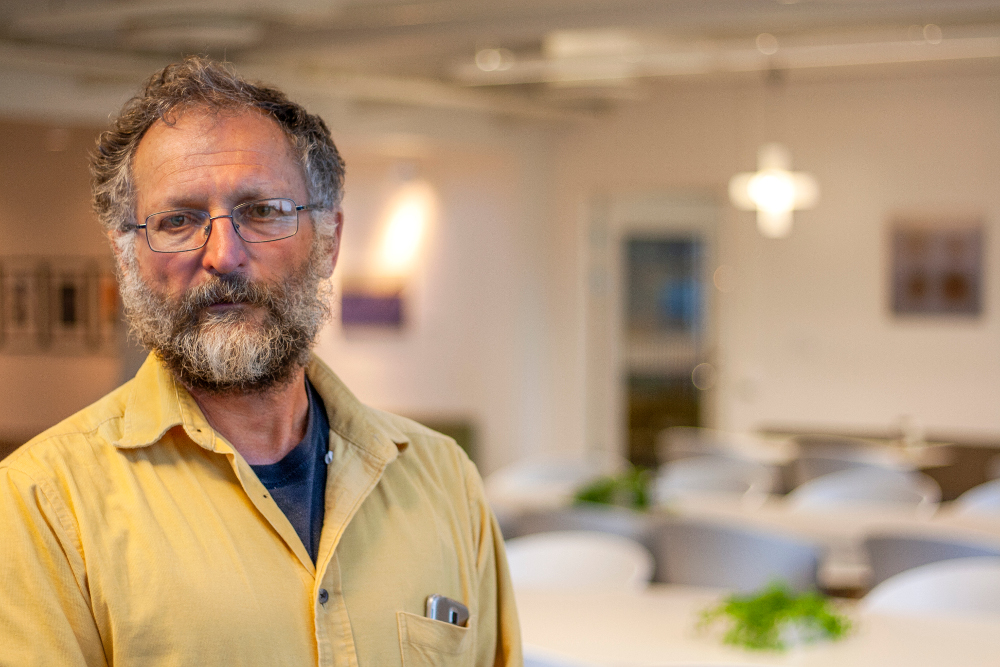
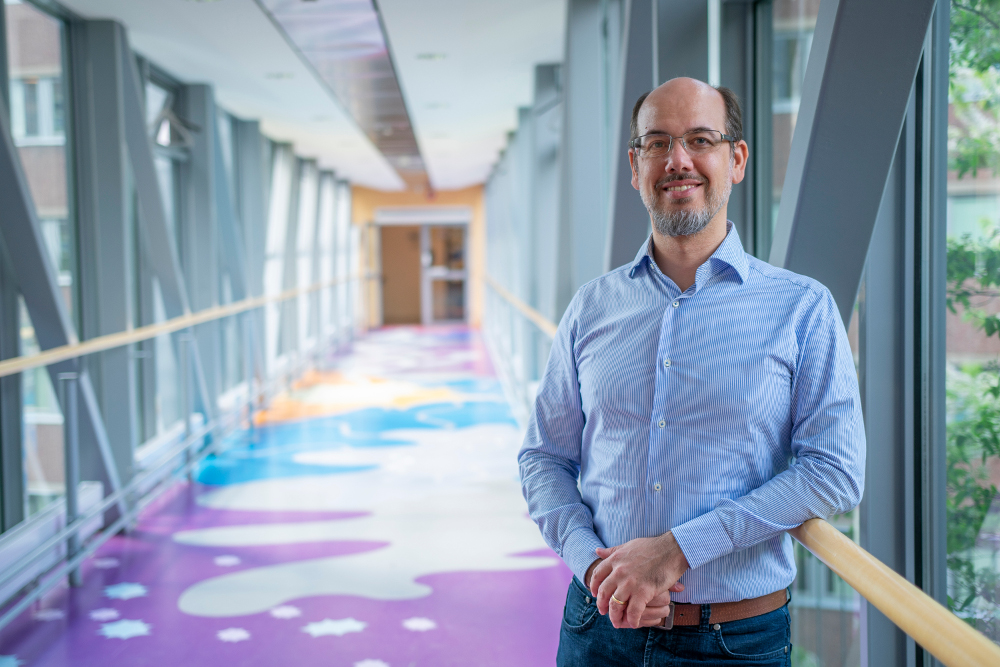
Seminar on Langevin equation in the small mass limit by Jan Wehr from the University of Arizona, Nexus, 21 Jun 2018

Langevin equation in the small mass limit: higher order approximations
Seminar by Jan Wehr from the University of Arizona, Tucson (AZ), USA.

Abstract: We study the Langevin equation describing the motion of a particle of mass m in a potential and/or magnetic field, with state-dependent drift and diffusion.  We develop a hierarchy of approximate equations for the position degrees of freedom that achieve accuracy of order m^{k/2} over finite time intervals for any positive integer k.  This extends the previous work in which effective equations for the position variables were derived in the limit when the mass goes to zero.  The work was done jointly with Jeremiah Birrell.

Place: Nexus, meeting room, Fysik Origo, Fysik
Time: 21 June, 2018, 11:00

Talk by A. Magazzù at Italian Soft Days 2018, Padua, 13-14 Sept 2018

Microscopic engine powered by critical demixing
Alessandro Magazzù, Falko Schmidt, Agnese Callegari, Luca Biancofiore, Frank Cichos & Giovanni Volpe
Italian Soft Days 2018, Padua, Italy
13-14 September 2018

We propose a new type of engine powered by the local, reversible demixing of a critical binary liquid. In particular, we show that a light absorbing, optically trapped particle, performs revolutions around the trapping beam producing work.
This behavior results from an equilibrium between optical forces and diffusiophoresis induced by a local demixing of the critical mixture. This new kind of engine can be controlled by the optical power supplied, the temperature of the environment and the criticality of the system.

Reference: Schmidt et al. Microscopic Engine Powered by Critical Demixing,  Phys. Rev. Lett. 120, 068004 (2018)

Freddie Ogemark & Maximilian Leyman defended their Master Thesis. Congrats!

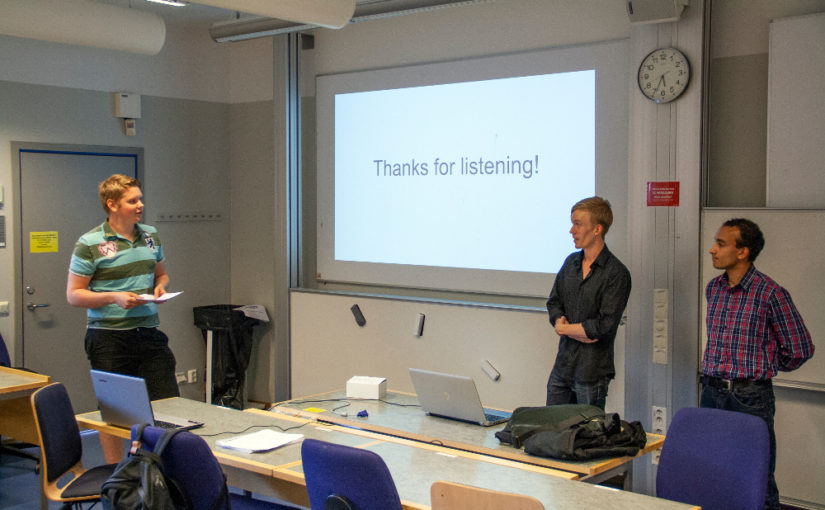
Freddie Ogemark & Maximlian Leyman defended their Master thesis in Complex Adaptive Systems at Chalmers University of Technology on 14 June 2018

Title: Cooperative Robotics with Sensorial Delay

The purpose of this work is to study how the behaviour of robots changes when the data from their sensors is affected by a certain delay. Robots of the model Elisa-3 were therefore studied while performing Brownian motion and with certain features varying as a function of the intensity measured by its sensors. Introducing a delay and varying its sign is shown to have a significant effect on a robot’s behavior. A single robot moving in an intensity field is either drawn to or avoiding higher inten- sities for a positive or a negative delay respectively. In this case experimental data show good agreement with simulated behavior. Simulations also show that multi- ple robots should form clusters when interacting under the influence of a positive delay; however, only weak tendencies towards cluster formation can be seen in the experiments.

​Name of the master programme: MPCAS – Complex Adaptive Systems
Supervisor: Giovanni Volpe, Department of Physics, University of Gothenburg
Examiner: Giovanni Volpe, Department of Physics, University of Gothenburg
Opponents: Andres Hansson & Richard Sundqvist, MP Complex Adaptive Systems, Department of Physics, Chalmers University of Technology

Place: ES51, EDIT building
Time: 14 June, 2018, 17:00


Talk by F. Schmidt at IONS Scandinavia 2018, Copenhagen, 5-9 Jun 2018

Light-controlled Assembly of Active Colloidal Molecules
Falko Schmidt, Benno Liebchen, Hartmut Löwen & Giovanni Volpe
IONS Scandinavia 2018, Copenhagen, Denmark
5-9 June 2018

We experimentally demonstrate the light-controlled assembly of active colloidal molecules from a suspension of two species of passive microspheres. When light is shone on the sample, the ac- tive molecules form and acquire motility through non-reciprocal interactions between their passive components. As their size grows, they feature a complex array of behaviors, becoming propellers, spinners and rotators. Their shape and functionality can be tuned by applying periodic illumination. We also provide a theoretical model allowing to predict the complete table of emerging active molecules and their properties in quantitative agreement with the experiments.

Reference: Schmidt et al. Light-controlled Assembly of Active Colloidal Molecules arXiv:1801.06868 (2018)

Viridiana Carmosa Sosa visits the Soft Matter Lab. Welcome!

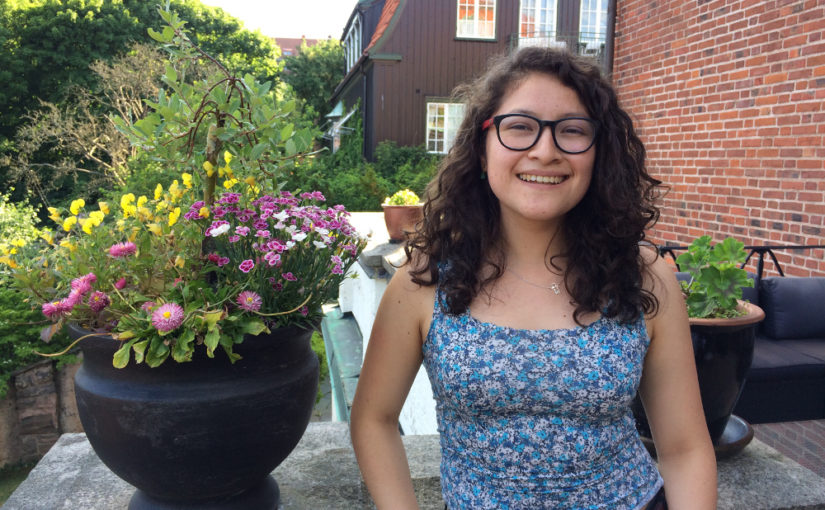
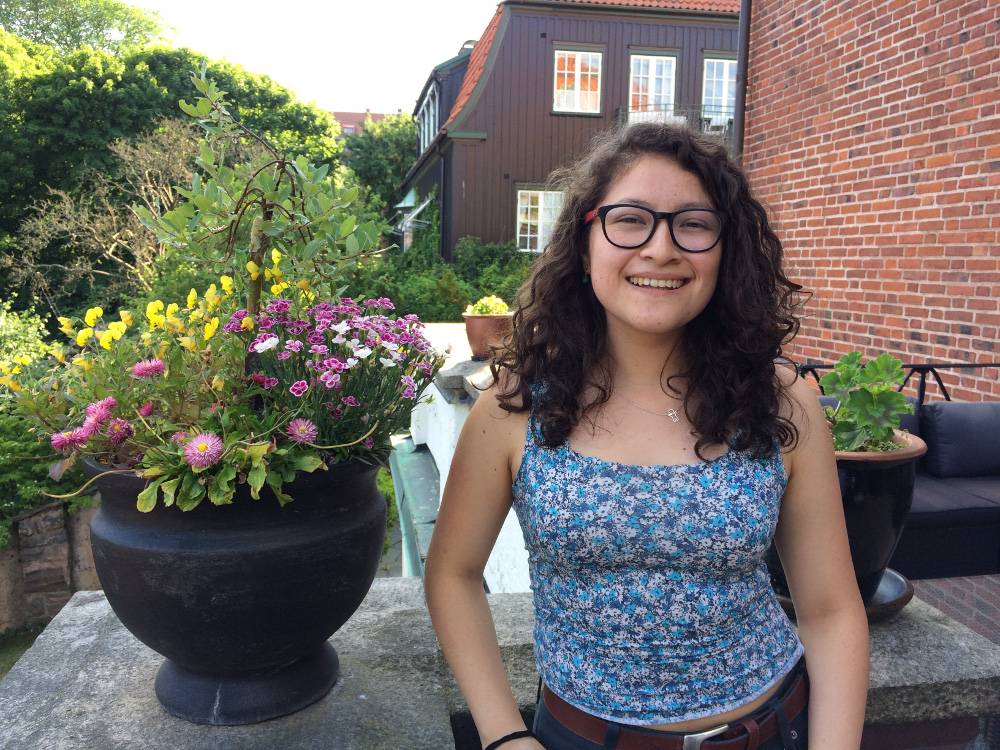
Viridiana Carmosa Sosa studied her bachelor and master degree in Physics in the National Autonomous University of Mexico. In those years, she was working with optical tweezers, structured laser beams, and cavitation bubbles. Nowadays, she is a PhD student at Sapienza University of Rome under the supervision of Roberto Di Leonardo, where she uses two-photon polymerization to fabricate microstructures that allow her to study the dynamics of active and non-active matter at the micron scale.

She will spend a week at the Soft Matter Lab to work together with Alessandro Magazzù on a joint project.

Francesco Patti visits the Soft Matter Lab. Welcome!

Francesco Patti is a PhD student in Physics at the University of Messina (started in October 2017). His master’s degree thesis was about “Theoretical study of the interaction between E.M. radiation and chiral nanomaterials” (July 2017) and now he is a visiting student at the Soft Matter Lab where he will work on modeling of optical forces in liquids and vacuum as well as modelling of passive and active stochastic systems“ (June-July 2018).

Frida Brogren, Kirill Danilov, Klas Holmgren, Oskar Leinonen, Benjamin Midtvedt & Arian Rohani defended their Bachelor Thesis. Congrats!

Frida Brogren, Kirill Danilov, Klas Holmgren, Oskar Leinonen, Benjamin Midtvedt & Arian Rohani defended their Bachelor Thesis at Chambers University of Technology on 25 May 2018.

Title: Experimentell studie av kritiska fenomen med optiska pincetter

Abstract: I samband med nanoteknologins framfart ses ett växande intresse för kolloida sy- stem för att överkomma många svårigheter med konstruktionen av nanostrukturer. På grund av kritikalitetens skalinvarianta egenskaper kan kolloider användas som analo- ger för nanopartiklar i studier av kritiska fenomen. Detta arbete ämnar att undersöka och utvidga förståelsen av kritiska fluktuationer och kritiska Casimirkrafter, som kan användas för att binda och styra kolloider. En optisk pincett byggdes för att undersö- ka kritisk motorisering och kolloida aggregationer, medan en färdigbyggd holografisk pincett användes för att mäta kritiska Casimirkrafter. De motoriserade kolloiderna uppvisade mer kaotisk rörelse för högre lasereffekter, och de kritiska Casimirkrafterna visades växa skarpt i närheten av den kritiska temperaturen.

Supervisors: Alessandro Magazzù & Giovanni Volpe, Department of Physics, University of Gothenburg
Examiner: Lena Falk, Department of Physics, University of Gothenburg
Opponent: Markus Fällman, Gabriella Grenander, Oskar Holmstedt, Viktor Olsson, Maria Söderberg & Wilhelm Tranheden
Place: FL62
Time: 25 May, 2018, 11:05-11:50

Markus Fällman, Gabriella Grenander, Oskar Holmstedt, Viktor Olsson, Maria Söderberg & Wilhelm Tranheden defended their Bachelor Thesis. Congrats!

Markus Fällman, Gabriella Grenander, Oskar Holmstedt, Viktor Olsson, Maria Söderberg & Wilhelm Tranheden defended their Bachelor Thesis at Chambers University of Technology on 25 May 2018.

Title: Sökstrategier i komplexa miljöer – Påverkan av kiralitet på aktiva agenters sökförmåga i komplexa miljöer

Abstract: I en framtid där autonoma agenter sannolikt kommer spela en betydande roll är utveck- lingen av enkla sökstrategier relevant. Ett specialfall av sådana är sökning utan återkopp- ling från miljön, något som kan vara viktigt för enkla agenter med begränsad datorkraft. Kiralitet är ett fenomen som i applikationer ofta ses som en olägenhet hos sådana agen- ter. Det är en asymmetri hos agenten som leder till att dess rörelse roterar åt ett visst håll. Detta beteende är vanligt inom robotik, men har även observerats inom kemi och biologi, till exempel hos olika mikroorganismer. Influensen av kiralitet på prestationen hos sökstrategier är i hög grad okänd. Studier saknas på huruvida kiralitet kan förbättra prestationen för agenter utan miljöåterkoppling och, om så är fallet, i vilken sorts miljöer som denna positiva effekt uppstår.
Genom datorsimuleringar och robotexperiment har vi funnit att kiralitet kan ha en positiv effekt på aktiva agenters sökförmåga i både regelbundna och stokastiska miljöer och med olika grad av stokastiskt brus som påverkar agenternas rörelse. Vi visar också att det finns en positiv relation mellan existensen av hörn i miljön och den relativa prestationen av kiral rörelse.
Våra resultat är relevanta för den som är intresserad av att manipulera eller förstå rörelsen hos kirala agenter i komplexa miljöer. Resultaten är också relevanta för vidare forskning riktad mot potentiella implementationer inom till exempel robotik och mikroteknik.

Supervisor: Giovanni Volpe, Department of Physics, University of Gothenburg
Examiner: Lena Falk, Department of Physics, University of Gothenburg
Opponent: Frida Brogren, Kirill Danilov, Klas Holmgren, Oskar Leinonen, Benjamin Midtvedt & Arian Rohani
Place: FL62
Time: 25 May, 2018, 10:15-11:00

Antonio A. R. Neves visits the Soft Matter Lab. Welcome!

Antonio Alvaro Ranha Neves is a Visiting Professor from the Federal University of ABC in Brazil. His visiting position is financed through a FAPESP-ERC grant. He will visit us for 4 months from May 12, 2018, to September 12, 2018.

He works mainly with optical tweezers studying optical forces with both experimental and theoretical tools.

He obtained his Ph.D. in physics in 2006, at the State University of Campinas (Brazil). From 2006 to 2012, he worked as a postdoctoral researcher at the National Nanotechnology Laboratories of the Nanoscience Institute in Lecce (Italy), within the Soft-matter division. Since 2012, he is a professor at the Federal University of ABC (Brazil), accredited in the graduate program of Nanoscience and Advanced Materials.

His main research interest is in the field of light-matter interaction, with a special focus on the applications of optical tweezers as well as linear and multi-photon spectroscopy as well. His current line of research is the study of bull sperm motility with optical tweezers, and starting the characterization of thermal properties of metallic nanoparticles in optical traps.

Seminar by G. Volpe at TU Dresden, 3 May 2018

Emergent Complex Behaviors in Active Matter
Giovanni Volpe
TU Dresden, Dresden, Germany
3 May 2018

After a brief introduction of active particles, I’ll present some recent advances on the study of active particles in complex and crowded environments.
First, I’ll show that active particles can work as microswimmers and microengines powered by critical fluctuations and controlled by light.
Then, I’ll discuss some examples of behavior of active particles in crowded environments: a few active particles alter the overall dynamics of a system; active particles create metastable clusters and channels; active matter leads to non-Boltzmann distributions and alternative non-equilibrium relations; and active colloidal molecules can be created and controlled by light.
Finally, I’ll present some examples of the behavior of active particles in complex environments: active particles often perform 2D active Brownian motion; active particles at liquid-liquid interfaces behave as active interstitials or as active atoms; and the environment alters the optimal search strategy for active particles in complex topologies.