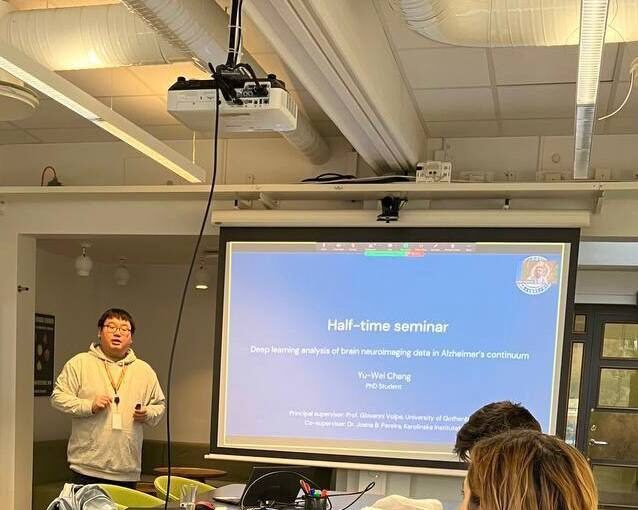
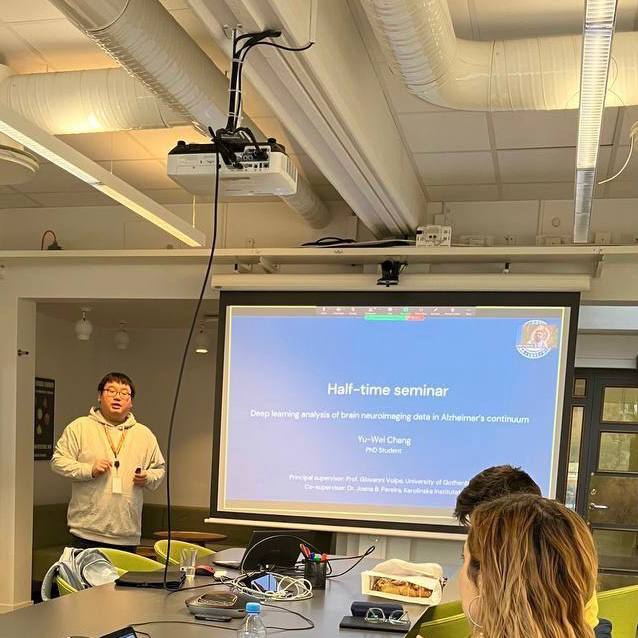
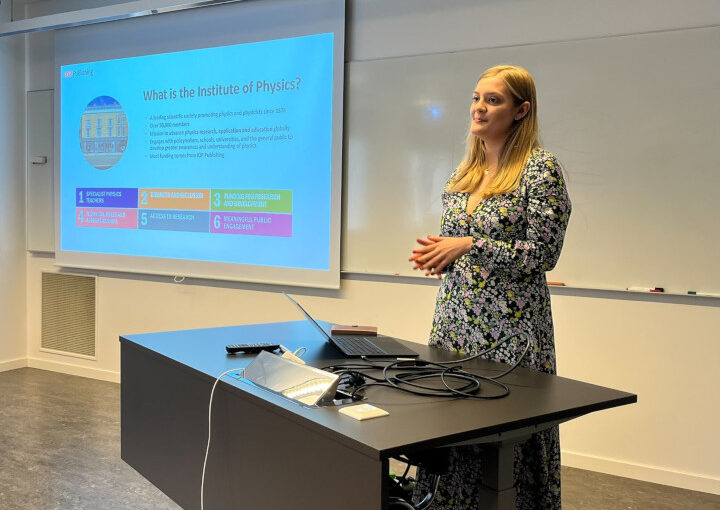
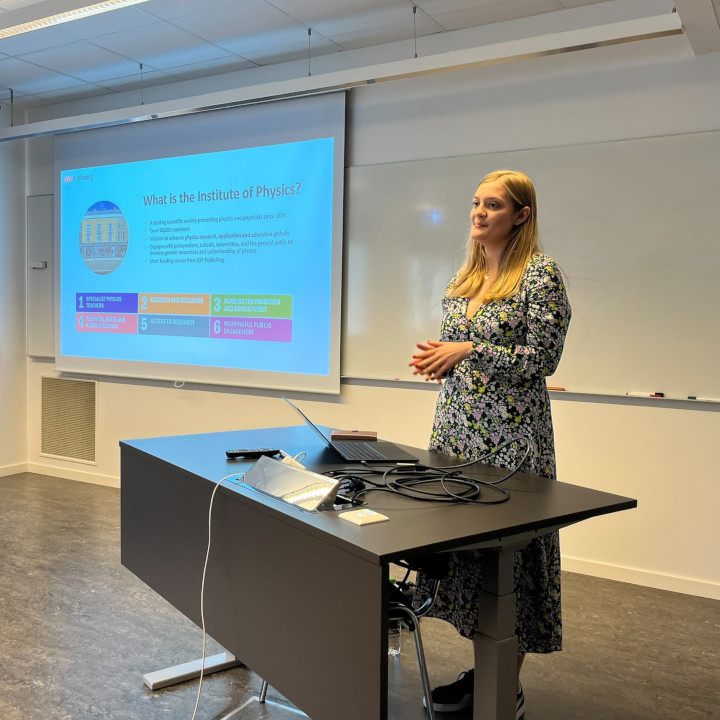
Opponent Saikat Chatterjee (on Zoom), Yu-Wei Chang (left), and PhD co-supervisor Joana B. Pereira (right). (Photo by P.-J. Chien.)Yu-Wei Chang completed the first half of his doctoral studies and he defended his half-time on the 3rd of November 2023.
The presentation was conducted in a hybrid format, with part of the audience present in the Nexus room and the remainder connected through Zoom. The seminar comprised a presentation covering both his completed and planned projects, followed by a discussion and questions posed by his opponent, Prof. Saikat Chatterjee.
The presentation commenced with an overview of his concluded projects. The first project involves handling incomplete medical datasets using neural networks and is published in ‘Machine Learning: Science and Technology.‘ It then transitioned to his second project, focusing on the development of software for brain connectivity analysis using multilayer graphs and deep learning. The corresponding repository is accessible on GitHub. In the final segment, he outlined the proposed continuation of his PhD, discussing an ongoing project centered around the deep learning analysis of longitudinal brain neural imaging data.
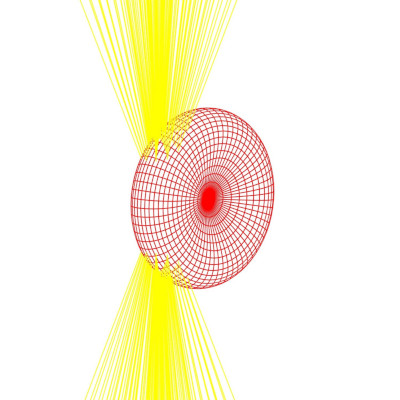
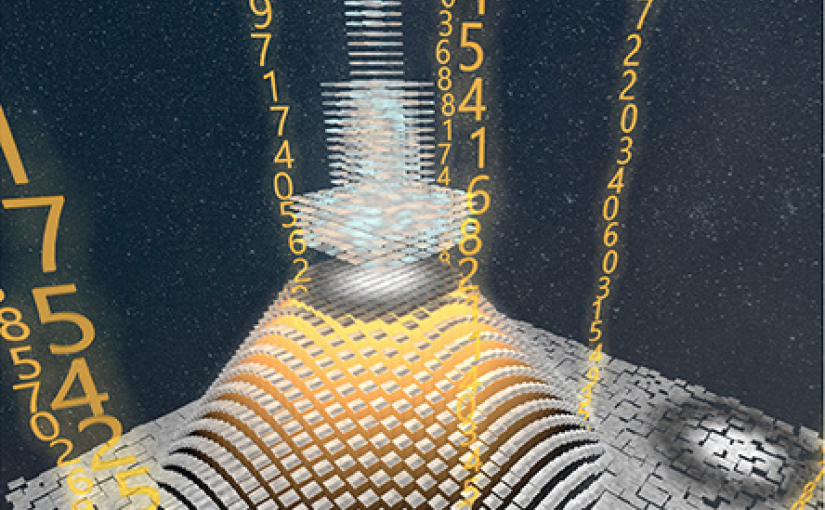
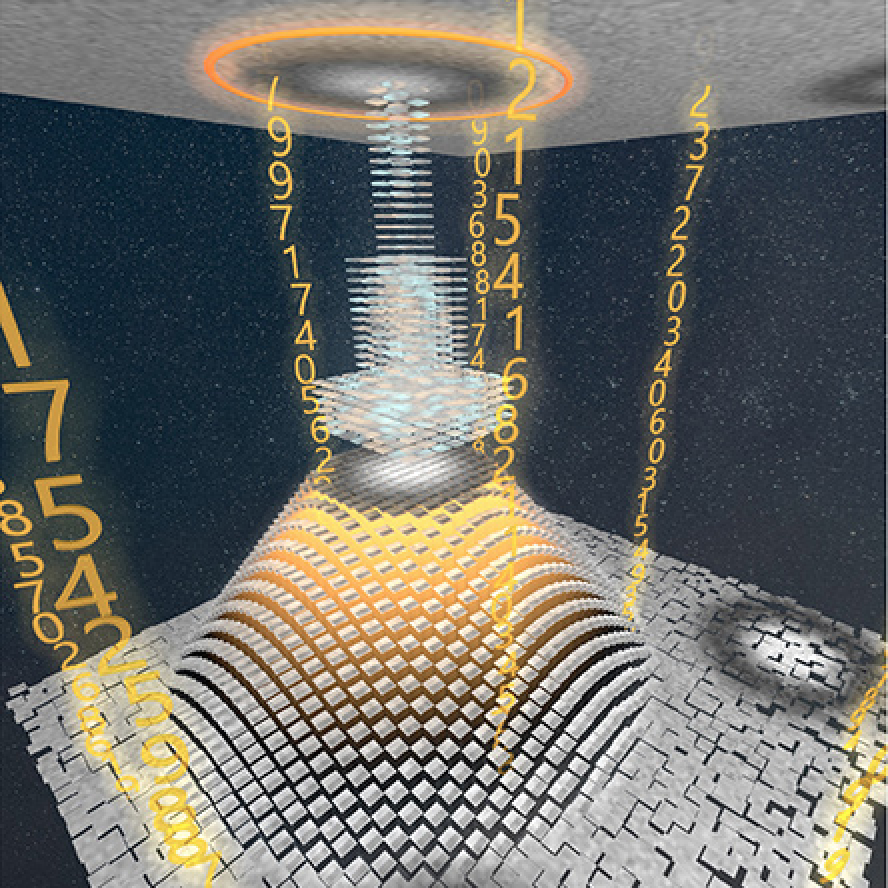
Schematic of a red blood cell in a focused optical beam. (Image by E. Erdem.)Optical trapping of red blood cells and different geometrical shapes
Emir Erdem
Red Blood Cells (RBC), also known as erythrocyts, are essential cells that are present in the blood of every vertebrate. Because of their hemoglobin protein content, they carry oxygen to the cells and perform a vital function. Due to their complex shapes, behavior of cells like RBCs under optical forces are not fully been discovered. In this study, the behavior of RBCs as well as other shapes under optical trap are simulated using OTGO which is a numeric toolbox utilizing geometrical optics approximation for optical calculations. As a result of the simulations, it is observed that the RBC aligns itself in a vertical configuration, parallel to the incident beam propagating towards the cell from below. Conducted static analysis showed that it is possible to stably trap a RBC in all three dimensions. The center of the trap is near the edge of the cell, where the thickness is larger. After the analysis on RBC, how well different geometrical shapes can optically be trapped are investigated by integrating different shapes modeled by spherical harmonics to OTGO. A similar static analysis is conducted on a dumbbell shape and its trapping effectiveness is compared with an ellipsoid. A dumbbell shape can effectively be trapped in the horizontal plane similar to an ellipsoid, but in the light propagation direction, it is more challenging to trap the shape and it requires modifications on optical properties of the setup. The aim of this study after this point is to optimize the optical force calculations by training a neural network model and to apply flow conditions to cells.
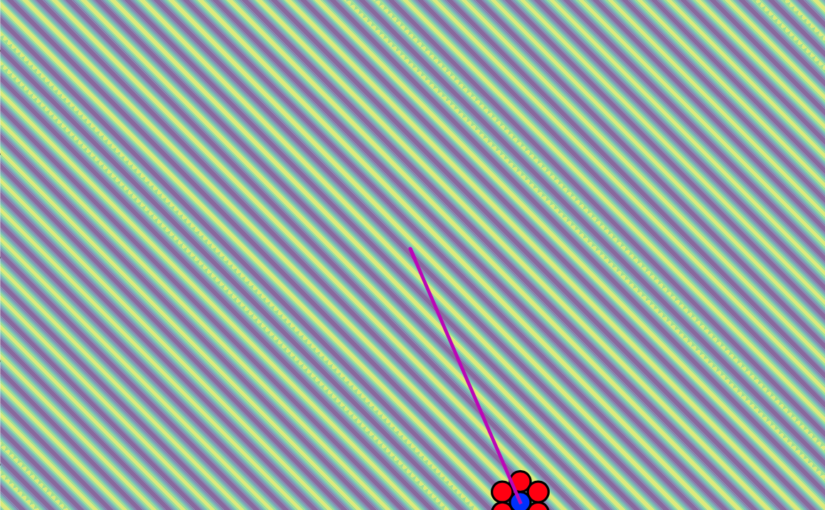
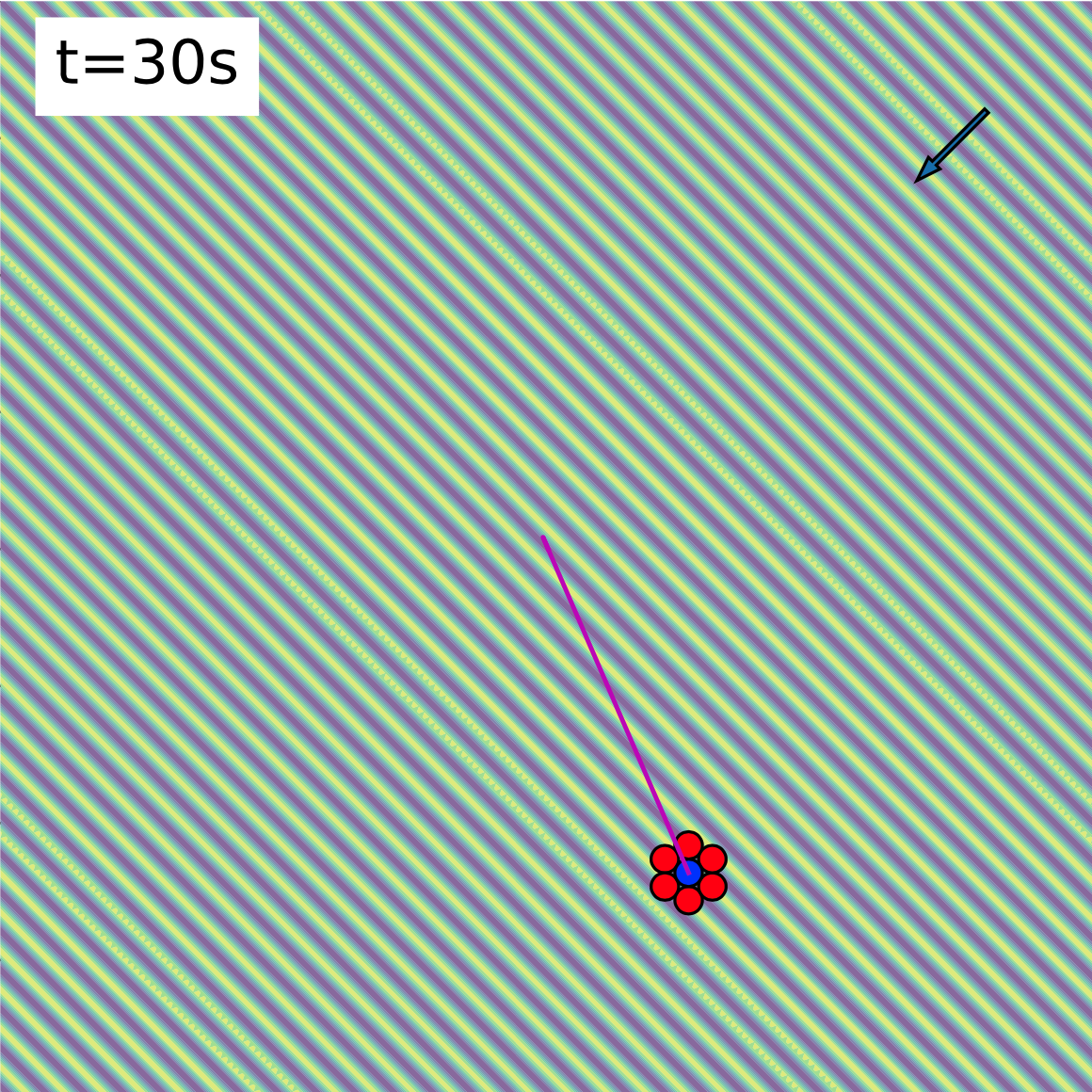
Trajectory of a hexagonal cluster formed by a transparent particle (blu circle) and six light-absorbing particles (red circles) in a traveling sinusoidal optical pattern, in the absence of thermal noise. The direction of the motion of the optical pattern is given by the arrow. The trajectory’s duration is 30 s. (Image by A. Bergsten.)Alfred Bergsten defended his Master Thesis on 18 September 2023 at 17:00. Congrats!
Title: Controlling Active Clusters Using Wave-Shaped Light Patterns
Abstract:
Colloidal systems appear in various contexts. In some of these systems, thermophoretic forces can arise around otherwise passive particles when they are illuminated, leading to the emergence of complex behaviours. These types of systems has been extensively studied under constant, uniform light where the emergent behaviours are simply activated and deactivated. The aim of this project is to show that the emergent behaviour can not only be activated and deactivated, but also controlled by employing more complex light patterns.
The model used in this project includes Brownian motion and thermophoretic forces, with collisions between particles being resolved by a volume exclusion method. The thermophoretic forces are activated by employing travelling wave light patterns to affect the behaviours of different clusters formed as a result of these forces. Two different patterns are then superimposed to show that more complex light patterns can induce more complex behaviours.
This study is mostly qualitative in nature and only conducted in simulations. While the parameter space has only been roughly explored and the study needs to be validated through physical experiments, the results of the project indicate that a more comprehensive exploration of the parameter space for a broader range of clusters can be of interest.
Supervisor: Agnese Callegari Examiner: Giovanni Volpe Opponent: Simon Carlson
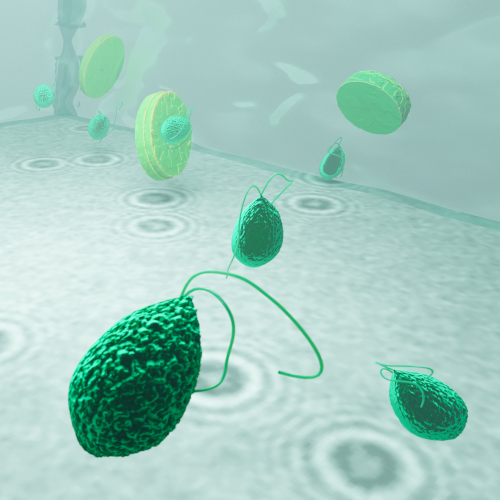
Planktons imaged under a holographic microscope. (Illustration by J. Heuschele.)
Bringing microplankton to focus: Holography and deep learning Harshith Bachimanchi
21 September 2023, 11:15 AM CEST
The marine microbial food web plays a central role in the global carbon cycle. However, our mechanistic understanding of the ocean is biased toward its larger constituents, while rates and biomass fluxes in the microbial food web are mainly inferred from indirect measurements and ensemble averages. Yet, resolution at the level of the individual microplankton is required to advance our understanding of the microbial food web. Here, we demonstrate that, by combining holographic microscopy with deep learning, we can follow microplanktons throughout their lifespan, continuously measuring their three-dimensional position and dry mass. The deep-learning algorithms circumvent the computationally intensive processing of holographic data and allow rapid measurements over extended time periods. This permits us to reliably estimate growth rates, both in terms of dry mass increase and cell divisions, as well as to measure trophic interactions between species such as predation events. The individual resolution provides information about selectivity, individual feeding rates, and handling times for individual microplanktons. The method is particularly useful to detail the rates and routes of organic matter transfer in micro-zooplankton, the most important and least known group of primary consumers in the oceans. Studying individual interactions in idealized small systems provides insights that help us understand microbial food webs and ultimately larger-scale processes. We exemplify this by detailed descriptions of micro-zooplankton feeding events, cell divisions, and long-term monitoring of single cells from division to division.
Drying of a microgel monolyer. (Image by M. Karg.)Microgel monolayers at liquid interfaces: In situ analysis and role of uniaxial compression
Matthias Karg
20 September 2023, 12:30, Nexus
Microgels are soft polymeric objects with an internal gel-like structure and overall dimensions in the colloidal regime [1]. It is known that microgels strongly adsorb to liquid/liquid and liquid/air interfaces. Many studies in the last two decades attempted to understand the phase behavior of soft, deformable microgels at such liquid interfaces. Typically, the microstructures in dependence on applied surface pressure are studied ex situ using transfer of microgel monolayers from the liquid to a solid interface followed by investigation with different types of microscopies. Interestingly, in situ studies at the liquid interface are scare to nonexistent.
We tackled two challenges in this respect: 1) We managed to synthesize core-shell microgels that are large enough to be studied by optical microscopy or small-angle scattering using light [2]. 2) We build a setup that combines a Langmuir trough with small-angle light scattering (LTSALS) that allows for the large area study of monolayers during compression with excellent resolution in time [3]. In this work we present first results of the in situ analysis of microgel monolayers at air/water interfaces. Instead of the commonly reported solid-solid isostructural phase transition [4,5], we find a continuous compression of the monolayer with continuously decreasing interparticle distances [3]. Furthermore, drying of a thin liquid film with the monolayer at the liquid/air interface on hydrophilic and hydrophobic substrates shines light on the complex interplay between softness, adhesion and capillary interactions. We then studied the role of uniaxial compression/expansion by using our LT-SALS setup. Upon compression and/or expansion the monolayer remains somewhat anisotropic and a fast and a slow relaxation process is observed during an equilibration phase, i.e. when compression or expansion is stopped. Possible explanations for this behavior will be discussed.
References
[1] M. Karg, et al., Langmuir, 2019, 35, 6231-6255.
[2] K. Kuk, L. Gregel, V. Abgarjan, C. Croonenbrock, S. Hänsch, M. Karg, Gels 2022, 8, 516.
[3] K. Kuk, V. Abgarjan, L. Gregel, Y. Zhou, V. Carrasco-Fadanelli, I. Buttinoni, M. Karg, Soft
Matter, 2023, 19, 175-188.
[4] M.Rey, et al., Soft Matter, 2016, 12, 3545-3557.
[5] A. Rauh, et al., Soft Matter, 2017, 13, 158-169
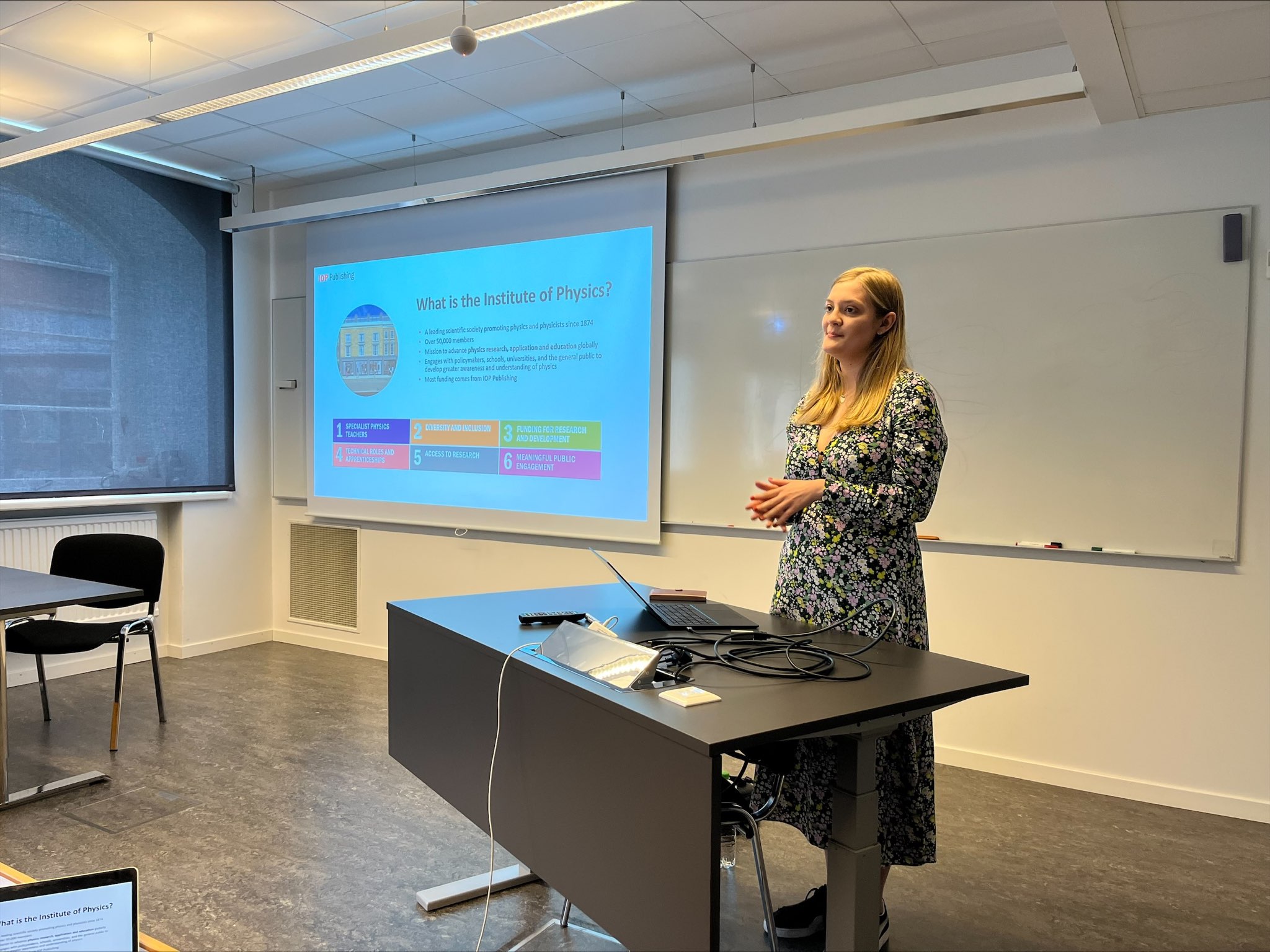
(Photo by G. Volpe.)How to get published: a talk from IOP Publishing
Kate Porter
IOP Publishing
Do you want your article to stand out from the crowd, improving your chances of publication in this highly competitive industry? If so, you won’t want to miss this talk from Kate Porter, Senior Publisher from IOP Publishing! During this talk, Kate will provide you with a toolkit to help you navigate the world of academic publishing and share some top tips to help you get published.
Topics covered in this talk include:
Choosing the right journal for your research
Open access and transformative agreements
Publication ethics
Top tips for writing your article so it captures the interest of editors/reviewers
Peer review and responding to reviewers
Post-acceptance activities to promote your article
Date: 6 Sep 2023 Time: 12:30 PM Location: PJ
Kate Porter in PJ salen. (Photo by G. Volpe.)PhD students at the faculty of science attending the seminar. (Photo by G. Volpe.)
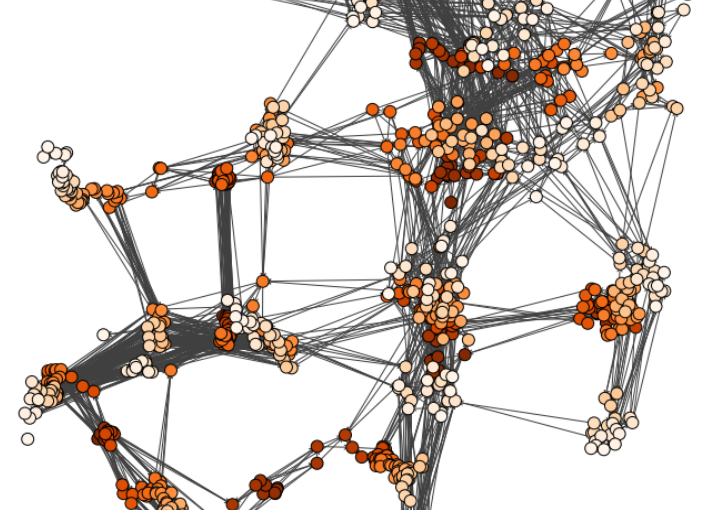
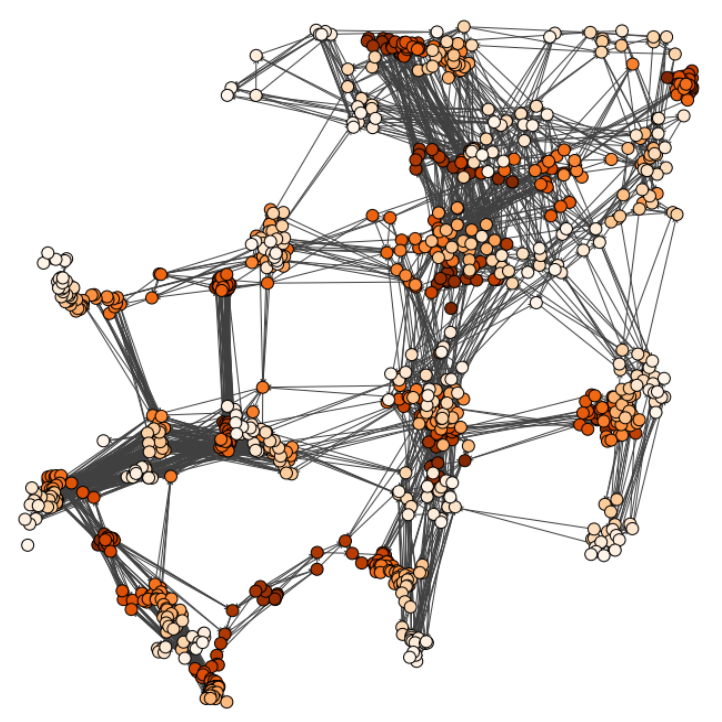
Input graph structure including a redundant number of edges. (Image by J. Pineda.)MAGIK: Microscopic motion analysis through graph inductive knowledge Jesús Pineda Date: 23 August 2023 Time: 2:30 PM PDT
Characterizing dynamic processes in living systems provides essential information for advancing our understanding of life processes in health and diseases and for developing new technologies and treatments. In the past two decades, optical microscopy has undergone significant developments, enabling us to study the motion of cells, organelles, and individual molecules with unprecedented detail at various scales in space and time. However, analyzing the dynamic processes that occur in complex and crowded environments remains a challenge. This work introduces MAGIK, a deep-learning framework for the analysis of biological system dynamics from time-lapse microscopy. MAGIK models the movement and interactions of particles through a directed graph where nodes represent detections and edges connect spatiotemporally close nodes. The framework utilizes an attention-based graph neural network (GNN) to process the graph and modulate the strength of associations between its elements, enabling MAGIK to derive insights into the dynamics of the systems. MAGIK provides a key enabling technology to estimate any dynamic aspect of the particles, from reconstructing their trajectories to inferring local and global dynamics. We demonstrate the flexibility and reliability of the framework by applying it to real and simulated data corresponding to a broad range of biological experiments.
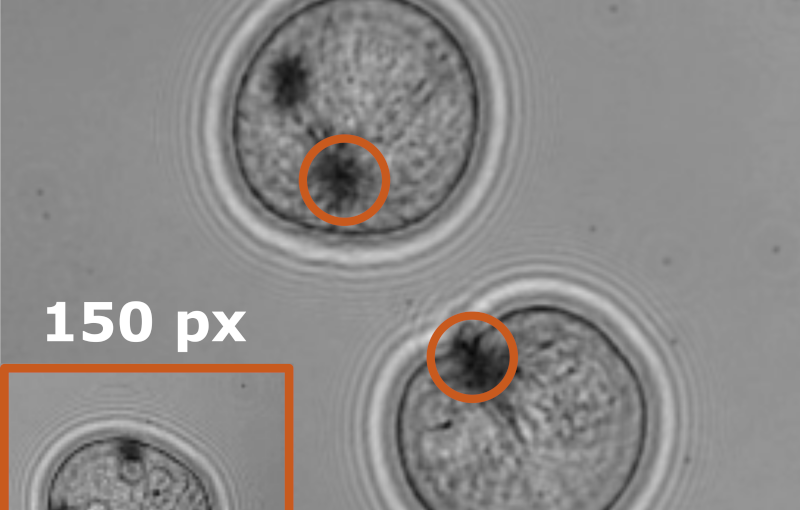
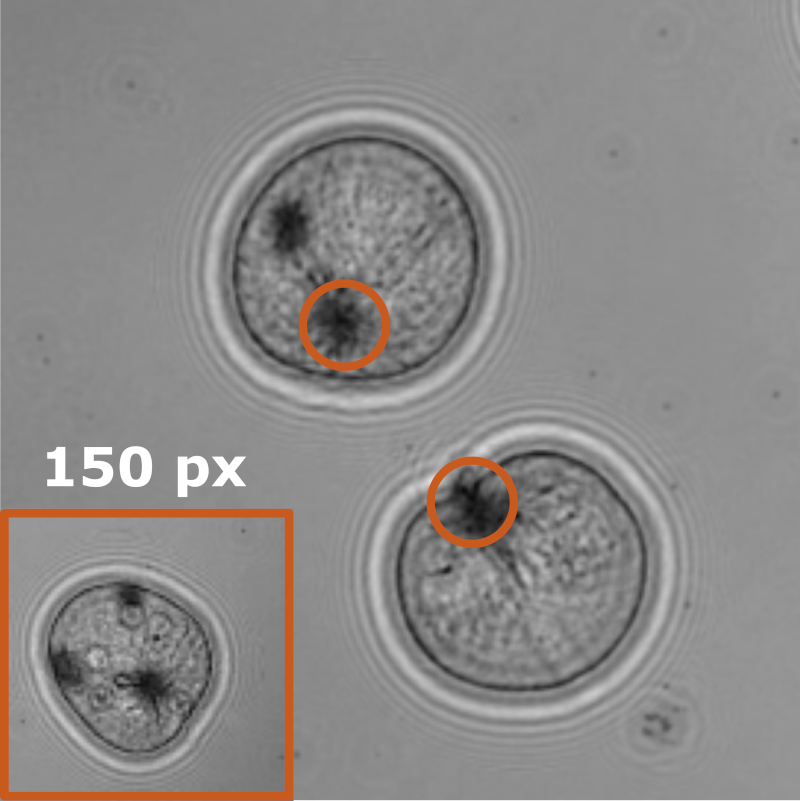
LodeSTAR tracks the plankton Noctiluca scintillans. (Image by the Authors of the manuscript.)Single-shot self-supervised object detection Benjamin Midtvedt, Jesus Pineda, Fredrik Skärberg, Erik Olsén, Harshith Bachimanchi, Emelie Wesén, Elin Esbjörner, Erik Selander, Fredrik Höök, Daniel Midtvedt, Giovanni Volpe Date: 23 August 2023 Time: 10:30 AM (PDT)
Object detection is a fundamental task in digital microscopy. Recently, machine-learning approaches have made great strides in overcoming the limitations of more classical approaches. The training of state-of-the-art machine-learning methods almost universally relies on either vast amounts of labeled experimental data or the ability to numerically simulate realistic datasets. However, the data produced by experiments are often challenging to label and cannot be easily reproduced numerically. Here, we propose a novel deep-learning method, named LodeSTAR (Low-shot deep Symmetric Tracking And Regression), that learns to detect small, spatially confined, and largely homogeneous objects that have sufficient contrast to the background with sub-pixel accuracy from a single unlabeled experimental image. This is made possible by exploiting the inherent roto-translational symmetries of the data. We demonstrate that LodeSTAR outperforms traditional methods in terms of accuracy. Furthermore, we analyze challenging experimental data containing densely packed cells or noisy backgrounds. We also exploit additional symmetries to extend the measurable particle properties to the particle’s vertical position by propagating the signal in Fourier space and its polarizability by scaling the signal strength. Thanks to the ability to train deep-learning models with a single unlabeled image, LodeSTAR can accelerate the development of high-quality microscopic analysis pipelines for engineering, biology, and medicine.
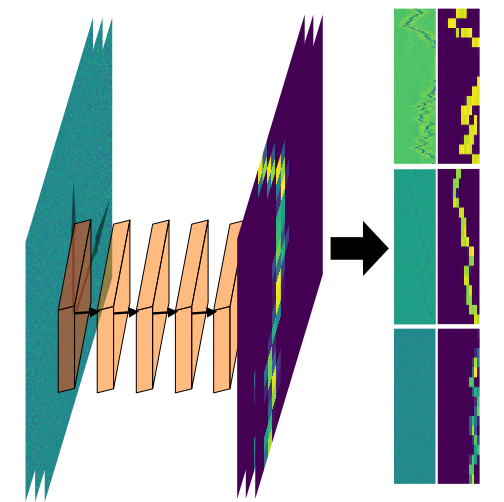
A convolutional neural network characterizes the properties of very small biomolecules without requiring prior detection. (Image by H. Klein Moberg.)Deep learning for nanofluidic scattering microscopy
Henrik Klein Moberg
Date: 23 August 2023
Time: 8:15 AM PDT
We show that a custom ResNet-inspired CNN architecture trained on simulated biomolecule trajectories surpasses the performance of standard algorithms in terms of tracking and determining the molecular weight and hydrodynamic radius of biomolecules in the low-kDa regime in optical microscopy. We show that high accuracy and precision is retained even below the 10-kDa regime, constituting approximately an order of magnitude improvement in limit of detection compared to current state-of-the-art, enabling analysis of hitherto elusive species of biomolecules such as cytokines (~5-25 kDa) important for cancer research and the protein hormone insulin (~5.6 kDa), potentially opening up entirely new avenues of biological research.