Presentation by A. Domenzain at SPIE-ETAI, San Diego, 25 August 2026

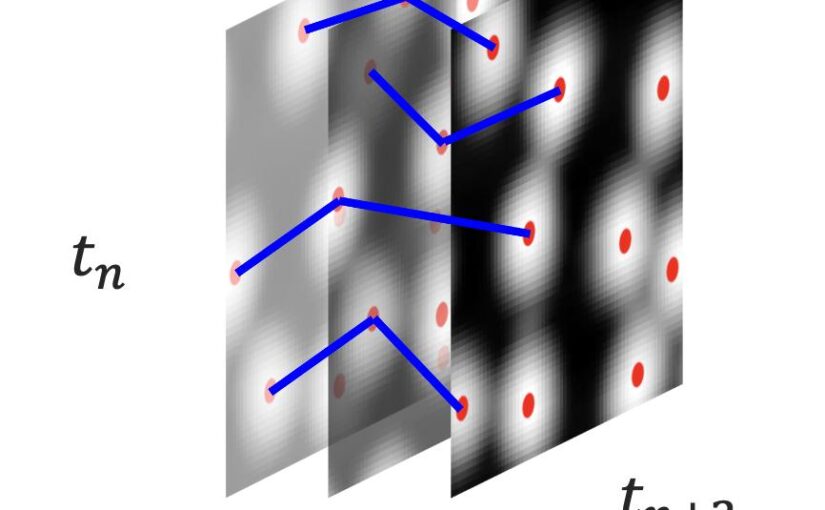
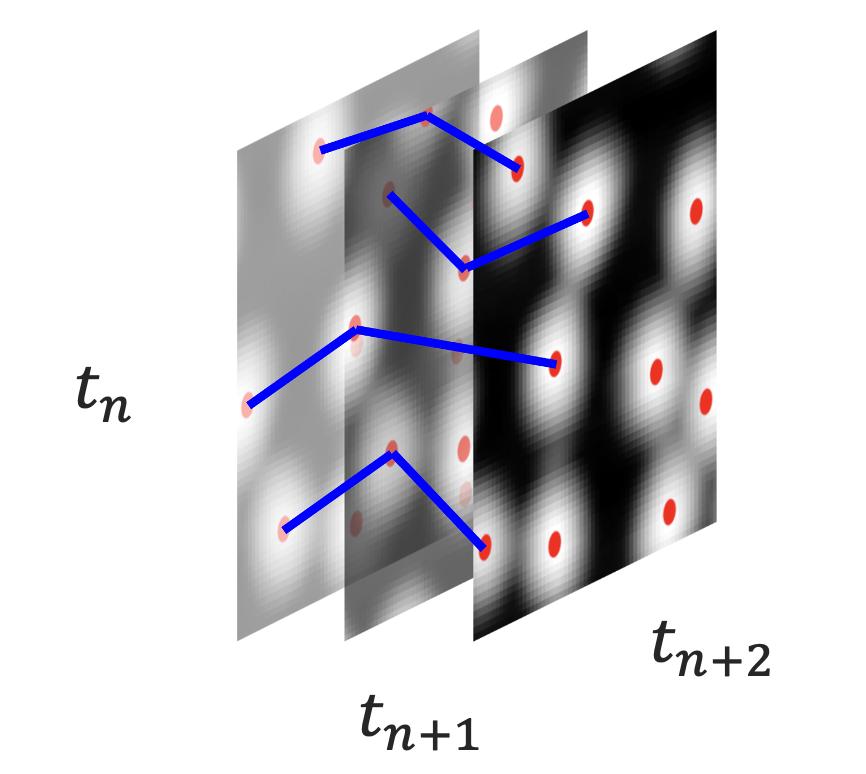
Particle tracking turns microscopy videos into measurable motion, revealing how cells, molecules, and materials move and interact. Combining standard and deep learning-based methods, users can create custom, modular pipelines enabling high-throughput, automated and unbiased trajectory determination.  (Image by A. Domenzain)
Particle tracking in quantitative microscopy: a modular tutorial on classical and deep learning methods
Aarón Domenzain, Alex Lech, Jesco Schönfelder, Marta Conti, Daniel Midtvedt, Marcel Rey, Carlo Manzo, Giovanni Volpe
Date: 25 August 2026
Time: 9:35 AM – 9:50 AM PDT
Place: Conv. Ctr. Room 2

Particle tracking is a central tool in digital microscopy for quantifying micro- and nanoscale dynamics. Selecting and validating appropriate methods remains challenging, particularly under low signal-to-noise ratios or high particle densities and for researchers with limited computational expertise. In this talk, we present a modular, Python notebook-based tutorial that organizes tracking into two stages—object detection and trajectory linking—providing a structured basis for systematic comparison of classical and deep learning approaches and stage-specific performance diagnosis. For detection, we compare intensity thresholding and Gaussian feature localization (Crocker-Grier) with convolutional neural networks, including supervised segmentation (U-Net) and a self- supervised geometric deep learning model (LodeSTAR). For linking, we evaluate nearest-neighbor and Hungarian assignment methods alongside a graph neural network classifier (MAGIK). Hands-on examples using simulated datasets with ground truth support quantitative benchmarking that identifies performance regimes and computational trade-offs. The resulting workflows are ready-to-use and adaptable across diverse scenarios.

Soft Matter Lab members present at SPIE Optics+Photonics conference in San Diego, 23-27 August 2026

The Soft Matter Lab participates to the SPIE Optics+Photonics conference in San Diego, CA, USA, 23-27 August 2026, with the presentations listed below.

Giovanni Volpe is a coauthor of the following presentations:

  • Mite Mijalkov In-silico cognition signals aging and cognitive decline
    23 August 2026 • 3:15 PM – 3:30 PM PDT | Conv. Ctr. Room 2
    [link on SPIE]
  • Iok-ui Tiunn Unsupervised analysis of 3D human bone reveals age-sensitive niches for CXCL12+ stromal cells
    24 August 2026 • 2:15 PM – 2:30 PM PDT | Conv. Ctr. Room 2
    [link on SPIE]
  • Alexandra Badea Graph-Based Embeddings of Laminar Cortical Columns Reveal Interpretable Microstructural Patterns Associated with Alzheimer’s Disease Risk (Invited Paper)
    26 August 2026 • 10:30 AM – 11:00 AM PDT | Conv. Ctr. Room 2
    [link on SPIE]
  • Massimiliano Passaretti Clinical progression and genetic pathways in body-first and brain-first Parkinson’s disease
    26 August 2026 • 2:15 PM – 2:30 PM PDT | Conv. Ctr. Room 2
    [link on SPIE]
  • Mite Mijalkov The locus coeruleus gap: a novel marker of neurodegenerative resilience
    27 August 2026 • 8:45 AM – 9:00 AM PDT | Conv. Ctr. Room 2
    [link on SPIE]

Aarón Domenzain joins the Soft Matter Lab

(Photo by A. Ciarlo.)
Aarón Domenzain starts his PhD at the Physics Department of the University of Gothenburg on 2 September 2024.

Aarón has a Master degree in Nanotechnology from Chalmers University of Technology, Gothenburg.

In his PhD, he will focus on optical tweezers and applications.