Researchers at the University of Gothenburg, together with researchers from Portugal, have now found a way to estimate the probability that a patient will suffer from a common genetic disease by training an algorithm using patient data. Continue reading (in English)
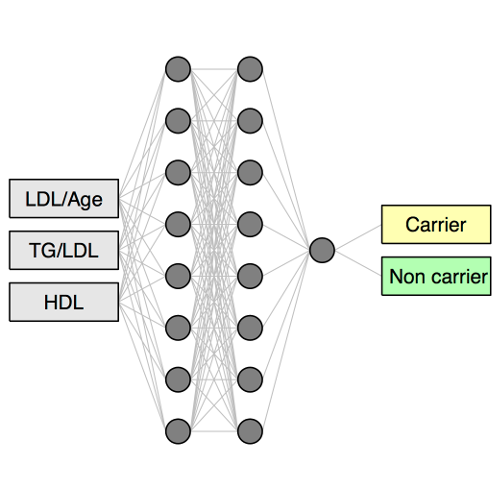
Neural networks consist of a series of connected layers of neurons, whose connection weights are adjusted to learn how to determine the diagnosis from the input data.
Virtual genetic diagnosis for familial hypercholesterolemia powered by machine learning
Anna Pina, Saga Helgadottir, Rosellina Margherita Mancina, Chiara Pavanello, Carlo Pirazzi, Tiziana Montalcini, Roberto Henriques, Laura Calabresi, Olov Wiklund, M Paula Macedo, Luca Valenti, Giovanni Volpe, Stefano Romeo
European Journal of Preventive Cardiology (2020)
doi: https://doi.org/10.1177/2047487319898951
Aims
Familial hypercholesterolemia (FH) is the most common genetic disorder of lipid metabolism. The gold standard for FH diagnosis is genetic testing, available, however, only in selected university hospitals. Clinical scores – for example, the Dutch Lipid Score – are often employed as alternative, more accessible, albeit less accurate FH diagnostic tools. The aim of this study is to obtain a more reliable approach to FH diagnosis by a “virtual” genetic test using machine-learning approaches.
Methods and results
We used three machine-learning algorithms (a classification tree (CT), a gradient boosting machine (GBM), a neural network (NN)) to predict the presence of FH-causative genetic mutations in two independent FH cohorts: the FH Gothenburg cohort (split into training data (N = 174) and internal test (N = 74)) and the FH-CEGP Milan cohort (external test, N = 364). By evaluating their area under the receiver operating characteristic (AUROC) curves, we found that the three machine-learning algorithms performed better (AUROC 0.79 (CT), 0.83 (GBM), and 0.83 (NN) on the Gothenburg cohort, and 0.70 (CT), 0.78 (GBM), and 0.76 (NN) on the Milan cohort) than the clinical Dutch Lipid Score (AUROC 0.68 and 0.64 on the Gothenburg and Milan cohorts, respectively) in predicting carriers of FH-causative mutations.
Conclusion
In the diagnosis of FH-causative genetic mutations, all three machine-learning approaches we have tested outperform the Dutch Lipid Score, which is the clinical standard. We expect these machine-learning algorithms to provide the tools to implement a virtual genetic test of FH. These tools might prove particularly important for lipid clinics without access to genetic testing.
Polymers under local active forces: a simplified stochastic model for motor-induced translocations.
Seminar by Laura Natali from the University of Rome “La Sapienza”, Rome, Italy.
Molecular motors are a wide class of enzymes that can transport even large macromolecules by converting chemical into mechanical energy, through the process of ATP-hydrolysis. Among those, active nanopore translocation is a common mechanism to carry proteins across biological membranes. The phospholipid bilayer is impenetrable for the folded protein, that requires to be unfolded and pulled across channels such as alpha-hemolysin [1]. Exploiting the translocation process, we can acquire information about the target proteins’ structure, such as the intermediate configurations between the folded and denatured structures [2]. Here follows the interest in modeling the motor proteins complex in a simple simulation setup.
First of all, we characterized the active polymer’s features in free space and subsequently, we confined it inside a nanopore model. The study in free space aims to investigate how activity affects both the global and the local polymer properties. The chosen model for the active force is an Active Ornstein-Uhlenbeck Particle, a model closely related to Active Brownian Particles [3]. The presence of the catalytic head affects the end-to-end distance of the polymer, which describes its degree of compactness. The active chain can be studied through the Rouse mode decomposition [4], which allowed us to analyze the dependence of the second moment of the end-to-end distance as a function of the persistence time of the activity. We considered also the distance between consecutive monomers, which provides an insight into the local effects of the active force and how it is transmitted along the chain.
In this work, we were inspired by an experiment employing the ClpXP complex [5], a protein-degradation machine responsible for unfolding and digesting malfunctioning proteins through unidirectional transport across the nanopore. In the model we propose, we enclose the polymer chain in a confining potential, simulating the effect of the nanopore. The energy generated by the molecular motor translocates the polymers, which means they cross the pore from side to side. In our setup, the effect of the molecular motor [6] is represented as a potential barrier combined with a region that makes active the monomers that are crossing it. The translocation pathways have a step-wise profile typical of their biological counterparts.
References:
J. Nivala, D. B. Marks and M. Akeson, Nature Biotechnol., 2013, 31, 247
M. Bacci, M. Chinappi, C. M. Casciola and F. Cecconi, J. Phys.Chem. B, 2012, 116, 4255–4262
L. Caprini and U. M. B. Marconi, Soft matter, 2018, 14, 9044–9054.
P. E. Rouse, J. Chem. Phys., 1953, 21, 1272.
T. A. Baker and R. T. Sauer, Biochimica et Biophysica Acta (BBA) – Molecular Cell Research, 2012, 1823, 15–28.
L. Caprini, U. Marini Bettolo Marconi, A. Puglisi and A. Vulpiani, J. Chemi. Phys., 2019, 150, 024902.
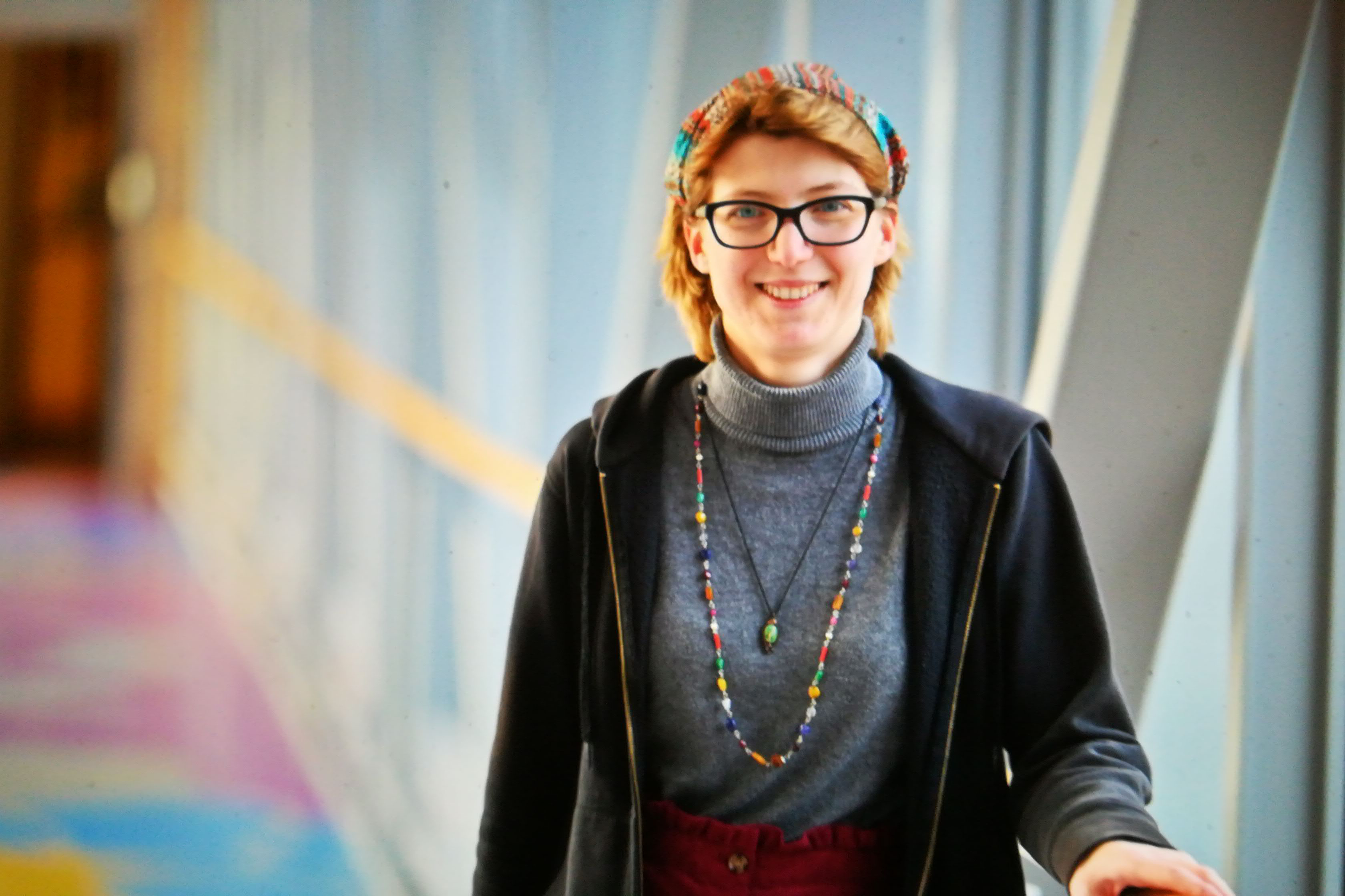
Hillevi Wachtmeister joined the Soft Matter Lab on 21 January 2020.
Hillevi Wachtmeister is a Master student in Physics at Chalmers University of Technology.
During her Master thesis work she will work on characterizing and tracking different particles and micro organisms using deep learning. She is supervised by Daniel Midtvedt.
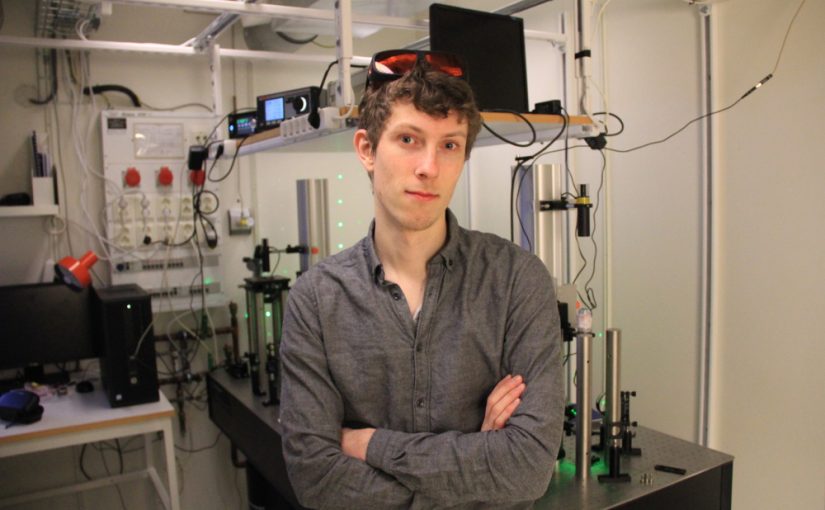
Harshith Bachimanchi. (Photo by A. Argun)Harshith Bachimanchi starts his PhD at the Physics Department of the University of Gothenburg on 20th January 2020.
Harshith has a Master degree in physics from the Indian Institute of Science Education and Research, Pune, India, where he submitted a Master thesis in optics, whose results can be found here.
In his PhD, he will focus on microscopy and deep learning.
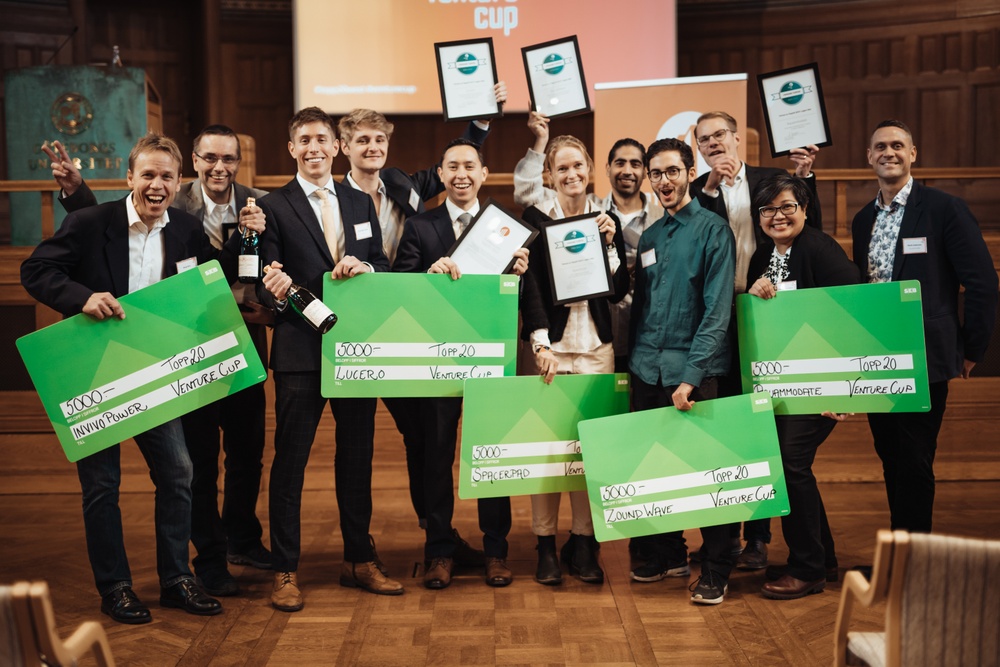
Lucero will compete, among other 41 semifinalists, for cash prizes and business support.
In addition, Lucero was awarded one of the three Early Stage Entrepreneurship Travel Grants to attend the semi-final.
The start-up is aiming to make cutting-edge laser technology easy to use and available to anyone by combining it with commercial microscope. The product and software combo utilizes optical tweezers in a brand-new way – and bridges the gap between physics and other scientific fields that would greatly benefit from easier access to this tool.
On Monday, the 16th of December, Falko Schmidt, will visit Frank Cichos’ lab at the University of Leipzig. He will present latest research on a nanoscopic particle in a harmonic trap.
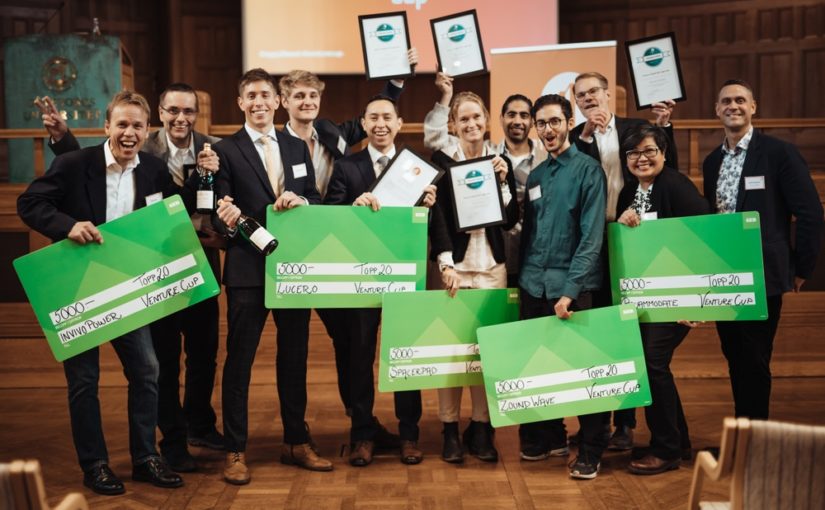
Falko Schmidt and other researchers at the University of Gothenburg, in collaboration with Business students at the Chalmers School of Entrepreneurship, have received early acclaimfor their Start-up idea “Lucero Bio”.
Lucero Bio was ranked among one of the top 5 business ideas in West Sweden by Venture Cup Sweden. Out of the 376 ideas that were submitted to the competition, nearly half came from the western region of Sweden.
The start-up is aiming to make cutting-edge laser technology easy to use and available to anyone by combining it with commercial microscope. The product and software combo utilizes optical tweezers in a brand-new way – and bridges the gap between physics and other scientific fields that would greatly benefit from easier access to this tool.
Team components: Christopher Jacklin, Rich Zapata Rosas, Felix Mossberg, Falko Schmidt, Alejandro Diaz Tormo and Martin Mojica-Benavides.
On Friday, the 13th of December, Falko Schmidt, will visit Juliane Simmchen’s lab at the Technical University of Dresden. He will present results on Liquid-Liquid-Phase Separation a project that is currently in collaboration with their lab.
Light-induced phase separation power novel micro machines Falko Schmidt, and Giovanni Volpe
Light at the Nanoscale Conference, Chalmers University, Gothenburg, Sweden
5 December 2019, 16:30-18:30
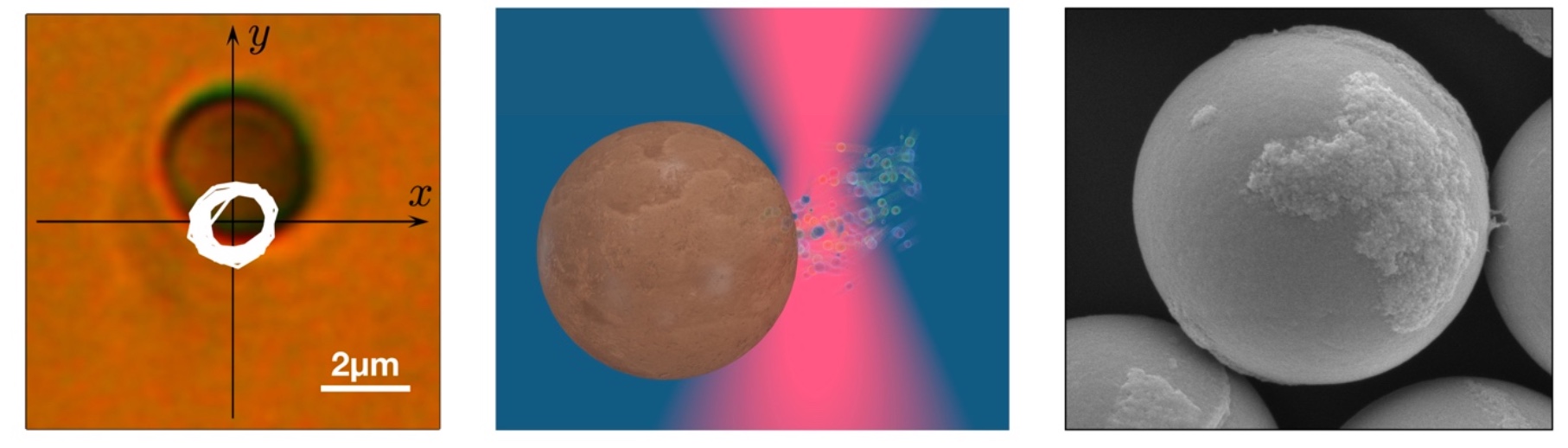
Focused laser light is used to trap a micronsized absorbing particle around its beam center where it performs constant orbital rotation. The light-induced local phase separations create a concentration gradient on which the particle moves along. Large patches of absorbing material on the particle’s surface give rise to a torque required for steady rotation1
Phase separation is a phenomena that commonly exists in nature, from the freezing of ice to the intrinsic mechanism of the cell to order matter. We are exploiting phase separations to produce new types of miniaturised machines, in particular micron and nano sized engines1as well as to form self-assembled colloidal molecules2. We control their behaviour using only light and varying its ambient temperature making this a simple tool to study complex matter3. This will enhance the development of future medicine where nano robots deliver drugs specifically to the local infection side.
References:1. F. Schmidt et al. Microscopic engine powered by critical demixing, Phys Rev Lett 120, 068004, 2018
2. F. Schmidt et al. Light-controlled assembly of active colloidal molecules, J Chem Phys150, 094905, 2019
3. S. Bo et al. Measurement of anomalous diffusion using recurrent neural networks, Phys Rev E 100, 010102(R), 2019