Alex Lech defended his Master Thesis on 16 May 2024. Congrats!

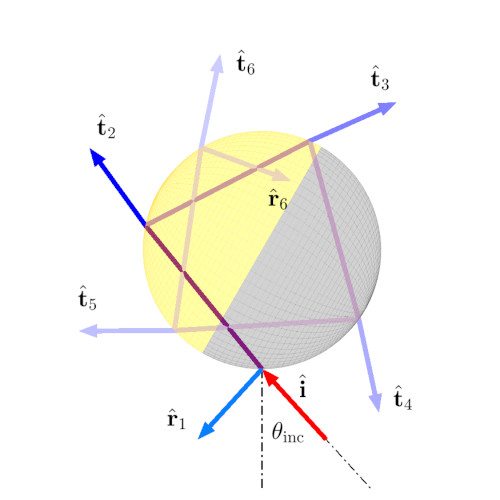
Rendering of the absorption of optical power by iron-oxide nanocores in a super-paramagnetic particle. (Image by A. Lech.)
Alex Lech defended his Master Thesis on 16 May 2024 at 15:45. Congrats!

Title: Simulation of light-absorbing microparticles in an optical landscape

Abstract:
Simulating the dynamics of active particles play a key role in understanding the many behaviours active matter can exhibit. Experimental studies are more costly than simulations in this regard, as there is much work that needs to be performed with setups and observation time. Computer simulations are a powerful and cost-effective alternative to experiments. One topic of study within active matter is light-absorbing microparticles which are commonly made of silica with a light-absorbing metallic compound such as iron oxide or gold. One such microparticle is the Janus particle, a silica particle with a hemispherical coating of gold as the absorbing compound. When illuminated with a laser, the coating absorbs the light and heats up rapidly, generating a temperature gradient which allows the Janus particle to exhibit self-propulsion and clustering with other Janus particles due to thermophoresis and Brownian motion.

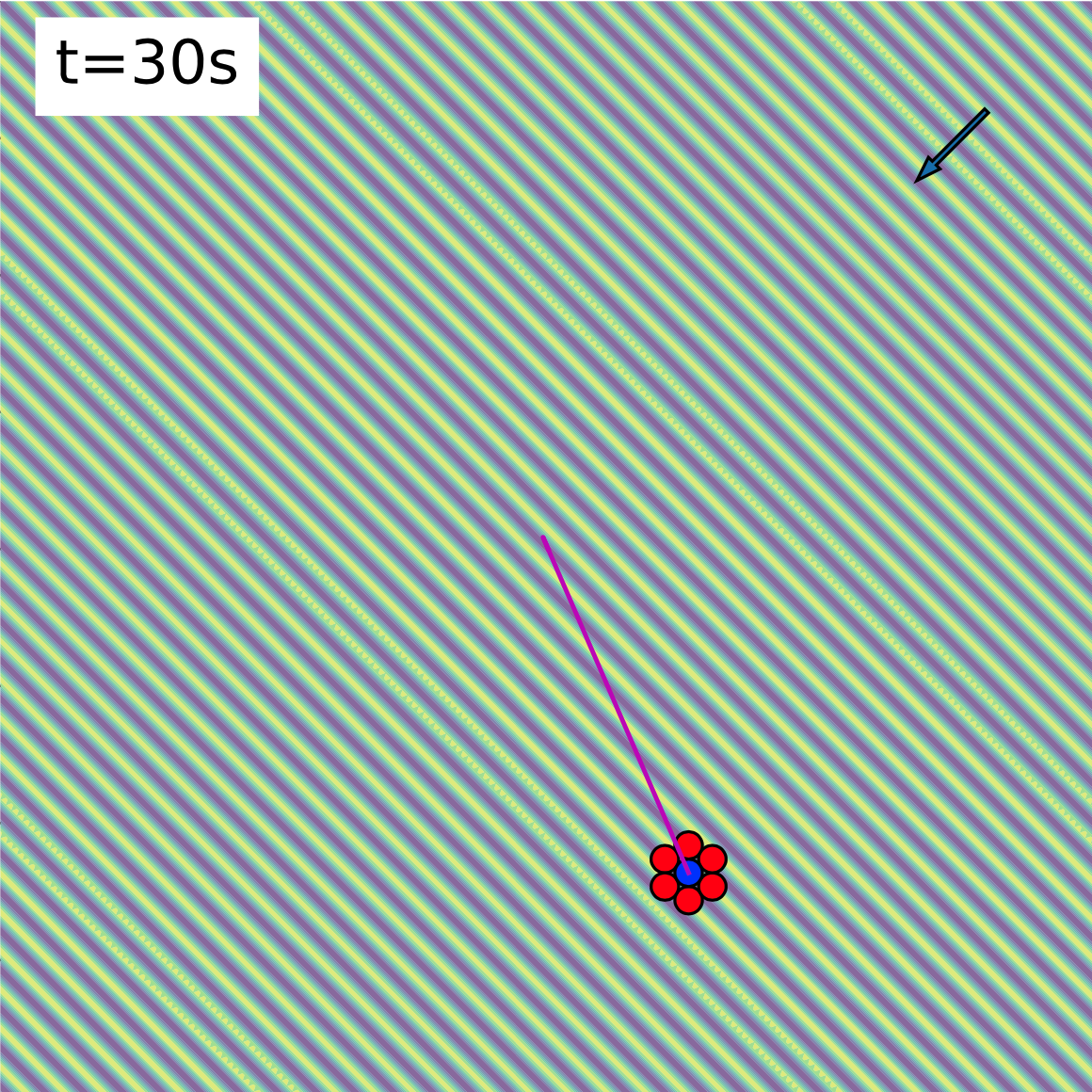
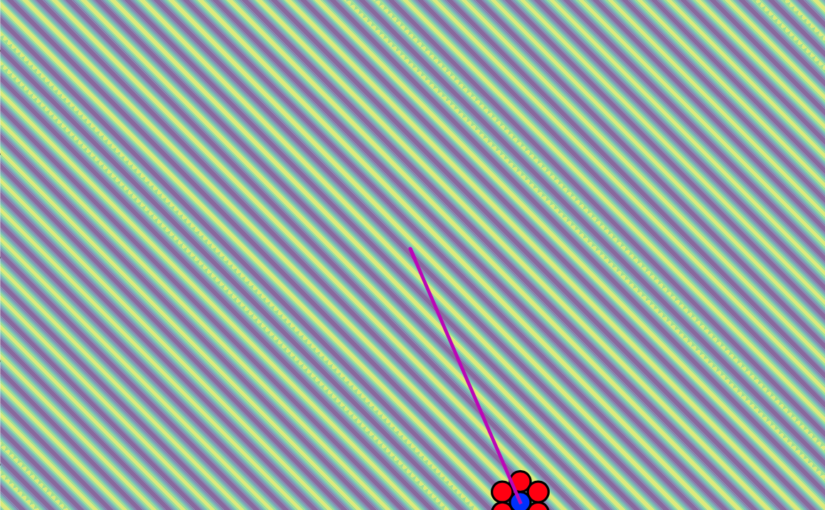
In this thesis, I introduce a simulation model which simulates light-absorbing microparticles with a desired distribution of iron oxide in an optical landscape. In particular, I will consider the case of an optical landscape characterized by a periodical sinusoidal intensity profile of a given spatial periodicity.

The results show that for a hemispherical distribution (Janus particle) there is self-propulsion originating at the side of the cap, with super-diffusive characteristics. When the laser periodicity is similar to the particle radius, it becomes confined between two high intensity peaks. A particle with uniform distribution diffuses with Brownian motion, with no self-propulsion. Clustering behaviour arises when multiple particles are in close proximity to each other, as observed in experiments.

The agreement with experimental results opens up for the opportunity to simulate other light-absorbing particles with different distributions of absorbing compounds.

Supervisor: Agnese Callegari
Examiner: Giovanni Volpe
Opponent: John Klint, Niphredil Klint

Place: von Bahr
Time: 16 May, 2023, 15:45

Kunli Xiong appointed at Uppsala University

(Photo by A. Argun.)
Kunli Xiong has been appointed as an assistant professor at Uppsala University, Department of Material Science and Engineering. Congrats!

He will start his new appointment on May 6th 2024. His research will focus on nanooptics technology for electronic paper, optical neural networks, and intelligent microparticles.

Seminar by A. Rohrbach on 15 May 2024

Correlated photons in superresolution imaging and correlated motions in biophysical interaction
Alexander Rohrbach
15 May 2024
12:30
Nexus

Abstract
Our research concentrates on light scattering at small biological structures enabling image formation and particle tracking in biophysics.
Coherent light, i.e. correlated photons enable higher scattering cross-sections than for instance incoherent fluorescence light. Thereby laser light enables to acquire images with millisecond integration times and small motion blur of dynamic particles, such as viruses in the cell periphery. The inherent speckle formation in coherent imaging is avoided by a novel technique called Rotating Coherent Scattering (ROCS) microscopy, which is the only technique that can image diffusing viruses and thereby allows to investigate their binding behavior to the cell periphery.
In the second part of my talk I discuss correlated particle motions, i.e. timescale dependent memory effects in viscoelastic media such as the cell periphery. Using a frequency decomposition of the tracked particle motions, apparently invisible binding of particles to the cell can be made visible.

Short CV
I studied physics at the university of Erlangen-Nürnberg (Germany), where I did my diploma in 1994 at the institute of optics. During my PhD in physics in Heidelberg I investigated different kinds of light scattering at the University, as well as evanescent wave microscopy at the Max-Planck-Institute for medical research. In both cases I worked on applications in cell biology. After my PhD in 1998, I continued my research as a Post-Doc at the European Molecular Biology Laboratory (EMBL) in Heidelberg. I intensified my studies on microscopy, light scattering and optical forces. In 2001 I became project leader of the photonic force microscopy group at EMBL, where I concentrated on the further technical development of this scanning probe microscopy and on applications in biophysics and soft matter physics. In 2005 I was awarded with the habilitation in physics at the university of Heidelberg. Since January 2006 I have been a full professor for Bio- and Nano-Photonics at IMTEK, Faculty of engineering and since 2007 also a member of the physics faculty, University of Freiburg.
I love mathematical models and I hate when the performance of scientists is squeezed into metric numbers.

CHAIR seminar by C. Martinez on 27 March 2024

Introduction to G-Research, a quantitative research and technology company
Charles Martinez
G-Research, London, UK
27 March 2024
12:30-14:30
PJ
Organized by the CHAIR theme AI for Scientific Data Analysis

We are a leading quantitative research and technology company based in London. Day to day we use a variety of quantitative techniques to predict financial markets from large data sets worldwide. Mathematics, statistics, machine learning, natural language processing and deep learning is what our business is built on. Our culture is academic and highly intellectual. In this seminar I will explain our background, current AI research applications to finance and our ongoing outreach, recruitment and grants programme.

Bio: Dr Charles Martinez is the Academic Relations Manager at G-Research. Charles started his studies as a physicist at University Portsmouth Physics department’s MPhys programme, and later completed a PhD in Phonon interactions in Gallium Nitride nanostructures at the University of Nottingham. Charles then worked on indexing and abstract databases at the Institution for Engineering and Technology (IET) before moving into sales in 2010. Charles’ previous role was as Elsevier’s Key Account Manager, managing sales and renewals for the UK Russell Group institutions, Government and Funding body accounts, including being one of the negotiators in the recent UK ScienceDirect Read and Publish agreement. Since leaving Elsevier Charles is dedicated to forming beneficial partnerships between G-Research and Europe’s top institutions, and is living in Cambridge, UK.

Seminar by C. Martinez on 27 March 2024

Learning about G-Research: thinking about strategies in quantitative finance
Charles Martinez
G-Research, London, UK
27 March 2024
10:00-11:30
FB (Fysik-Huset)

We are a leading quantitative research and technology company based in London. Day to day we use a variety of quantitative techniques to predict financial markets from large data sets worldwide. Mathematics, statistics, machine learning, natural language processing and deep learning is what our business is built on. Our culture is academic and highly intellectual. In this seminar I will explain our background, current AI research applications to finance and our ongoing outreach, recruitment and grants programme. The seminar will be aimed at students who are curious about quant finance or interested in internship opportunities. We will also play an interactive game. The game will last around 1 hour and there will be prizes for the Top 3 scores (amazon vouchers – £100). Dice will be provided.

Bio: Dr Charles Martinez is the Academic Relations Manager at G-Research. Charles started his studies as a physicist at University Portsmouth Physics department’s MPhys programme, and later completed a PhD in Phonon interactions in Gallium Nitride nanostructures at the University of Nottingham. Charles then worked on indexing and abstract databases at the Institution for Engineering and Technology (IET) before moving into sales in 2010. Charles’ previous role was as Elsevier’s Key Account Manager, managing sales and renewals for the UK Russell Group institutions, Government and Funding body accounts, including being one of the negotiators in the recent UK ScienceDirect Read and Publish agreement. Since leaving Elsevier Charles is dedicated to forming beneficial partnerships between G-Research and Europe’s top institutions, and is living in Cambridge, UK.

Destructive effect of fluctuations on the performance of a Brownian gyrator published in Soft Matter

Angular velocity in the steady-state. (Excerpt from Fig. 2 of the manuscript.)
Destructive effect of fluctuations on the performance of a Brownian gyrator
Pascal Viot, Aykut Argun, Giovanni Volpe, Alberto Imparato, Lamberto Rondoni, Gleb Oshanin
Soft Matter, 20, 3154-3160 (2024)
arxiv: 2307.05248
doi: 10.1039/D3SM01606D

The Brownian gyrator (BG) is often called a minimal model of a nano-engine performing a rotational motion, judging solely upon the fact that in non-equilibrium conditions its torque, specific angular momentum L and specific angular velocity W have non-zero mean values. For a time-discretised (with time-step δt) model we calculate here the previously unknown probability density functions (PDFs) of L and W. We show that for finite δt, the PDF of L has exponential tails and all moments are therefore well-defined. At the same time, this PDF appears to be effectively broad – the noise-to-signal ratio is generically bigger than unity meaning that L is strongly not self-averaging. Concurrently, the PDF of W exhibits heavy power-law tails and its mean W is the only existing moment. The BG is therefore not an engine in the common sense: it does not exhibit regular rotations on each run and its fluctuations are not only a minor nuisance – on contrary, their effect is completely destructive for the performance. Our theoretical predictions are confirmed by numerical simulations and experimental data. We discuss some plausible improvements of the model which may result in a more systematic rotational motion.

Seminar by W. Ahmed on 13 March 2024

A schematic of a passive particle immersed in an active bath experiencing non-equilibrium fluctuations. (Illustration by W. Ahmed)
Emergent behavior in active biological matter
Wylie Ahmed
Laboratoire de Physique Theorique, Toulouse (France) and California State University, Fullerton (USA)

13 March 2024, 12:30, Nexus

Motivated by nucleus centering in mouse oocytes, we explore a different type of biological active matter. We investigate the stochastic force fluctuations of micro swimmers in two scenarios: (1) a single swimmer navigating through a passive fluid; (2) a dense suspension of swimmers surrounding a passive tracer. By direct force measurement using optical tweezers we show that the force trajectory of an individual micro swimmer exhibits rich oscillatory dynamics that vary in time. Interestingly, when these highly fluctuating force dynamics are analyzed using the framework of stochastic thermodynamics we recover energy dissipation rates in agreement with time-averaged fluid dynamics studies. For a dense suspension of swimmers serving as an active bath for a passive tracer we observe both shear thinning and thickening, which depends on Peclet number, and enhanced diffusion of our tracer by a factor of 2. We estimate the energy transfer rate from the active bath to the passive tracer. These two scenarios allow us to explore energy exchange between an active swimmer in a passive bath and a passive tracer in an active bath.

Berenice García Rodríguez presented her half-time seminar on 8 March 2024

Berenice García Rodríguez (right) and opponent Dr. Hana Jungová (left). (Photo by J. P. Ramírez)
Berenice García Rodríguez completed the first half of her doctoral studies, and she defended her half-time on the 8th of March 2024.

The presentation, “Quantitative Analysis of Nanoparticle Properties Using Optical Scattering Techniques,” was held in a hybrid format, with part of the audience in the Nexus room and the rest connected through Zoom. The half-time consisted of a presentation about her past and planned projects, followed by a discussion and questions proposed by her opponent, Dr. Hana Jungová.

The presentation started with a short background introduction to optical scattering techniques and nanoparticle characterization techniques, followed by an introduction and description of the first paper, “Dual-Angle Interferometric Scattering Microscopy for Optical Multiparametric Particle Characterization,” and, in the end, a brief description of the projects in which Berenice is involved.

In the last section, she outlined the proposed continuation of her PhD: quantification and characterization of biomolecular condensates and their evolution over time, monitoring lipid droplets during long timescales inside living cells, and parametrization for core-shell particles.

Giovanni Volpe awarded the Göran Gustafsson prize

(Photo by Johan Wingborg.)
Giovanni Volpe was awarded one of Sweden’s most prestigious prizes for physics, the Göran Gustafsson Prize, which is handed out by the Göran Gustafsson Foundation with the help of the Royal Swedish Academy of Sciences. Giovanni receives the physics prize “for boundary breaking research focusing on microscopic particles with active functions”. The prize sum is 6.3 million SEK.

More details here:
Press release of Gothenburg University: Giovanni Volpe receives prestigious Göran Gustafsson prize
Press release of Kungl. Vetenskapsakademien: 33 miljoner till forskning om bland annat TBE och smarta mikropartiklar

Wylie Ahmed visits the Soft Matter Lab. Welcome!

(Photo by A. Ciarlo)
Wylie Ahmed is a Visiting Professor from the Laboratoire de Physique Theorique in Toulouse, France. He is also an associate professor (on leave) at California State University, Fullerton where he leads the Laboratory for Soft, Living, and Active Matter (SLAMLab). His visiting position is financed through the CNRS with partial support from the Soft Matter Lab.
He will visit us for 5 months from March 1, 2024, to July 31, 2024.

He completed his Ph.D. at the University of Illinois at Urbana-Champaign, and was a Marie Skłodowska-Curie Research Fellow at the Institut Curie in Paris, France. He started his group in 2016 in California and is now moving his research activities to Toulouse France. His research interests are in cellular biophysics, soft and active matter physics, and bio-inspired materials with a theme towards understanding emergent behavior.