Emir Erdem, Gökberk Kabacaoğlu, Giovanni Volpe, Agnese Callegari, and Luca Biancofiore
Biomedical Optics Express 17, 5355-5372 (2026)
doi: 10.1364/BOE.609102
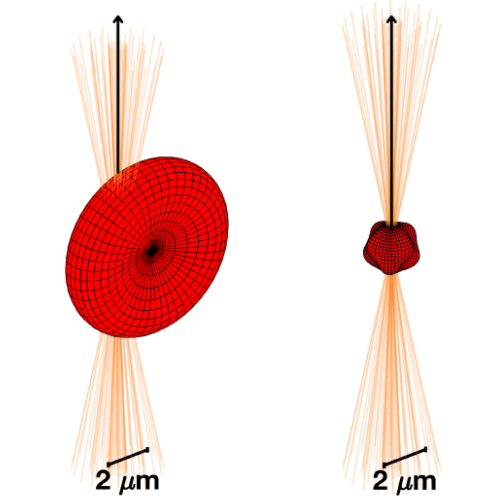
Optical tweezers are widely used to manipulate microscopic particles and biological cells through optical forces and torques, yet how cell shape controls trapping response has not been fully elucidated. Here, we develop a computational framework to investigate single-beam optical trapping of red blood cells with physiologically and pathologically relevant deformed morphologies. Representative cell shapes are generated parametrically and analyzed using static displacement and rotation tests, together with Brownian dynamics simulations. We show that all considered morphologies remain laterally and orientationally confined in a single-beam trap, while axial localization is weaker by pure optical means and is experimentally realized by the balance between the optical force and the buoyancy-corrected cell weight. Cell geometry strongly affects translational and rotational stiffness, preferred orientation, and Brownian confinement. In particular, shape-induced anisotropy produces distinct dynamical signatures, indicating that optical trapping measurements may be sensitive to morphological alterations beyond simple changes in cell size or volume. These results establish a quantitative connection between red-blood-cell morphology, trap stiffness, and dynamics, providing a computational framework for interpreting morphology-dependent optical trapping experiments.