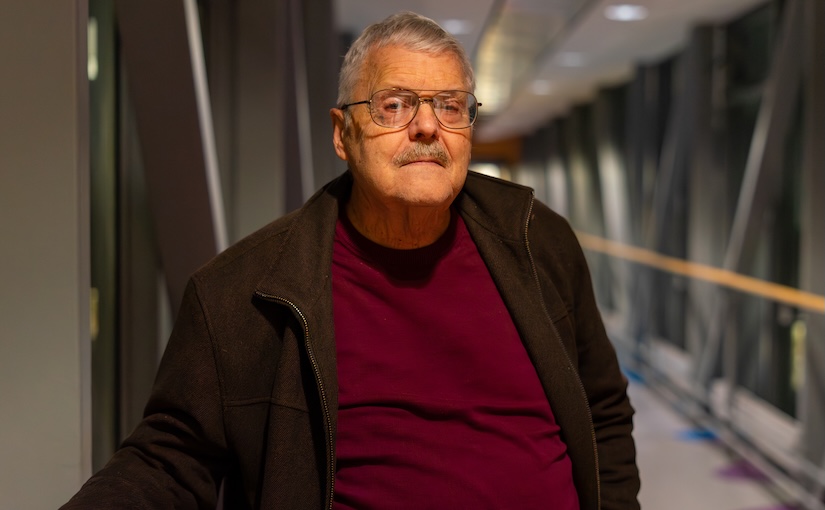
Steven B. Smith. (Photo by A. Ciarlo)Steven Smith will visit the Soft Matter Lab from 17 to 28 January 2026.
Steven brings years of expertise from the laboratory of Professor Carlos Bustamante, where they pioneered the use and development of optical tweezers. As the main developer of the widely used ‘minitweezers’ instrument, which today is used by dozens of research groups, he has helped shape the field of single-molecule biophysics on a global scale. We look forward to his visit, during which he will work on refining cutting-edge single-molecule measurement techniques.
Illustration of three different experiments autonomously performed by the SmartTrap system: DNA pulling experiments (top), red blood cell stretching (bottom left), and particle-particle interaction measurements (bottom right). (Image by M. Selin.)SmartTrap: Automated Precision Experiments with Optical Tweezers
Martin Selin, Antonio Ciarlo, Giuseppe Pesce, Lars Bengtsson, Joan Camunas-Soler, Vinoth Sundar Rajan, Fredrik Westerlund, L. Marcus Wilhelmsson, Isabel Pastor, Felix Ritort, Steven B. Smith, Carlos Bustamante, Giovanni Volpe
arXiv: 2505.05290
There is a trend in research towards more automation using smart systems powered by artificial intelligence. While experiments are often challenging to automate, they can greatly benefit from automation by reducing labor and increasing reproducibility. For example, optical tweezers are widely employed in single-molecule biophysics, cell biomechanics, and soft matter physics, but they still require a human operator, resulting in low throughput and limited repeatability. Here, we present a smart optical tweezers platform, which we name SmartTrap, capable of performing complex experiments completely autonomously. SmartTrap integrates real-time 3D particle tracking using
deep learning, custom electronics for precise feedback control, and a microfluidic setup for particle handling. We demonstrate the ability of SmartTrap to operate continuously, acquiring high-precision data over extended periods of time, through a series of experiments. By bridging the gap between manual experimentation and autonomous operation, SmartTrap establishes a robust and open source framework for the next generation of optical tweezers research, capable of performing large-scale studies in single-molecule biophysics, cell mechanics, and colloidal science with reduced experimental
overhead and operator bias.