Karl Palmås, Mats Benner, Monica Billger, Ben Clarke, Raimund Feifel, Julia Fernandez-Rodriguez, Anna Foka, Juliette Griffié, Claes Gustafsson, Kerstin Hamilton, Johan Holmén, Kristina Lindström, Tobias Olofsson, Joana B. Pereira, Marisa Ponti, Julia Ravanis, Sviatlana Shashkova, Emma Sparr, Pontus Strimling, Fredrik Höök, Giovanni Volpe
arXiv: 2603.10653
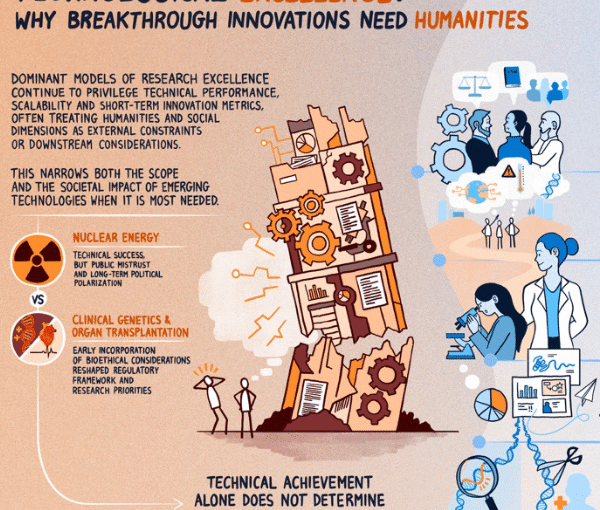
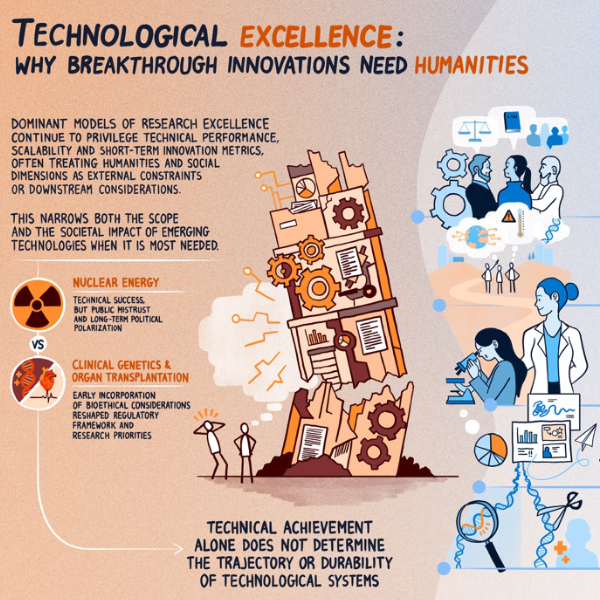
Breakthrough technologies increasingly shape social institutions, economic systems, and political futures. Yet models of research excellence associated with such technologies often prioritize technical performance, scalability, and short-term innovation metrics while treating ethical, social, and cultural dimensions as secondary considerations. This perspective article argues that such separation is no longer tenable. We propose a broader understanding of excellence that combines technical rigor with ethical robustness, social intelligibility, and long-term relevance. The rapid emergence of generative and agentic artificial intelligence further underscores this argument. As technological systems increasingly operate through language, interpretation, and normative alignment, expertise traditionally cultivated in the humanities and social sciences becomes integral to the design, governance, and responsible deployment of such systems. Drawing on historical examples and contemporary research practices, this article examines five interconnected domains where the humanities and social sciences, treated as integrated dimensions of research practice, can strengthen technological development: (1) ethical, legal, and social integration in agenda-setting and research design; (2) plural and reflexive foresight practices that shape technological futures; (3) graduate education as a leverage point for cross-disciplinary literacy; (4) visualization and communication as epistemic and civic practices; and (5) institutional frameworks that move beyond rigid distinctions between basic and applied research. Across these dimensions, we propose practical strategies for embedding interdisciplinary collaboration structurally rather than symbolically.