Nonadditivity of Critical Casimir Forces published in Nature Commun.

Nonadditivity of critical Casimir forces

Nonadditivity of critical Casimir forces
Paladugu Sathyanarayana, Agnese Callegari, Yazgan Tuna, Lukas Barth, Siegfried Dietrich, Andrea Gambassi & Giovanni Volpe
Nature Communications 7, 11403 (2016)
DOI: 10.1038/ncomms11403
arXiv: 1511.02613

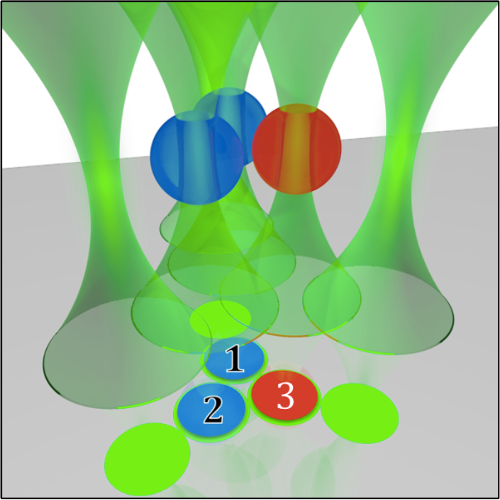
In soft condensed matter physics, effective interactions often emerge due to the spatial confinement of fluctuating fields. For instance, microscopic particles dissolved in a binary liquid mixture are subject to critical Casimir forces whenever their surfaces confine the thermal fluctuations of the order parameter of the solvent close to its critical demixing point. These forces are theoretically predicted to be nonadditive on the scale set by the bulk correlation length of the fluctuations. Here we provide direct experimental evidence of this fact by reporting the measurement of the associated many-body forces. We consider three colloidal particles in optical traps and observe that the critical Casimir force exerted on one of them by the other two differs from the sum of the forces they exert separately. This three-body effect depends sensitively on the distance from the critical point and on the chemical functionalisation of the colloid surfaces.

Featured in:
2+1 is not always 3: In the microworld unity is not always strength”, Phys.org
Wenn 2 plus 1 nicht 3 ergibt”, Scinexx
Физики доказали существование эффекта множества тел”, Gazeta.ru
2+1 is not always 3”, Health Medicinet
Nei colloidi 2 +1 non è uguale a 3”, Le Scienze
Nei colloidi 2 +1 non è uguale a 3”, All News 24
Wenn 2 plus 1 nicht 3 ergibt”, Scinexx
2+1 ist nicht immer 3 – In der Mikro-Welt macht Einigkeit nicht immer”, idw – Informationsdienst Wissenschaft

Microscopic Crowd Control published in Nature Commun.

Disorder-mediated crowd control in an active matter system

Disorder-mediated crowd control in an active matter system
Erçağ Pinçe, Sabareesh K. P. Velu, Agnese Callegari, Parviz Elahi, Sylvain Gigan, Giovanni Volpe & Giorgio Volpe
Nature Communications 7, 10907 (2016)
DOI: 10.1038/ncomms10907

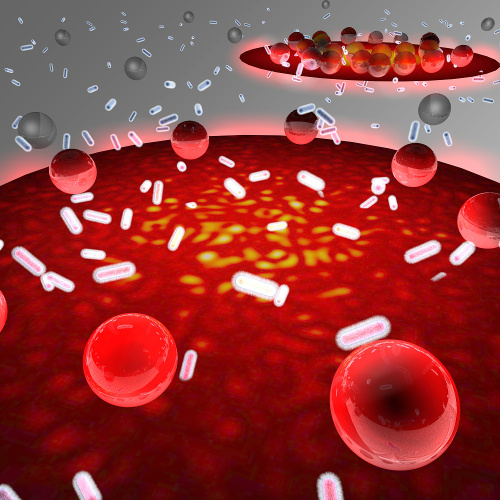
Living active matter systems such as bacterial colonies, schools of fish and human crowds, display a wealth of emerging collective and dynamic behaviours as a result of far-from- equilibrium interactions. The dynamics of these systems are better understood and controlled considering their interaction with the environment, which for realistic systems is often highly heterogeneous and disordered. Here, we demonstrate that the presence of spatial disorder can alter the long-term dynamics in a colloidal active matter system, making it switch between gathering and dispersal of individuals. At equilibrium, colloidal particles always gather at the bottom of any attractive potential; however, under non-equilibrium driving forces in a bacterial bath, the colloids disperse if disorder is added to the potential. The depth of the local roughness in the environment regulates the transition between gathering and dispersal of individuals in the active matter system, thus inspiring novel routes for controlling emerging behaviours far from equilibrium.


Featured in:
Understanding the dynamics of crowd behavior”, Phys.com
Understanding the dynamics of crowd behavior”, ScienceDaily.com
Physics Explains Group Dynamics: When There’s Chaos, Individuals Disperse”, Medical Daily
Ученые выяснили, как меняющаяся окружающая среда влияет на движение толпы”, Gazeta.ru
Understanding the dynamics of crowd behaviour”, Nano
Understanding the dynamics of crowd behaviour”, Noodls
Understanding the dynamics of crowd behavior”, EurekAlert!
Understanding the dynamics of crowd behavior”, Informs
Understanding the dynamics of crowd behavior”, Nanowerk

OTGO published in JOSA B

Computational toolbox for optical tweezers in geometrical optics

Computational toolbox for optical tweezers in geometrical optics
Agnese Callegari, Mite Mijalkov, Burak Gököz & Giovanni Volpe
Journal of the Optical Society of America B 32(5), B11—B19 (2015)
DOI: 10.1364/JOSAB.32.000B11
arXiv: 1402.5439

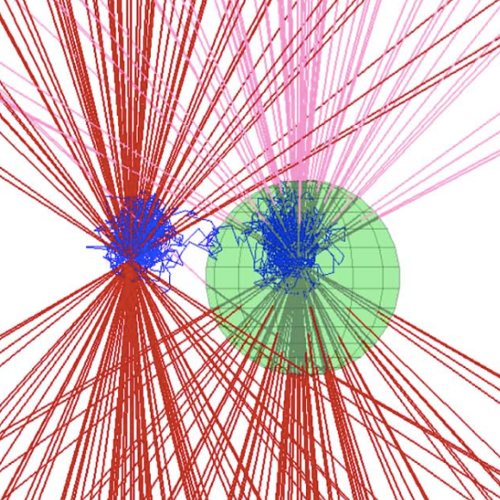
Optical tweezers have found widespread application in many fields, from physics to biology. Here, we explain in detail how optical forces and torques can be described within the geometrical optics approximation, and we show that this approximation provides reliable results in agreement with experiments for particles whose characteristic dimensions are larger than the wavelength of the trapping light. Furthermore, we provide an object-oriented software package implemented in MATLAB for the calculation of optical forces and torques in the geometrical optics regime: Optical Tweezers in Geometrical Optics (OTGO). We provide all source codes for OTGO as well as documentation and code examples—e.g., standard optical tweezers, optical tweezers with elon- gated particles, the windmill effect, and Kramers transitions between two optical traps—necessary to enable users to effectively employ it in their research.

Speckle Optical Tweezers published in Opt. Express

Speckle optical tweezers: Micromanipulation with random light fields

Speckle optical tweezers: Micromanipulation with random light fields
Giorgio Volpe, Lisa Kurz, Agnese Callegari, Giovanni Volpe & Sylvain Gigan
Optics Express 22(15), 18159—18167 (2014)
DOI: 10.1364/OE.22.018159
arXiv: 1403.0364

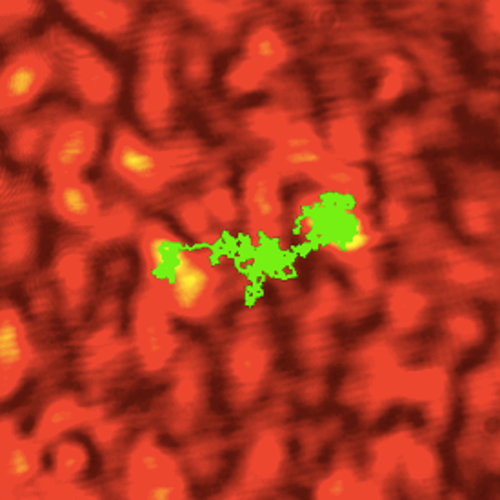
Current optical manipulation techniques rely on carefully engineered setups and samples. Although similar conditions are routinely met in research laboratories, it is still a challenge to manipulate microparticles when the environment is not well controlled and known a priori, since optical imperfections and scattering limit the applicability of this technique to real-life situations, such as in biomedical or microfluidic applications. Nonetheless, scattering of coherent light by disordered structures gives rise to speckles, random diffraction patterns with well- defined statistical properties. Here, we experimentally demonstrate how speckle fields can become a versatile tool to efficiently perform fundamental optical manipulation tasks such as trapping, guiding and sorting. We anticipate that the simplicity of these “speckle optical tweezers” will greatly broaden the perspectives of optical manipulation for real-life applications.