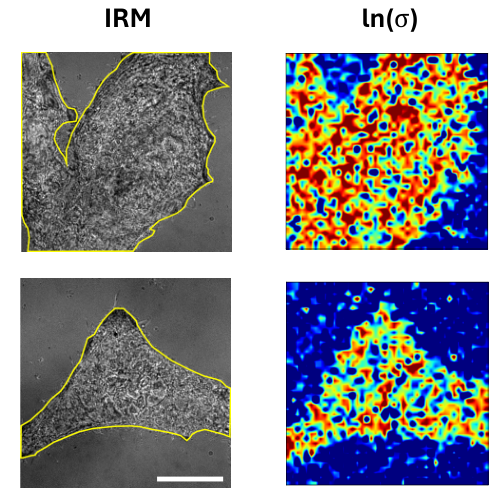
Recent advances in nonequilibrium physics allow extracting thermodynamic quantities, such as entropy production, directly from dynamical information in microscopic movies. (Figure by S. Manikandan, adapted from Manikandan et al., Phys. Rev. Research 6, 023310 (2024).)Probing the Non-equilibrium Dynamics of Living Matter
Sreekanth K Manikandan Date: 11 March 2026 Time: 18.00-20.00 Place: Aula Medica, Stockholm Sweden
Conference Protein Folding in Real Time, 11-13 March 2026, Stockholm, Sweden
Identifying whether a process is in equilibrium, quantifying its distance from equilibrium, and constructing optimal reduced descriptions of non-equilibrium dynamics remain central challenges in the study of living matter. Here, we discuss how data-driven approaches grounded in stochastic thermodynamics enable these features to be inferred directly from experimental data. In particular, we show how entropy production can be localized in space and time, and how maximally dissipative coordinates emerge as effective low-dimensional descriptions of non-equilibrium processes. We highlight applications to experimental biophysical systems and discuss key challenges and limitations.
Identifying whether a process is in equilibrium, quantifying how far it lies from equilibrium, and determining optimal reduced descriptions of non-equilibrium processes remain challenging open problems. Here, we discuss how novel data-driven techniques grounded in stochastic thermodynamics can be used to efficiently learn these features directly from experimental data. In particular, we show how entropy production can be localized in space and time, and how maximally dissipative coordinates can be consistently inferred as effective low-dimensional descriptions of non-equilibrium processes. We further discuss applications to experimental biophysical systems and outline key challenges and limitations.
Active Matter: Model Systems and Experimental Tests
Agnese Callegari, Antonio Ciarlo, Sreekanth Manikandan Dates and times:
23 Feb 14:00-15:00 (Agnese)
24 Feb 11:30-12:30 (Antonio)
24 Feb 14:00-15:00 (Sreekanth) Place: PJ Winter school on Geometry of nonequilibrium critical phenomena
Active matter is a broad class of systems that operate intrinsically out of equilibrium. It spans multiple length scales—from macroscopic to micro- and nanoscopic—and includes both biological and artificial realizations, often displaying rich and emerging collective behaviors. The study of active matter aims to explain and interpret these phenomena using concepts and tools from physics. As such, understanding active and non-equilibrium systems requires a combination of theoretical, computational, and experimental approaches.
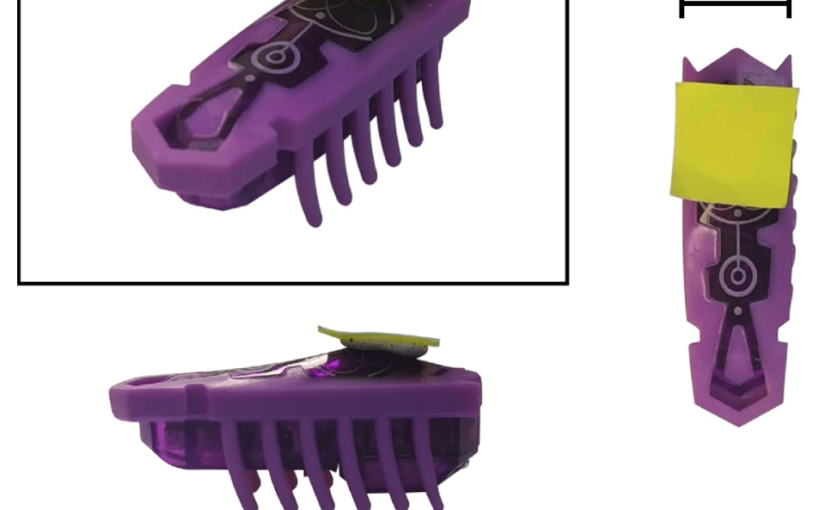
In the first part of the lecture, we introduce the concept of an active particle and demonstrate how it can be embodied in a macroscopic, self-propelled toy robot (a Hexbug). Despite their simplicity, such systems reproduce characteristic—and sometimes counterintuitive—features of microscopic active matter. These experiments have a strong pedagogical value and are designed to help bridge a gap in traditional physics curricula at the primary and secondary education levels.
The second part of the lecture focuses on active matter and non-equilibrium phenomena at the microscopic scale, where advanced experimental tools are essential. Optical tweezers provide precise control over microscopic systems and access to key physical observables. We introduce their operating principles and illustrate how they can be used to construct a minimal, well-controlled experimental model for studying non-equilibrium dynamics at the single-particle level.
In the final part of the lecture, we turn to the theoretical and computational tools required to analyze active matter systems. We discuss how non-equilibrium dynamics can be quantitatively characterized directly from experimental data in a model-independent framework. This naturally leads to an introduction to machine-learning–based inference techniques, which extract dynamical and thermodynamic information from data without relying on a priori assumptions about the underlying physical model.
References:
[1] A. Barona Balda, A. Argun, A. Callegari, G. Volpe. Playing with Active Matter, Am. J. Phys. 92, 847–858 (2024). https://doi.org/10.1119/5.0125111
[2] Martins, T.T., Malavazi, A.H.A., Kamizaki, L.P. et al. Fluctuation theorems with optical tweezers: theory and practice. Eur. Phys. J. Plus 141, 71 (2026). https://doi.org/10.1140/epjp/s13360-025-07181-4
[3] Manikandan, Sreekanth K. and Ghosh, T. and Mandal, T. and Biswas, A. and Sinha, B. and Mitra, D. Estimate of entropy production rate can spatiotemporally resolve the active nature of cell flickering. Phys. Rev. Res. 6, 023310 (2024). https://doi.org/10.1103/PhysRevResearch.6.023310
Photos
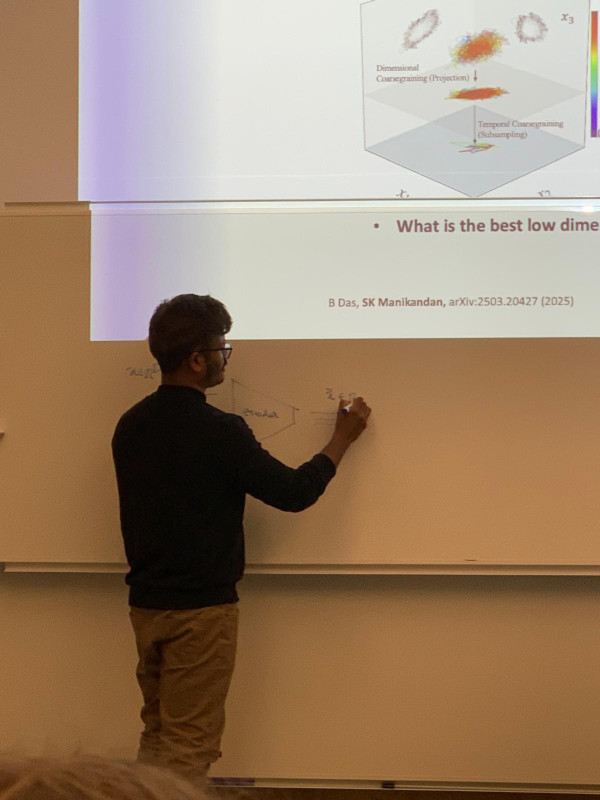
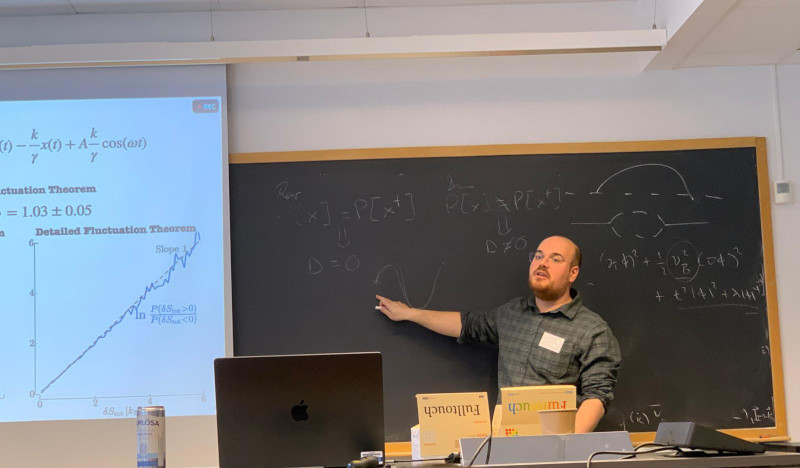
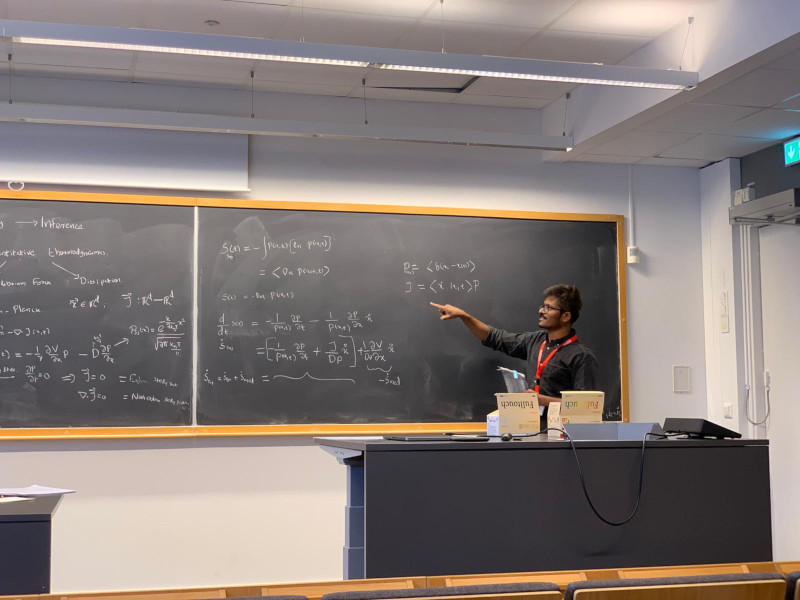
Antonio, presenting. (Photo by M. Orsino)Sreekanth, presenting. (Photo by A. Ciarlo)
Quantifying the spatiotemporal forces, affinities, and dissipative costs of cellular-scale non-equilibrium processes from experimental data and localizing it in space and time remain a significant open challenge. Here, I explore how principles from stochastic thermodynamics, combined with machine learning techniques, offer a promising approach to addressing this issue. I will present preliminary results from experiments on fluctuating cell membranes and simulations of non-equilibrium systems in stationary and time-dependently driven states. These studies reveal potential strategies for localizing entropy production in experimental biophysical contexts while also highlighting key challenges and limitations that must be addressed.
Recent advances in nonequilibrium physics allow extracting thermodynamic quantities, such as entropy production, directly from dynamical information in microscopic movies. (Image by S. Manikandan.)Localizing entropy production in cellular processes
Sreekanth Manikandan Date: 14 Mar 2025 Time: 17:30 CEST Place: Online
Part of the Workshop on Stochastic Thermodynamics
Quantifying the spatiotemporal forces, affinities, and dissipative costs of cellular-scale non-equilibrium processes from experimental data and localizing it in space and time remain a significant open challenge. Here, I explore how principles from stochastic thermodynamics, combined with machine learning techniques, offer a promising approach to addressing this issue. I will present preliminary results from experiments on fluctuating cell membranes and simulations of non-equilibrium systems in stationary and time-dependently driven states. These studies reveal potential strategies for localizing entropy production in experimental biophysical contexts while also highlighting key challenges and limitations that must be addressed.
Recent advances in nonequilibrium physics allow extracting thermodynamic quantities, such as entropy production, directly from dynamical information in microscopic movies. (Image by S. Manikandan.)Localizing entropy production in non-equilibrium processes
Sreekanth Manikandan Date: 5 Mar 2025 Time: 14:45 Place: Nordita
Part of the 14th Nordic Workshop on Statistical Physics
Quantifying the spatiotemporal forces, affinities, and dissipative costs of cellular-scale non-equilibrium processes from experimental data and localizing it in space and time remain a significant open challenge. Here, I explore how principles from stochastic thermodynamics, combined with machine learning techniques, offer a promising approach to addressing this issue. I will present preliminary results from experiments on fluctuating cell membranes and simulations of non-equilibrium systems in stationary and time-dependently driven states. These studies reveal potential strategies for localizing entropy production in experimental biophysical contexts while also highlighting key challenges and limitations that must be addressed.
(Photo by A. Ciarlo.)Sreekanth K. Manikandan began working as a researcher at the Physics Department of the University of Gothenburg on December 9, 2024.
He received his Ph.D. in Theoretical Physics in 2020 from Stockholm University under the supervision of Supriya Krishnamurthy. His thesis, titled “Nonequilibrium Thermodynamics at the Microscopic Scales,” focused on finite and short-time fluctuations in non-equilibrium systems, as opposed to the large-time asymptotic properties studied within the framework of large deviation theory. One of the key outcomes of his Ph.D. research was the development of a method to infer entropy production rates directly from experimentally accessible trajectories in a model-independent manner.
Following his PhD, Sreekanth received the NORDITA postdoctoral fellowship for independent research. During this time, he expanded on his earlier work by developing generalizations of the inference scheme for entropy production and integrating it with machine-learning tools for practical inference of dissipative forces and entropy production from experimental data. Later, in 2022, he was awarded the Wallenberg Scholarship for postdoctoral research at Stanford, where he developed machine-learning-based non-equilibrium control techniques for targeted self-assembly and transport of biomolecular systems.
Currently he is interested in combining methods from Non-equilibrium Physics and Machine Learning to quantitatively characterize and control nanoscale biophysical processes.
Inferring entropy production in microscopic systems
Sreekanth K. Manikandan
Stanford University
10 February 2023, 15:00, Raven and Fox
An inherent feature of small systems in contact with thermal reservoirs, be it a pollen grain in water, or an active microbe flagellum, is fluctuations. Even with advanced microscopic techniques, distinguishing active, non-equilibrium processes defined by a constant dissipation of energy (entropy production) to the environment from passive, equilibrium processes is a very challenging task and a vastly developing field of research. In this talk, I will present a simple and effective way to infer entropy production in microscopic non-equilibrium systems, from short empirical trajectories [1]. I will also demonstrate how this scheme can be used to spatiotemporally resolve the active nature of cell flickering [2]. Our result is built upon the Thermodynamic Uncertainty Relation (TUR) which relates current fluctuations in non-equilibrium states to the entropy production rate.
References
[1] Inferring entropy production from short experiments [ Phys. Rev. Lett. 124, 120603 (2020) ]
[2] Estimate of entropy generation rate can spatiotemporally resolve the active nature of cell flickering [arXiv:2205.12849]
Bio: Sreekanth completed his PhD at the department of Physics, Stockholm University, in June 2020. His PhD supervisor was Supriya Krishnamurthy. From August 2020 – October 2022, Sreekanth was a Nordita fellow postdoc in the soft condensed matter group at Nordita. Currently, he is a postdoctoral scholar at the Department of Chemistry at Stanford University, funded by the Wallenberg foundation.