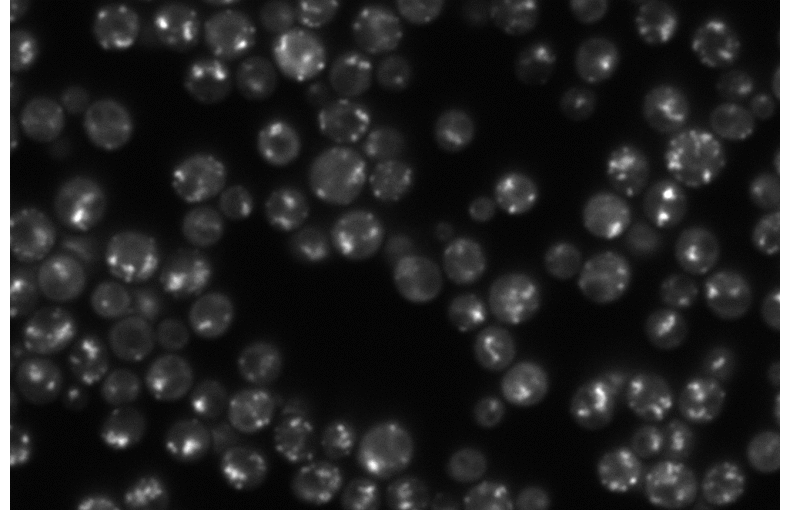
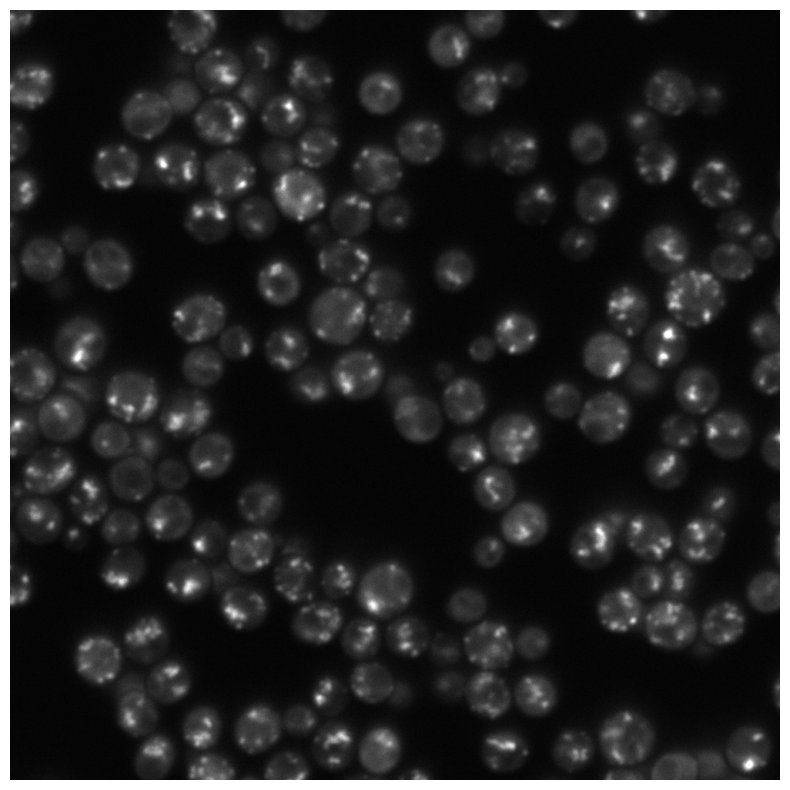
Fluorescence microscopy image of yeast cells, with Hsp104-GFP marking protein aggregates, making them visible as bright spots. (Image by J. Masaryk.)Machine learning based tracking of protein aggregates in yeast
Mirja Granfors, Jakub Masaryk, Carlo Manzo, Markus Tamas, Giovanni Volpe Date: 11th March 2026 Time: 18:00 – 20:00 Place: Aula Medica, Karolinska Institute, Solna
Conference Protein Folding in Real Time, 11-13 March 2026, Stockholm, Sweden
Arsenic is a toxic metal linked to serious diseases like cancer and neurodegeneration. One proposed mechanism of toxicity is that arsenic causes proteins to misfold and aggregate inside cells, but the dynamics and regulation of this process remain poorly understood. Using fluorescence microscopy data from living yeast cells, we are developing a machine learning approach to automatically detect, track, and analyze protein aggregate movement over time.
DeepTrack2 Logo. (Image by J. Pineda)DeepTrack2: physics-based microscopy simulations for deep learning
Mirja Granfors, Alex Lech, Benjamin Midtvedt, Jesús Pineda, Harshith Bachimanchi, Carlo Manzo, and Giovanni Volpe BNMI 2025, 19-22 August 2025, Gothenburg, Sweden Date: 20 August 2025 Time: 15:00 – 15:15 Place: Wallenberg Conference Centre
DeepTrack2 is a flexible and scalable Python library designed to generate physics-based synthetic microscopy datasets for training deep learning models. It supports a wide range of imaging modalities, including brightfield, fluorescence, darkfield, and holography, enabling the creation of synthetic samples that accurately replicate real experimental conditions. Its modular architecture empowers users to customize optical systems, incorporate optical aberrations and noise, simulate diverse objects across various imaging scenarios, and apply image augmentations. DeepTrack2 is accompanied by a dedicated GitHub page, providing extensive documentation, examples, and an active community for support and collaboration: https://github.com/DeepTrackAI/DeepTrack2.
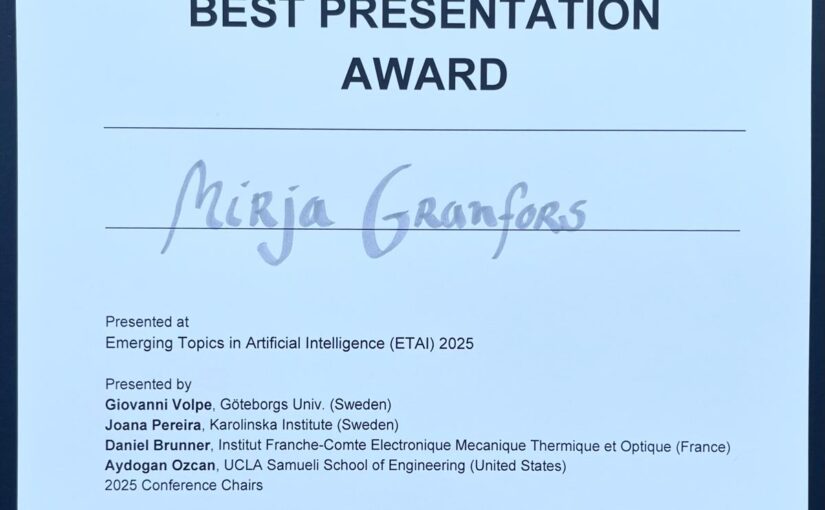
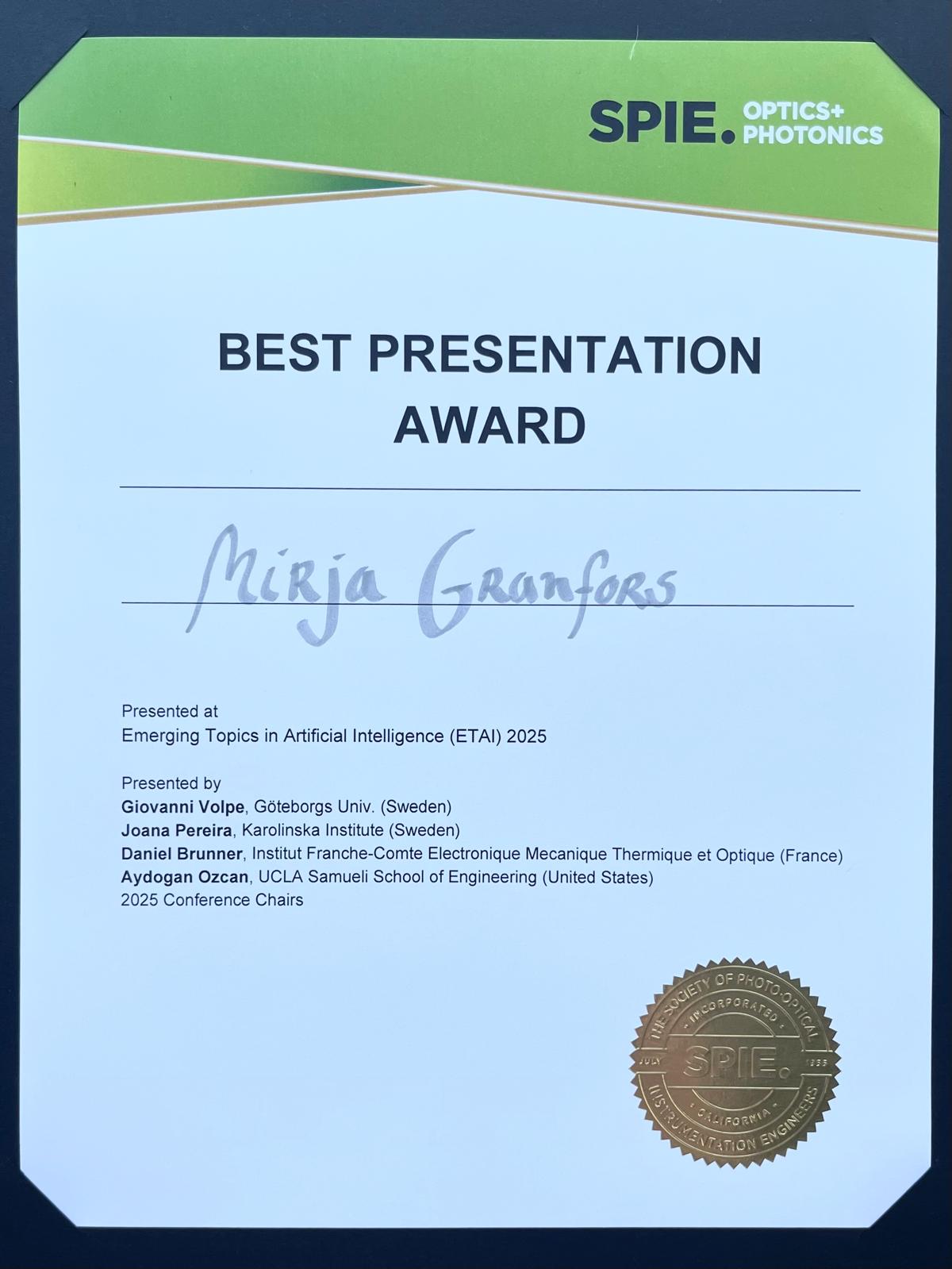
The award, which includes a certificate, a cash prize of $300, and a T-shirt, is presented by the organizers of the conference in collaboration with SPIE Optics + Photonics.
Mirja was awarded the prize for her presentation titled “DeepTrack2: physics-based microscopy simulations for deep learning”. Below is the full abstract of her presentation:
DeepTrack2 is a flexible and scalable Python library designed to generate physics-based synthetic microscopy datasets for training deep learning models. It supports a wide range of imaging modalities, including brightfield, fluorescence, darkfield, and holography, enabling the creation of synthetic samples that accurately replicate real experimental conditions. Its modular architecture empowers users to customize optical systems, incorporate optical aberrations and noise, simulate diverse objects across various imaging scenarios, and apply image augmentations. DeepTrack2 is accompanied by a dedicated GitHub page, providing extensive documentation, examples, and an active community for support and collaboration: https://github.com/DeepTrackAI/DeepTrack2.
GAUDI leverages a hierarchical graph-convolutional variational autoencoder architecture, where an encoder progressively compresses the graph into a low-dimensional latent space, and a decoder reconstructs the graph from the latent embedding. (Image by M. Granfors and J. Pineda.)Global graph features unveiled by unsupervised geometric deep learning
Mirja Granfors, Jesús Pineda, Blanca Zufiria Gerbolés, Joana Pereira, Carlo Manzo, and Giovanni Volpe Date: 7 August 2025 Time: 2:45 PM – 3:00 PM Place: Conv. Ctr. Room 4
Graphs are used to model complex relationships, such as interactions between particles or connections between brain regions. The structural complexity and variability of graphs pose challenges to their efficient analysis and classification. Here, we propose GAUDI (Graph Autoencoder Uncovering Descriptive Information), a graph autoencoder that addresses these challenges. GAUDI is trained in an unsupervised manner to capture the most critical parameters of graphs in the latent space, thereby enabling the extraction of essential parameters characterizing the graphs. We demonstrate the performance of GAUDI across diverse graph data originating from complex systems, including the estimation of the parameters of Watts-Strogatz graphs, the classification of protein assembly structures from single-molecule localization microscopy data, the analysis of collective behaviors, and correlations between brain connections and age. This approach offers a robust framework for efficiently analyzing and interpreting complex graph data, facilitating the extraction of meaningful patterns and insights across a wide range of applications.
DeepTrack2 Logo. (Image by J. Pineda)DeepTrack2: physics-based microscopy simulations for deep learning Mirja Granfors, Alex Lech, Benjamin Midtvedt, Jesús Pineda, Harshith Bachimanchi, Carlo Manzo, and Giovanni Volpe Date: 5 August 2025 Time: 2:45 PM – 3:00 PM Place: Conv. Ctr. Room 4
DeepTrack2 is a flexible and scalable Python library designed to generate physics-based synthetic microscopy datasets for training deep learning models. It supports a wide range of imaging modalities, including brightfield, fluorescence, darkfield, and holography, enabling the creation of synthetic samples that accurately replicate real experimental conditions. Its modular architecture empowers users to customize optical systems, incorporate optical aberrations and noise, simulate diverse objects across various imaging scenarios, and apply image augmentations. DeepTrack2 is accompanied by a dedicated GitHub page, providing extensive documentation, examples, and an active community for support and collaboration: https://github.com/DeepTrackAI/DeepTrack2.
Mirja Granfors receives the award. From left to right: Giorgio Volpe, Mirja Granfors, Wojciech Chachólski, Arrate Muñoz-Barrutia, Gorka Muñoz-Gil, Carlo Manzo. (Photo by A. Callegari.)
Mirja Granfors won the best early career researcher presentation award at AnDi+ 2025 workshop (AI for Bioimaging Beyond Trajectory Analysis) held in Gothenburg, from 2 June – 5 June 2025.
The award, consisting of a certificate and a cash prize of 250€, is sponsored by Nanophotonics.
Mirja was awarded the prize for her presentation titled “DeepTrack2: Physics-based Microscopy Simulations for Deep Learning & Deeplay: Enhancing PyTorch with Customizable and Reusable Neural Networks”. In her presentation, she presented the Python libraries DeepTrack2 and Deeplay, both developed by the Soft Matter Lab to support AI-driven microscopy.
DeepTrack2 is a flexible and scalable Python library designed to generate physics-based synthetic microscopy datasets for training deep learning models. It supports a wide range of imaging modalities, including brightfield, fluorescence, darkfield, and holography, enabling the creation of synthetic samples that accurately replicate real experimental conditions. Its modular architecture empowers users to customize optical systems, incorporate optical aberrations and noise, simulate diverse objects across various imaging scenarios, and apply image augmentations.
Deeplay is a flexible Python library for deep learning that simplifies the definition and optimization of neural networks. It provides an intuitive framework that makes it easy to define and train models. With its modular design, Deeplay enables users to efficiently build and refine complex neural network architectures by seamlessly integrating reusable components.
Mirja Granfors presenting at the EUROMECH Colloquium. (Photo by A. Lech.)DeepTrack2: Physics-based Microscopy Simulations for Deep Learning
Mirja Granfors
DeepTrack2 is a flexible and scalable Python library designed to generate physics-based synthetic microscopy datasets for training deep learning models. It supports a wide range of imaging modalities, including brightfield, fluorescence, darkfield, and holography, enabling the creation of synthetic samples that accurately replicate real experimental conditions. Its modular architecture empowers users to customize optical systems, incorporate optical aberrations and noise, simulate diverse objects across various imaging scenarios, and apply image augmentations. DeepTrack2 is accompanied by a dedicated GitHub page, providing extensive documentation, examples, and an active community for support and collaboration: https://github.com/DeepTrackAI/DeepTrack2.
GAUDI leverages a hierarchical graph-convolutional variational autoencoder architecture, where an encoder progressively compresses the graph into a low-dimensional latent space, and a decoder reconstructs the graph from the latent embedding. (Image by M. Granfors and J. Pineda.)Global graph features unveiled by unsupervised geometric deep learning Mirja Granfors, Jesús Pineda, Blanca Zufiria Gerbolés, Joana B. Pereira, Carlo Manzo, Giovanni Volpe
arXiv: 2503.05560
Graphs provide a powerful framework for modeling complex systems, but their structural variability makes analysis and classification challenging. To address this, we introduce GAUDI (Graph Autoencoder Uncovering Descriptive Information), a novel unsupervised geometric deep learning framework that captures both local details and global structure. GAUDI employs an innovative hourglass architecture with hierarchical pooling and upsampling layers, linked through skip connections to preserve essential connectivity information throughout the encoding-decoding process. By mapping different realizations of a system – generated from the same underlying parameters – into a continuous, structured latent space, GAUDI disentangles invariant process-level features from stochastic noise. We demonstrate its power across multiple applications, including modeling small-world networks, characterizing protein assemblies from super-resolution microscopy, analyzing collective motion in the Vicsek model, and capturing age-related changes in brain connectivity. This approach not only improves the analysis of complex graphs but also provides new insights into emergent phenomena across diverse scientific domains.
GAUDI leverages a hierarchical graph-convolutional variational autoencoder architecture, where an encoder progressively compresses the graph into a low-dimensional latent space, and a decoder reconstructs the graph from the latent embedding. (Image by M. Granfors and J. Pineda.)Global graph features unveiled by unsupervised geometric deep learning
Mirja Granfors, Jesús Pineda, Blanca Zufiria Gerbolés, Daniel Vereb, Joana B. Pereira, Carlo Manzo, and Giovanni Volpe Learning on graphs and geometry meetup at Uppsala University Date: 11 February 2025 Place: Uppsala university
Graphs are used to model complex relationships, such as interactions between particles or connections between brain regions. The structural complexity and variability of graphs pose challenges to their efficient analysis and classification. Here, we propose GAUDI (Graph Autoencoder Uncovering Descriptive Information), a graph autoencoder that addresses these challenges. GAUDI’s encoder progressively reduces the size of the graph using multi-step hierarchical pooling, while its decoder incrementally increases the graph size until the original dimensions are restored, focusing on the node and edge features while preserving the graph structure through skip-connections. By training GAUDI to minimize the difference between the node and edge features of the input graph and those of the output graph, it is compelled to capture the most critical parameters describing these features in the latent space, thereby enabling the extraction of essential parameters characterizing the graphs. We demonstrate the performance of GAUDI across diverse graph data originating from complex systems, including the estimation of the parameters of Watts-Strogatz graphs, the classification of protein assembly structures from single-molecule localization microscopy data, the analysis of collective behaviors, and correlations between brain connections and age. This approach offers a robust framework for efficiently analyzing and interpreting complex graph data, facilitating the extraction of meaningful patterns and insights across a wide range of applications.
Mirja Granfors with the Best Poster Award at SPIE conference in San Diego. (Photo by G. Volpe.)Mirja Granfors won the best early career researcher poster award at Emerging Topics in Artificial Intelligence (ETAI) 2024 held in San Diego, from 18 to 24 August 2024. The award, consisting of a certificate and a cash prize, is offered by the organizers of the conference, and SPIE Optics + Photonics, and is sponsored by G-Research.
In this poster, Mirja presented her recent work on the development of a graph autoencoder. This graph autoencoder effectively summarizes graph structures while preserving important topological details through multiple hierarchical pooling steps. This enables the extraction of physical parameters describing the graphs. She demonstrated the performance of the graph autoencoder across diverse graph data originating from complicated systems, including the classification of protein assembly structures from single-molecule localization microscopy data, as well as the analysis of collective behavior and correlations between brain connections and age.
Best Poster Award (Image by M. Granfors.)Mirja @ Poster Pops Presentation (Photo by A. Callegari.)Mirja @ Poster Pops Presentation (Photo by A. Callegari.)ETAI Best Poster and Best Presentation Award Ceremony @ SPIE-ETAI. People (left to right): Joana B. Pereira (conference chair), Patrick Grant, Yuzhu Li, Mirja Granfors, Diptabrata Paul. (Photo by G. Volpe.)