Myxococcus xanthus for active matter studies: a tutorial for its growth and potential applications published in Soft Matter

Myxococcus xanthus colonies develop different strategies to adapt to their environment, leading to the formation of macroscopic patterns from microscopic entities. (Image by the Authors of the manuscript.)
Tutorial for the growth and development of Myxococcus xanthus as a Model System at the Intersection of Biology and Physics
Jesus Manuel Antúnez Domínguez, Laura Pérez García, Natsuko Rivera-Yoshida, Jasmin Di Franco, David Steiner, Alejandro V. Arzola, Mariana Benítez, Charlotte Hamngren Blomqvist, Roberto Cerbino, Caroline Beck Adiels, Giovanni Volpe
Soft Matter 21, 8602-8623 (2025)
arXiv: 2407.18714
doi: 10.1063/5.0235449

Myxococcus xanthus is a unicellular organism known for its capacity to move and communicate, giving rise to complex collective properties, structures and behaviors. These characteristics have contributed to position M. xanthus as a valuable model organism for exploring emergent collective phenomena at the interface of biology and physics, particularly within the growing domain of active matter research. Yet, researchers frequently encounter difficulties in establishing reproducible and reliable culturing protocols. This tutorial provides a detailed and accessible guide to the culture, growth, development, and experimental sample preparation of M. xanthus. In addition, it presents several exemplary experiments that can be conducted using these samples, including motility assays, fruiting body formation, predation, and elasticotaxis—phenomena of direct relevance for active matter studies.
The environment topography alters the transition from single-cell populations to multicellular structures in Myxococcus xanthus published in Science Advances

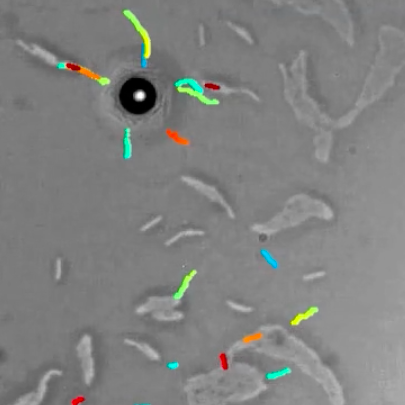
M. xanthus cell-cell and cell-particle local interactions during cellular aggregation.
The environment topography alters the transition from single-cell populations to multicellular structures in Myxococcus xanthus
Karla C. Hernández Ramos, Edna Rodríguez-Sánchez, Juan Antonio Arias del Angel, Alejandro V. Arzola, Mariana Benítez, Ana E. Escalante, Alessio Franci, Giovanni Volpe, Natsuko Rivera-Yoshida
Sci. Adv. 7(35), eabh2278 (2021)
bioRxiv: 10.1101/2021.01.27.428527
doi: 10.1126/sciadv.abh2278

The social soil-dwelling bacteria Myxococcus xanthus can form multicellular structures, known as fruiting bodies. Experiments in homogeneous environments have shown that this process is affected by the physico-chemical properties of the substrate, but they have largely neglected the role of complex topographies. We experimentally demonstrate that the topography alters single-cell motility and multicellular organization in M. xanthus. In topographies realized by randomly placing silica particles over agar plates, we observe that the cells’ interaction with particles drastically modifies the dynamics of cellular aggregation, leading to changes in the number, size and shape of the fruiting bodies, and even to arresting their formation in certain conditions. We further explore this type of cell-particle interaction in a minimal computational model. These results provide fundamental insights into how the environment topography influences the emergence of complex multicellular structures from single cells, which is a fundamental problem of biological, ecological and medical relevance.