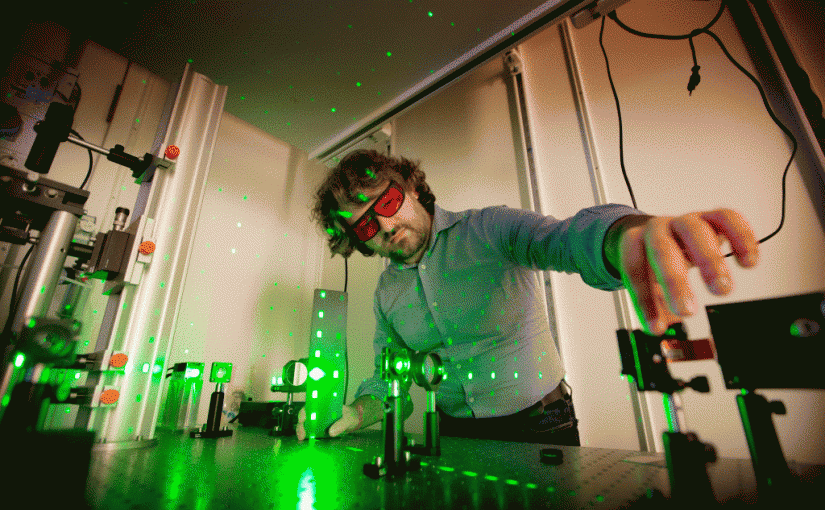
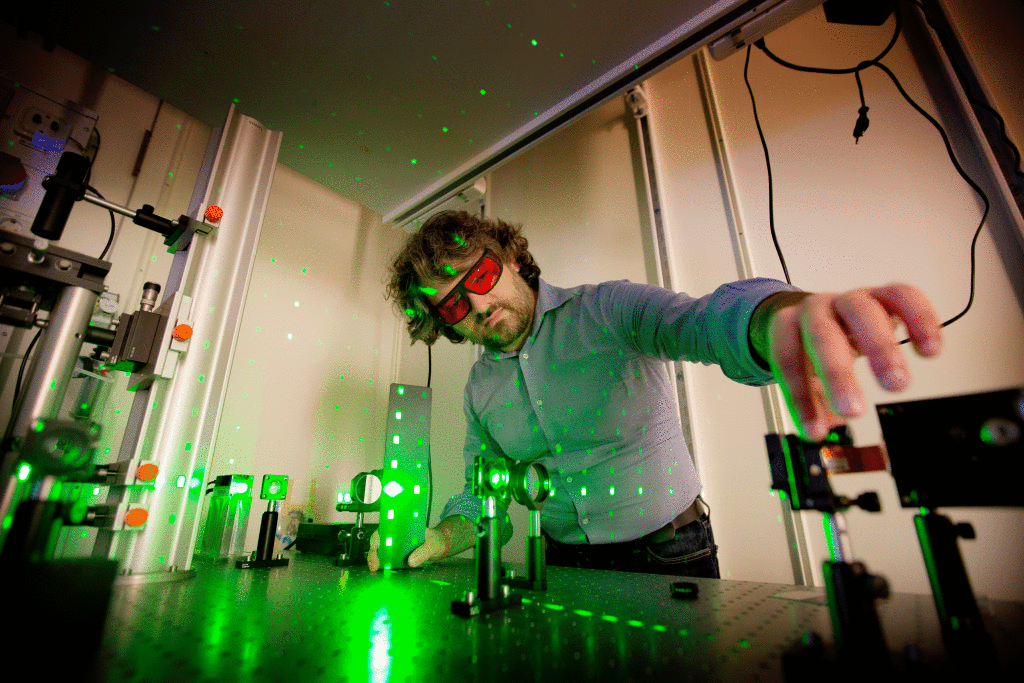
Alessandro Magazzù has been awarded a best oral contribution “Soft Matter poster price” during the conference Italian Soft Matter Days 2018, held in Padua, Italy on September 13-14, 2018. The prize has been given by Emanuela Zaccarelli, editorial board members of the Soft Matter journal. This prize mainly consists in an invitation to submit a manuscript without the pre-screening by the Editors. It also includes a “poster prize” and a personal yearly subscription to the journal.
News
Colloquium on active matter by Hartmut Löwen, PJ Lecture Hall, 13 sep 2018

Physics of active soft matter
General Physics Colloquium by Hartmut Löwen, Heinrich-Heine Universität Düsseldorf, Germany
Abstract: Ordinary materials are “passive” in the sense that their constituents are typically made by inert particles which are subjected to thermal fluctuations, internal interactions and external fields but do not move on their own. Living systems, like schools of fish, swarms of birds, pedestrians and swimming microbes are called “active matter” since they are composed of self-propelled constituents. Active matter is intrinsically in nonequilibrium and exhibits a plethora of novel phenomena as revealed by a recent combined effort
of statistical theory, computer simulation and real-space experiments. The colloquium talk provides an introduction into the physics of active matter focussing on biological and artificial microswimmers as key examples of active soft matter [1]. A number of single-particle and collective phenomena in active matter will be adressed ranging from the circle swimming to inertial delay effects.
[1] For a review, see: C. Bechinger, R. di Leonardo, H. Löwen, C. Reichhardt, G. Volpe, G. Volpe, Active particles in complex and crowded environments, Reviews of Modern Physics 88, 045006 (2016).
Place: PJ Lecture Hall
Time: 13 September, 2018, 13:15
See also https://www.chalmers.se/en/departments/physics/calendar/Pages/General-Physics-Colloquium_180913.aspx
Alejandro V. Arzola visits the Soft Matter Lab. Welcome!
Alejandro V. Arzola is a Visiting Professor from the Universidad Nacional Autónoma de México in Mexico City. His visiting position is financed through the Linnaeus Palme International Exchange Programme.
Alejandro was born in Oaxaca in the south of Mexico. He studied for a PhD at the Universidad Nacional Autónoma de México (UNAM) in Mexico City, worked as a posdoctoral researcher at the Institutte of Scientific Instruments in Brno, Czech Republic, and at UNAM. Since 2014 he joined the group of Optical Micromanipulation at the Institute of Physics in UNAM.
He is interested in optical micromanipulation and related research fields. His latest research deals with the transport of Brownian particles in optical landscapes under breaking space-time symmetries, a system which is known in the literature as ratchets. He is also interested in the behavior of microscopic particles in structured light fields with spin and orbital angular momentum.
Talk by G. Volpe at SPIE OTOM XV, San Diego, 23 Aug 2018
Microscopic Engine Powered by Critical Demixing
Falko Schmidt, Alessandro Magazzù, Agnese Callegari, Luca Biancofiore, Frank Cichos & Giovanni Volpe
SPIE Nanoscience + Engineering, Optical trapping and Optical Manipulation XV, San Diego (CA), USA
19-23 August 2018
During the last few decades much effort has gone into the miniaturization of machines down to the microscopic scale with robotic solutions indispensable in modern industrial processes and play a central role in many biological systems. There has been a quest in understanding the mechanism behind molecular motors and several approaches have been proposed to realize artificial engines capable of converting energy into mechanical work. These current micronsized engines depend on the transfer of angular momentum of light, are driven by external magnetic fields, due to chemical reactions or by the energy flow between two thermal reservoirs. Here we propose a new type of engine that is powered by the local, reversible demixing of a critical binary liquid. In particular, we show that an absorbing, optically trapped particle performs revolutions around the optical beam because of the emergence of diffusiophoresis and thereby produces work. This engines is adjustable by the optical power supplied, the temperature of the environment and the criticality of the system.
Reference: Schmidt et al., Phys. Rev. Lett. 120(6), 068004 (2018) DOI: 10.1103/PhysRevLett.120.068004
Stability of Brain Graph Measures published in Sci. Rep.

measures in structural brain
networks in Alzheimer’s disease
Stability of graph theoretical measures in structural brain networks in Alzheimer’s disease
Gustav Mårtensson, Joana B. Pereira, Patrizia Mecocci, Bruno Vellas, Magda Tsolaki, Iwona Kłoszewska, Hilkka Soininen, Simon Lovestone, Andrew Simmons, Giovanni Volpe & Eric Westman
Scientific Reports 8, 11592 (2018)
DOI: 10.1038/s41598-018-29927-0
Graph analysis has become a popular approach to study structural brain networks in neurodegenerative disorders such as Alzheimer’s disease (AD). However, reported results across similar studies are often not consistent. In this paper we investigated the stability of the graph analysis measures clustering, path length, global efficiency and transitivity in a cohort of AD (N = 293) and control subjects (N = 293). More specifically, we studied the effect that group size and composition, choice of neuroanatomical atlas, and choice of cortical measure (thickness or volume) have on binary and weighted network properties and relate them to the magnitude of the differences between groups of AD and control subjects. Our results showed that specific group composition heavily influenced the network properties, particularly for groups with less than 150 subjects. Weighted measures generally required fewer subjects to stabilize and all assessed measures showed robust significant differences, consistent across atlases and cortical measures. However, all these measures were driven by the average correlation strength, which implies a limitation of capturing more complex features in weighted networks. In binary graphs, significant differences were only found in the global efficiency and transitivity measures when using cortical thickness measures to define edges. The findings were consistent across the two atlases, but no differences were found when using cortical volumes. Our findings merits future investigations of weighted brain networks and suggest that cortical thickness measures should be preferred in future AD studies if using binary networks. Further, studying cortical networks in small cohorts should be complemented by analyzing smaller, subsampled groups to reduce the risk that findings are spurious.
Review on Optical Tweezers published in J. Quant. Spectrosc. Rad. Transf.

Optical tweezers and their applications
Paolo Polimeno, Alessandro Magazzù, Maria Antonia Iata, Francesco Patti, Rosalba Saija, Cristian Degli Esposti Boschi, Maria Grazia Donato, Pietro G. Gucciardi, Philip H. Jones, Giovanni Volpe & Onofrio M. Maragò
Journal of Quantitative Spectroscopy and Radiative Transfer 218(October 2018), 131—150 (2018)
DOI: 10.1016/j.jqsrt.2018.07.013
Optical tweezers, tools based on strongly focused light, enable optical trapping, manipulation, and characterisation of a wide range of microscopic and nanoscopic materials. In the limiting cases of spherical particles either much smaller or much larger than the trapping wavelength, the force in optical tweezers separates into a conservative gradient force, which is proportional to the light intensity gradient and responsible for trapping, and a non-conservative scattering force, which is proportional to the light intensity and is generally detrimental for trapping, but fundamental for optical manipulation and laser cooling. For non-spherical particles or at intermediate (meso)scales, the situation is more complex and this traditional identification of gradient and scattering force is more elusive. Moreover, shape and composition can have dramatic consequences for optically trapped particle dynamics. Here, after an introduction to the theory and practice of optical forces with a focus on the role of shape and composition, we give an overview of some recent applications to biology, nanotechnology, spectroscopy, stochastic thermodynamics, critical Casimir forces, and active matter.
Qiwei Li visits the Soft Matter Lab. Welcome!
Active Atoms and Interstitials published in Phys. Rev. Lett.

Active Atoms and Interstitials in Two-dimensional Colloidal Crystals
Kilian Dietrich, Giovanni Volpe, Muhammad Nasruddin Sulaiman, Damian Renggli, Ivo Buttinoni & Lucio Isa
Physical Review Letters 120(26), 268004 (2018)
DOI: 10.1103/PhysRevLett.120.268004
arXiv: 1710.08680
We study experimentally and numerically the motion of a self-phoretic active particle in two-dimensional loosely packed colloidal crystals at fluid interfaces. Two scenarios emerge depending on the interactions between the active particle and the lattice: the active particle either navigates throughout the crystal as an interstitial or is part of the lattice and behaves as an active atom. Active interstitials undergo a run-and-tumble-like motion, with the passive colloids of the crystal acting as tumbling sites. Instead, active atoms exhibit an intermittent motion, stemming from the interplay between the periodic potential landscape of the passive crystal and the particle’s self-propulsion. Our results constitute the first step towards the realization of non-close-packed crystalline phases with internal activity.
Seminar on non-conservative optical forces in speckle fields by Laura Pérez García from UNAM, Faraday, 26 jun 2018
Non conservative optical forces of speckle fields generated with a SLM
Seminar by Laura Pérez García from the Universidad National Autónoma de México (UNAM).
Speckle patterns arise when a highly coherent light source impinges on a rough surface or when it propagates through an inhomogeneous media. This phenomenon appeared after the invention of the laser in the 70’s and, initially was considered as a feature to avoid in optical setups since it limits the imaging resolution. However, speckle patterns can give information about the process that generates it and also can be incorporated by researchers in astronomy, surface characterization, biology, medicine and chemical processes [1, 2, 3]. In particular, speckle has been used in the last years in the area of optical micromanipulation to study the interaction of colloidal particles in random potentials[4, 5]. It is important the use of speckle patterns since it has a wide range of characteristic lengths, optical vortexes and intrinsic robustness to misalignment.
We’ve studied speckle patterns generated by a spatial light modulator (SLM), emphasizing in the intensity distribution, its spatial properties and the dynamical properties of particles subjected to these fields. Specifically, I studied the dynamical behavior of 1.54μm and 1μm spherical polystyrene particles embedded in deionized water in the presence of a speckle light field. We generated the speckle pattern using a 532 nm-wavelength laser which impinged on an SLM, which projected random values for each pixel, and then redirected to an optical micromanipulation system. It is important to mention that, by varying the optical resolution of the system with a diaphragm, we allowed the interference between all the wavefronts.
We analyzed the particle’s trajectories in the overdamped regime as an approximation for the particle dynamics. We didn’t assume the existence of a scalar potential, so we can study the nonconservative nature of the optical forces[6]. Additionally, the mean squared displacement was calculated and com- pared with free diffusion, we observed different regimes, owing to the spatial features in the speckle patterns used.
- J.C. Dainty. Laser speckle and related phenomena. Topics in Applied Physics. Springer-Verlag, 1984.
- J.W. Goodman. Speckle Phenomena in Optics: Theory and Applications. Roberts & Company, 2007.
- H.J. Rabal and R.A. Braga. Dynamic Laser Speckle and Applications. Optical Science and Engineering. CRC Press, 2008.
- Florian Evers, Christoph Zunke, Richard D L Hanes, J ̈org Bewerunge, Imad Ladadwa, Andreas Heuer, Stefan U. Egelhaaf, Giorgio Giovanni Volpe, Giorgio Giovanni Volpe, and Sylvain Gigan. Particle dynamics in two-dimensional random-energy landscapes: Experiments and simulations. Physical Review E – Statistical, Nonlinear, and Soft Matter Physics, 88(2):3936, 2014.
- Giorgio Volpe, Giovanni Volpe, and Sylvain Gigan. Brownian motion in a speckle light field: tunable anomalous diffusion and selective optical manipulation. Scientific Reports, 4:3936, 2014.
- Pinyu Wu, Rongxin Huang, Christian Tischer, Alexandr Jonas, and Ernst Ludwig Florin. Direct measurement of the nonconservative force field generated by optical tweezers. Physical Review Letters, 103(10):4–7, 2009.
Place: Faraday room, Fysik Origo, Fysik
Time: 26 June, 2018, 15:00
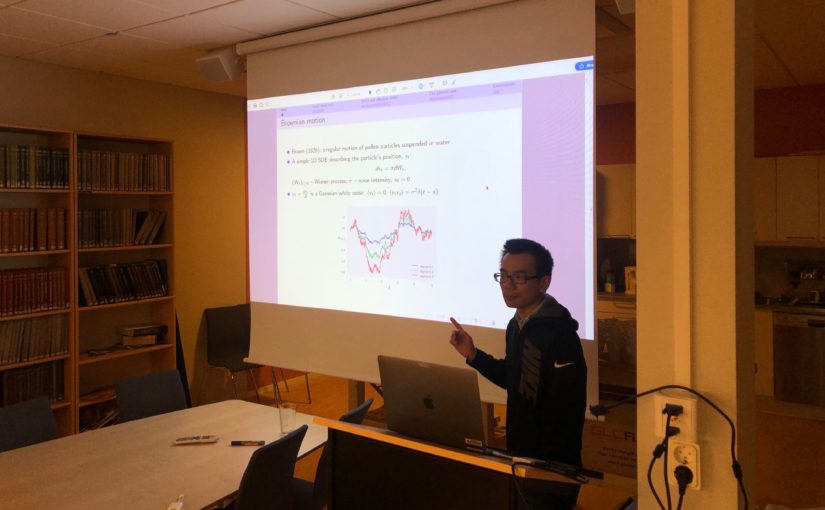
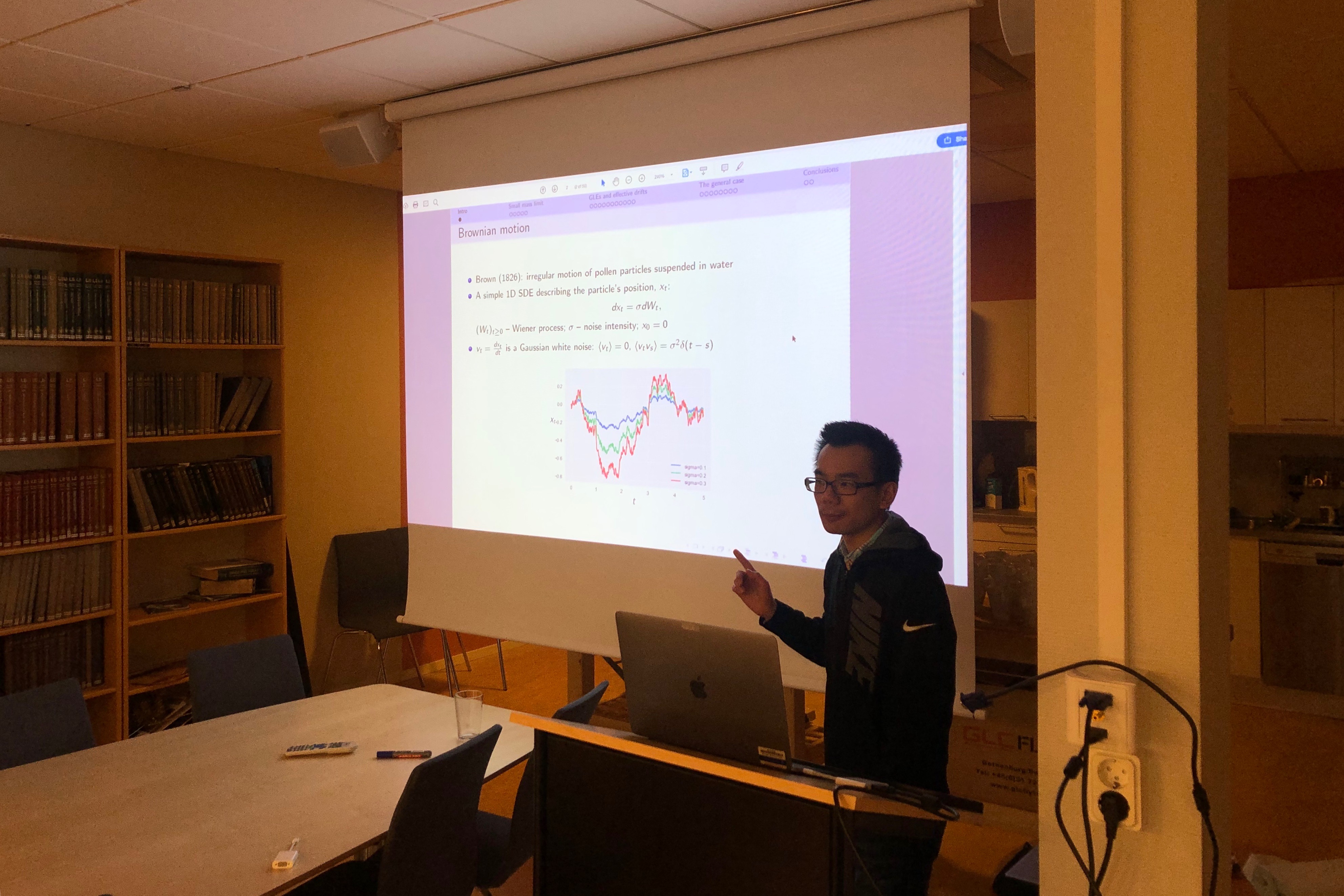
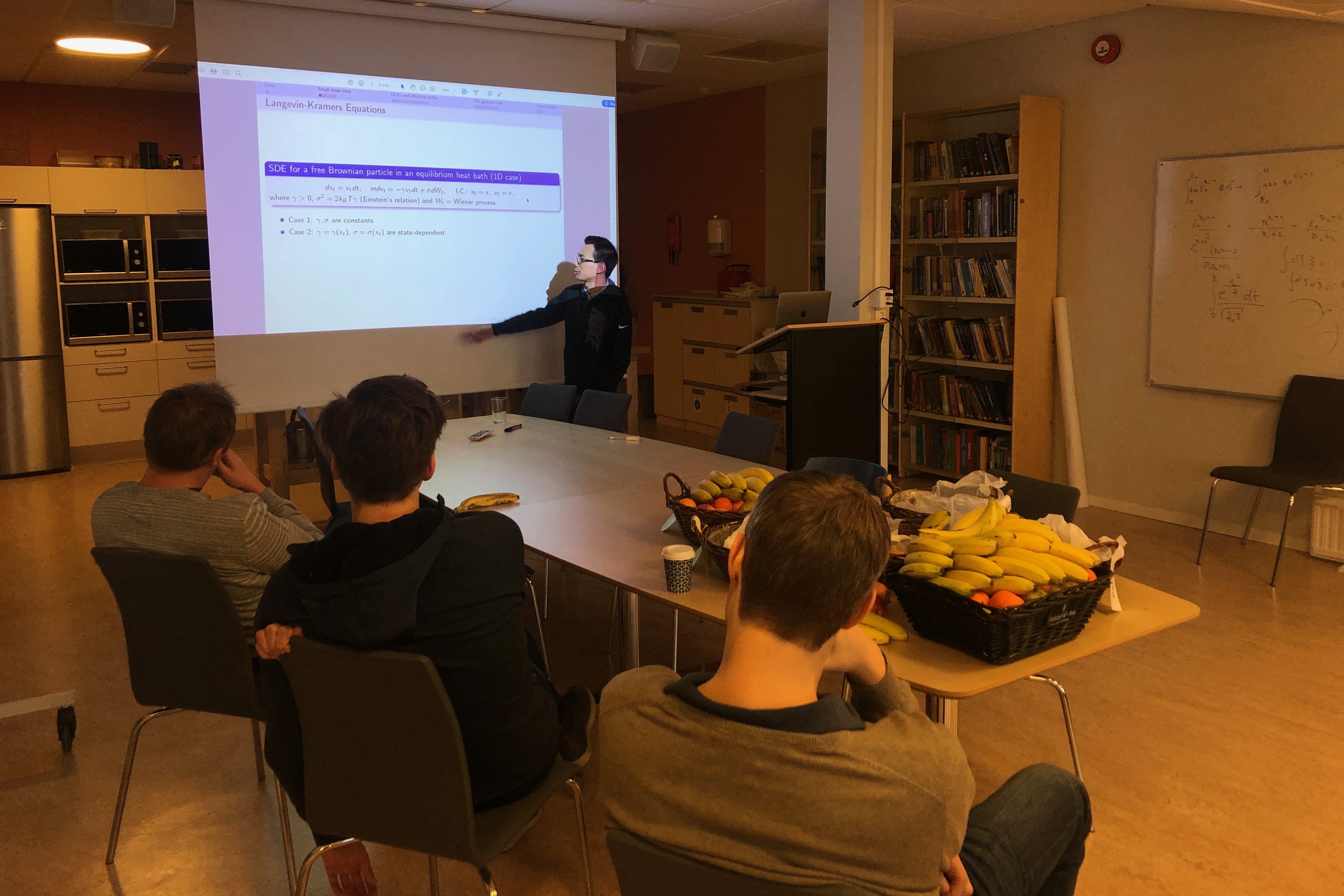
Seminar on Langevin equation in the small mass limit by Jan Wehr from the University of Arizona, Nexus, 21 Jun 2018
Langevin equation in the small mass limit: higher order approximations
Seminar by Jan Wehr from the University of Arizona, Tucson (AZ), USA.
Abstract: We study the Langevin equation describing the motion of a particle of mass m in a potential and/or magnetic field, with state-dependent drift and diffusion. We develop a hierarchy of approximate equations for the position degrees of freedom that achieve accuracy of order m^{k/2} over finite time intervals for any positive integer k. This extends the previous work in which effective equations for the position variables were derived in the limit when the mass goes to zero. The work was done jointly with Jeremiah Birrell.
Place: Nexus, meeting room, Fysik Origo, Fysik
Time: 21 June, 2018, 11:00