Presentation by J. Tember at Scintille di Scienza, Pisa, 25 September 2026

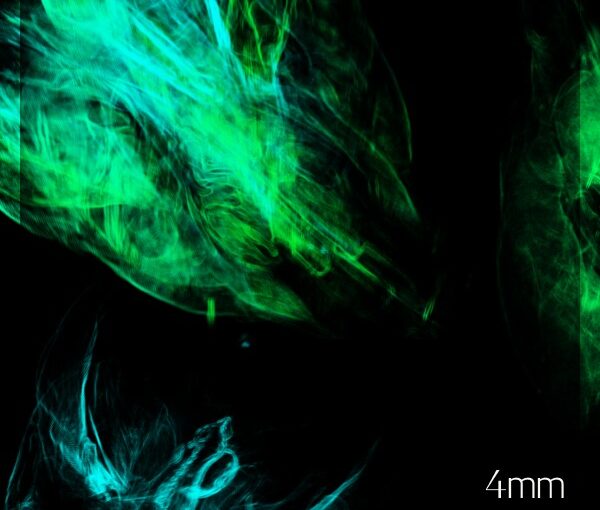
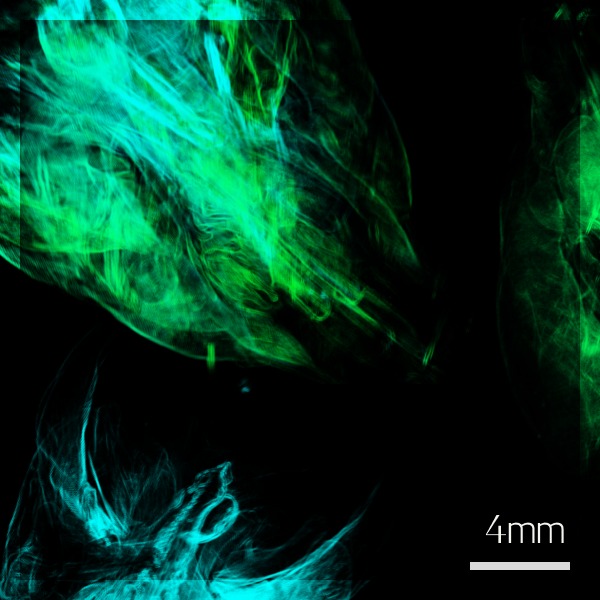
FIREFLY provides interactive rendering, exploration and analysis of large three-dimensional light-sheet microscopy datasets, combining real-time visualization, volumetric data processing and machine learning-based approaches for improved microscopy image analysis. (Image by J. Tember)
FIREFLY: Framework for Interactive Rendering, Exploration and Feature Extraction of Light-Sheet Microscopy
John Tember
Date: 25 September 2026
Time: 18:00 – 18:15
Place: Largo Ciro Menotti, Pisa, Italy

Modern tissue-clearing and light-sheet microscopy techniques can generate highly detailed three-dimensional images of biological samples, but the increasing size and complexity of these datasets pose significant challenges for efficient visualization, processing and analysis. Interactive computational tools are therefore essential for exploring large volumetric datasets and extracting quantitative information from them.

FIREFLY is being developed as a framework for interactive rendering, exploration and feature extraction of light-sheet microscopy data. The presentation introduced computational approaches for real-time 3D visualization, volumetric data processing and multi-scan reconstruction, together with ongoing work using self-supervised machine learning to improve the resolution of anisotropic microscopy volumes.

The work was presented at Scintille di Scienza: la Ricerca dal Laboratorio alla Piazza – II Edizione, a public outreach event organized by the Department of Pharmacy at the University of Pisa as part of BRIGHT Night 2026, the European Researchers’ Night in Tuscany. The event brought researchers to the city centre of Pisa for short talks, interactive activities and demonstrations aimed at communicating current research to a broad public audience.

The aim of FIREFLY is to develop computational tools that make increasingly large and complex microscopy datasets easier to explore, process and quantitatively analyse.
Poster by J. Tember at the Protein Folding in Real Time conference, Stockholm, 11 March 2026

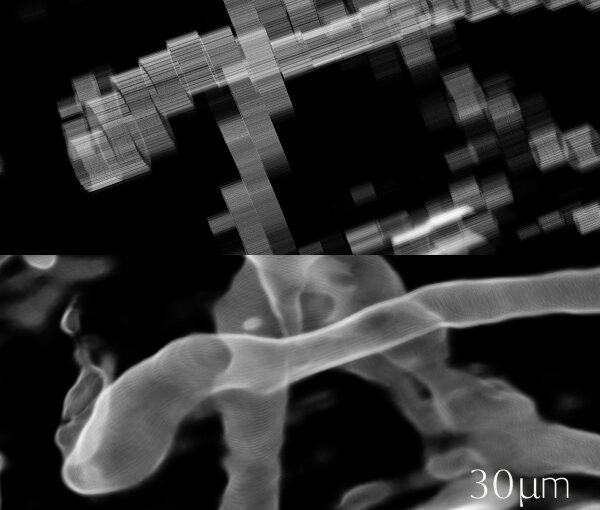
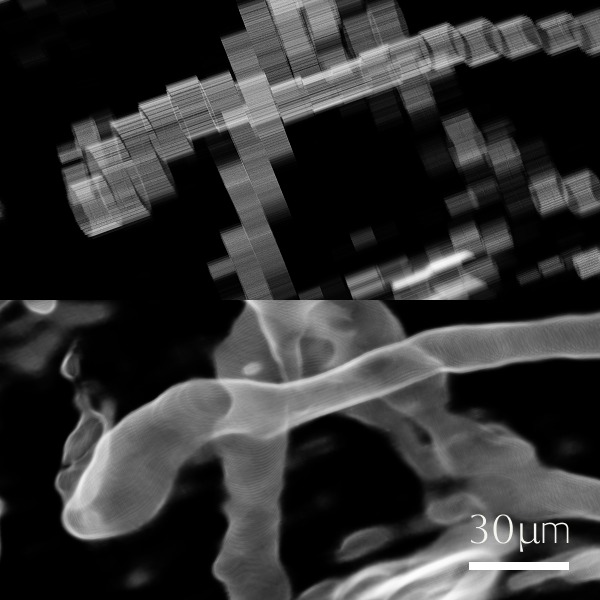
Comparison of anisotropic light-sheet microscopy data and super-resolved reconstruction, illustrating improved continuity and structural clarity of volumetric features. (Image by J. Tember.)
FIREFLY – Framework for Interactive Rendering, Exploration and Feature Extraction for Light-Sheet Microscopy
John Tember, Harshith Bachimanchi, Tsz Long Chu, Xin Tian, Andrei Chagin, Giovanni Volpe
Date: 11th March 2026
Time: 18:00 – 20:00
Place: Aula Medica, Karolinska Institute, Solna
Conference: Protein Folding in Real Time, 11-13 March 2026, Stockholm, Sweden

We present FIREFLY (Framework for Interactive Rendering, Exploration and Feature Extraction for Light-Sheet Microscopy), a platform for scalable computational tools. Modern 3D microscopy datasets are increasingly large and complex, posing challenges for efficient visualization, processing, and quantitative analysis. Our work focuses on developing tools and methods to support interactive and high-quality analysis workflows.

We are building a Unity-based application for real-time, multi-channel 3D rendering, enabling interactive inspection and quantitative analysis of large volumetric datasets. In parallel, we explore self-supervised machine learning approaches for enhancing anisotropic microscopy volumes and improving resolution without requiring additional training data.

Together, these efforts aim to provide an integrated and scalable pipeline for visualization and analysis in light-sheet microscopy.

John Tember joins the Soft Matter Lab

(Photo by A. Ciarlo.)
John Tember joined the Soft Matter Lab on 15 June 2025.

John is a PhD student in Physics at the University of Gothenburg.

He holds a Master’s degree in Media Technology and Engineering from Linköping University.

During his time at the Soft Matter Lab, he will work on data-driven life science, with a focus on developing and analyzing 3D models derived from lightsheet microscopy.