Amanda K. A. Silva Brun, Giorgio Presidente, Mangala Srinivas, Valentina Cauda, Alberto Fernandez-Tejada, Christine L. Mummery, Rami I. Aqeilan, Thomas Thum, Mehmet C. Onbasli, Robert Colebunders, Gianni Ciofani, Davide Iannuzzi, Marios Avraamides, João T. Barata, Romana Schirhagl, Ana Cecília A. Roque, Luana Dessbesell, Chloé Dupuis, Marco Paggi, Kerstin Kinkelin, Gerard J. J. Boink, Antonella Bongiovanni, Kevin Braeckmans, Kerem Pekkan, Lorenzo Moroni, Twan Lammers, Xiao Xiang Zhu, Adriele Prina-Mello, Carlo S. Casari, Max C. Lemme, Thomas Wolbers, Achillefs N. Kapanidis, Erdem Yörk, Jan S. Kirschke, Philipp-Leo Mengel, Giulio Cerullo, Volker Hessel, Víctor A. de la Peña O’Shea, Aitziber L. Cortajarena, Frank Kirchhoff, Harald H. H. W. Schmidt, Imre Berger, Anne Houdusse, Edgar R. Gomes, Frederic Amant, Tambet Teesalu, Joan Ballester, Juan José Vilatela, Raymond M. Schiffelers, Fabrizio d’Adda di Fagagna, Roman Jerala, Cristina Canal, Sophie Demolombe, Gaetano Gargiulo, Giovanni Volpe, Andrea C. Ferrari, Daniel Gros, Clemens Fuest, and Dario Polli
Science 393, 1302-1304 (2026)
doi: 10.1126/science.ady2388
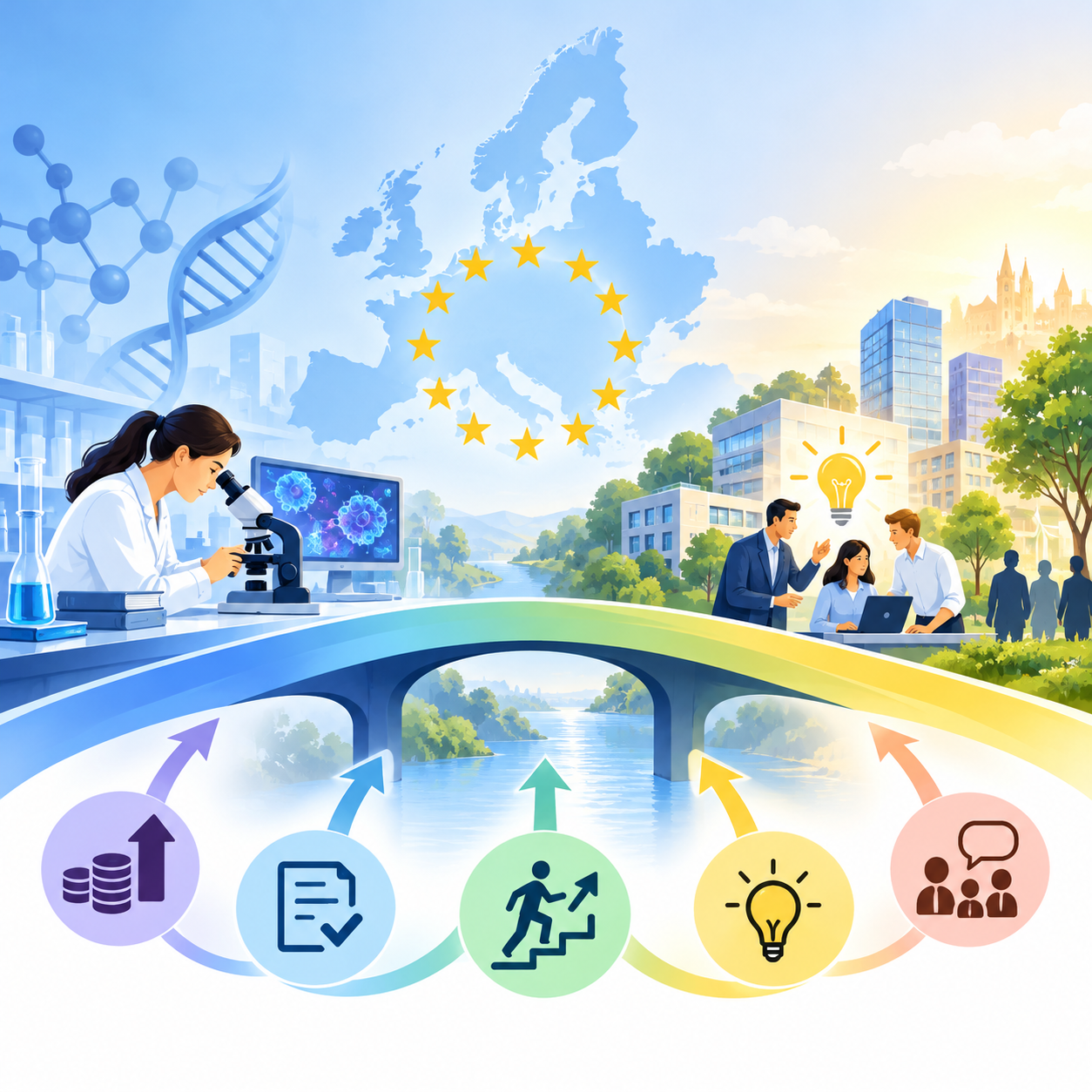
Europe has a strong scientific research base, yet many promising discoveries still face barriers on the path from academia to technologies, products, and companies. In this Policy Forum, a broad group of European researchers, innovators, and economists examines how these barriers could be reduced to strengthen Europe’s capacity for breakthrough innovation and socioeconomic impact. Focusing particularly on Horizon Europe, the authors propose a more continuous pathway from fundamental research to commercialization, including closer integration between European Research Council Proof of Concept grants and European Innovation Council programs, stronger and more flexible support for early-stage high-risk innovation, and simpler funding procedures. They also highlight the importance of recognizing entrepreneurship within academic careers, improving intellectual-property management, and providing researchers with clearer access to mentoring, industrial partnerships, and spin-off creation. Together, these measures could help translate more of Europe’s scientific excellence into new technologies, businesses, and solutions for society, strengthening Europe’s long-term competitiveness.