Prakhar Dutta, Jiacheng Huang, Nazli Demirpehlivan, Thomas Catley, Sylvia Whittle, Carlo Manzo, Rahul Nagshi, Rachel Owen, Giovanni Volpe
Date: 24 August 2026
Time: 10:30 AM – 11:00 AM PDT
Place: Conv. Ctr. Room 2
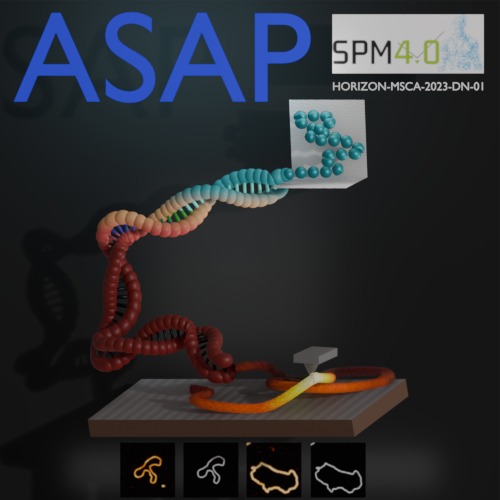
Atomic force microscopy (AFM) resolves biological structure and mechanics at high resolution, but produces heterogeneous datasets that are noisy and time-consuming to analyze. Although deep learning could automate quality control, segmentation and feature extraction, adoption is limited by scarce ground-truth training data and technical barriers for experimentalists. Here we present ASAP, an open-source tutorial and pipeline implemented in DeepTrack to provide a foundation for AI-enabled AFM. We demonstrate the framework with three examples: (i) an unsupervised variational autoencoder for force-curve quality control; (ii) a dual pathway simulation for DNA, offering both molecular dynamics and rapid, non-MD geometries to generate ground truth for segmentation training; and (iii) a versatile simulation framework that generates synthetic force curves for user-defined surfaces by applying selectable physical models. By consolidating simulation and learning into a modular ecosystem, this work enables users to utilize our pipeline to optimize AFM workflows for efficient data acquisition and processing.