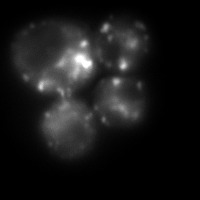
Heat-induced aggregates in Saccharomyces cerevisiae on Slimfield SMLM. Hsp104-mGFP binds to misfolded regions enabling aggregate visualisation for tracking. (Image by L. Viaene.)A single-molecule approach to study the spatial protein quality control system
Linde Viaene Date: 11 March 2026 Time: 18.00-20.00 Place: Aula Medica, Stockholm Sweden
Conference Protein Folding in Real Time, 11-13 March 2026, Stockholm, Sweden
Cell populations are inherently diverse, and averaging measurements across them can mask subtle or rare cellular behaviours. In this work, we use live Slimfield single-molecule microscopy to study the role of Hsp104 in clearing misfolded and aggregated proteins after stress. By analysing endogenously tagged Hsp104, we quantify molecular diffusion and stoichiometry before and after heat stress. Our results show a transition from faster, more mobile molecules to larger, more static assemblies following stress, consistent with Hsp104 functionally engaging with protein aggregates. These measurements provide molecular-level insight into how cells respond to proteotoxic stress.
Linde Viaene presenting at the PhD conference. (Image by S. Kilde Westberg.)Studying heat adaptation in yeast one-molecule at a time: The use of single-molecule microscopy for aggregate identification and tracking.
Linde Viaene Date: 25th of April Time: 13:00 Place: Veras Gräsmatta, Gothenburg
The importance of protein folding and misfolding is indicated by the broad range of clinical manifestations that have protein aggregation at the base, such as neurodegenerative diseases, cancer and type II diabetes. A key factor in (energy) homeostasis is the DNA configuration of chromatin which allows for essential gene expression and adaptation to environmental factors. The Rpd3 deacetylase histone complex (DHAC) plays a crucial role in gene regulation and its disruption impairs stress-induced gene activation, highlighting its importance in cellular adaptation.
Using Saccharomyces cerevisiae as a model system, we aim to investigate the role of chromatin remodelling components in protein aggregation and cellular rejuvenation, which may influence aggregate retention and recovery speed. We will expose yeast cells to stressors such as heat shock, metabolic shifts, and oxidative stress to assess their effects on protein homeostasis and chromatin regulation. Growth assays will evaluate survival rates, while Western blotting will measure Hsp104 expression, a key heat shock protein involved in aggregate clearance. By employing our bespoke single-molecule fluorescence microscope, we will track aggregate formation, clearance, and spatial localization in live cells at molecular precision.
Our preliminary results indicate that some components of the Rpd3L complex, respectively alter the recovery rate after heat stress exposure. Hence, the goal is to explore further candidate genes and to determine their role in the stress-induced response. By elucidating the role of chromatin remodelers in stress adaptation, our findings may inform novel therapeutic strategies for age-related diseases.