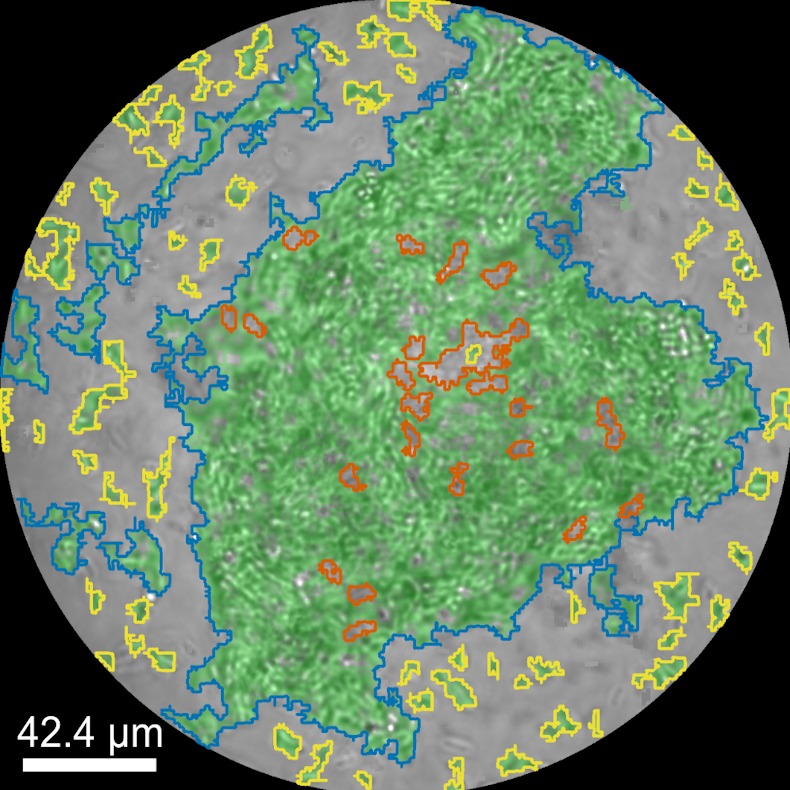
Brightfield image of biofilm inside the droplet where motile aggregates are highlighted in yellow, biofilm mass in blue, and open patches in the structures due to dispersal in orange. (Image from D. Pérez and J. Domínguez)Quantitative Analysis of Dynamic Biofilm Structures via Time-Resolved Droplet Microfluidics and Artificial Intelligence
Daniela Pérez Guerrero, Jesús Manuel Antúnez Domínguez, Aurélie Vigne, Daniel Midtvedt, Wylie Ahmed, Lisa Muiznieks, Giovanni Volpe and Caroline Beck Adiels Date: 11th March 2026 Time: 18:00 – 20:00 Place: Aula Medica, Karolinska Institute, Solna
Conference Protein Folding in Real Time, 11-13 March 2026, Stockholm, Sweden
Droplet Microfluidics offers a powerful approach to study the spatiotemporal dynamics of biofilm formation at high resolution and throughput. By encapsulating microbial communities within controlled microenvironments, it becomes possible to monitor biofilm development continuously using time-lapse imaging, capturing transitions from initial attachment to maturation and dispersal. To make sense of these complex, high-dimensional datasets, we are developing an unsupervised variational autoencoder framework that can automatically identify and separate distinct stages of biofilm growth without prior labeling. This approach enables the extraction of latent features that characterize structural and behavioral shifts within the biofilm over time. In this context, protein folding may play a critical role in regulating both the establishment and dispersal of biofilms, as the conformational states of key structural and regulatory proteins can influence adhesion, matrix production, and the transition back to planktonic states.
The three platforms developed to observe and characterise bacterial collective behaviour in different conditions. (Image by J. Dominguez.)Jesús Manuel Antúnez Domínguez defended his PhD thesis on 6 September 2024. Congrats!
The defense took place in PJ, Institutionen för fysik, Origovägen 6b, Göteborg.
Title: Microscopic approaches for bacterial collective behaviour studies.
Abstract: Bacteria significantly impact our lives, from their beneficial role as probiotics to their involvement in infection environments. Their widespread presence is largely due to their ability to adapt to diverse conditions through collective behavior, which enables the development of complex strategies from the contributions of simple individual entities. However the understanding of these systems is limited by the reach of current study techniques. This work presents the development of three platforms designed to perform microscopic studies and characterise bacterial collective behaviors in situ, profiting the advantages of microfluidics over traditional culture techniques.
The first platform integrates bacterial culture on solid agar directly on the microscope stage, allowing for extended observation periods of up to a week. The agar is housed within an elastomer structure sealed with glass, ensuring environmental isolation while maintaining optical accessibility. This platform was used to document the complex social strategies of Myxococcus xanthus, including motility mechanisms, predation organisation, and fruiting body formation.
The second platform is an automated testing system for quantifying bacterial viability under various conditions. Using microfluidic technology, this platform streamlines and parallelise the process. It adapts the Ames genotoxicity test to a miniaturized version, using microscopy imaging as the readout. This approach reduces experimental turnaround time and minimizes the handling of hazardous substances.
The third platform is a microfluidic system designed for the microscopy observation of bacteria within stabilised droplets. This approach enhances throughput and allows for the production of various types of droplets on the same chip. Bacillus subtilis bacteria were encapsulated in these droplets, and their entire biofilm formation life cycle was observed in detail. Parallel to this, custom software was developed specifically for analysing microscopy images to automatically quantify biofilm formation.
Each of these platforms provides a unique perspectives in the study of bacterial collective behavior to offer a comprehensive toolkit for researchers. complementing one another. This work will equip researchers with the tools to address the mysteries of bacterial collective behavior and opens up new possibilities for application and investigation.