
Daniela Pérez Guerrero, Jesús Manuel Antúnez Domínguez, Aurélie Vigne, Daniel Midtvedt, Wylie Ahmed, Lisa Muiznieks, Giovanni Volpe and Caroline Beck Adiels
Date: 11th March 2026
Time: 18:00 – 20:00
Place: Aula Medica, Karolinska Institute, Solna
Conference Protein Folding in Real Time, 11-13 March 2026, Stockholm, Sweden
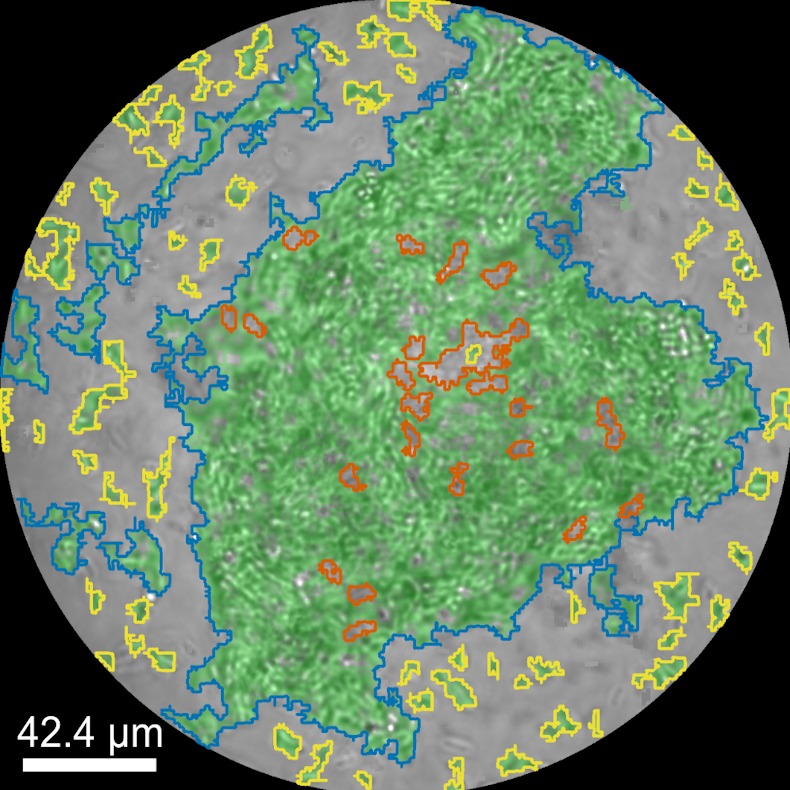
Droplet Microfluidics offers a powerful approach to study the spatiotemporal dynamics of biofilm formation at high resolution and throughput. By encapsulating microbial communities within controlled microenvironments, it becomes possible to monitor biofilm development continuously using time-lapse imaging, capturing transitions from initial attachment to maturation and dispersal. To make sense of these complex, high-dimensional datasets, we are developing an unsupervised variational autoencoder framework that can automatically identify and separate distinct stages of biofilm growth without prior labeling. This approach enables the extraction of latent features that characterize structural and behavioral shifts within the biofilm over time. In this context, protein folding may play a critical role in regulating both the establishment and dispersal of biofilms, as the conformational states of key structural and regulatory proteins can influence adhesion, matrix production, and the transition back to planktonic states.