Eduard Duta Costache, Benjamin Girault
Date: 11 March 2026
Time: 18:00-20:00
Place: Aula Medica, Karolinska Institute, Solna
Conference Protein Folding in Real Time, 11-13 March 2026, Stockholm, Sweden
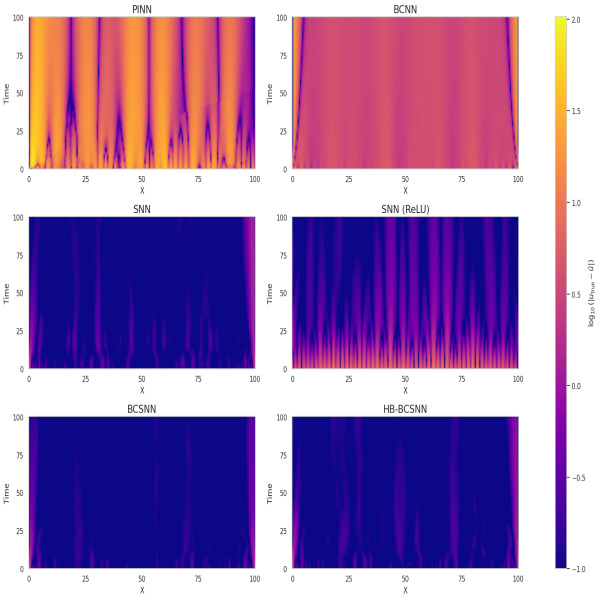
Physics-Informed Neural Networks (PINNs) have emerged as a promising method for solving Partial Differential Equations (PDEs) by combining data-driven learning with physical laws. However, the spectral bias and optimization challenges limit their efficacy. This work investigates these issues and whether the advantages of classical spectral methods translate to the non-convex neural network optimization landscape. We show that gradient imbalance greatly affect learning and we study the Hessian conditioning under different settings. Our results indicate that spectral priors stabilize training, reduce error, and improve parameter efficiency. We also identify that learnable-basis models act as implicit regularizers under sparse sampling.